
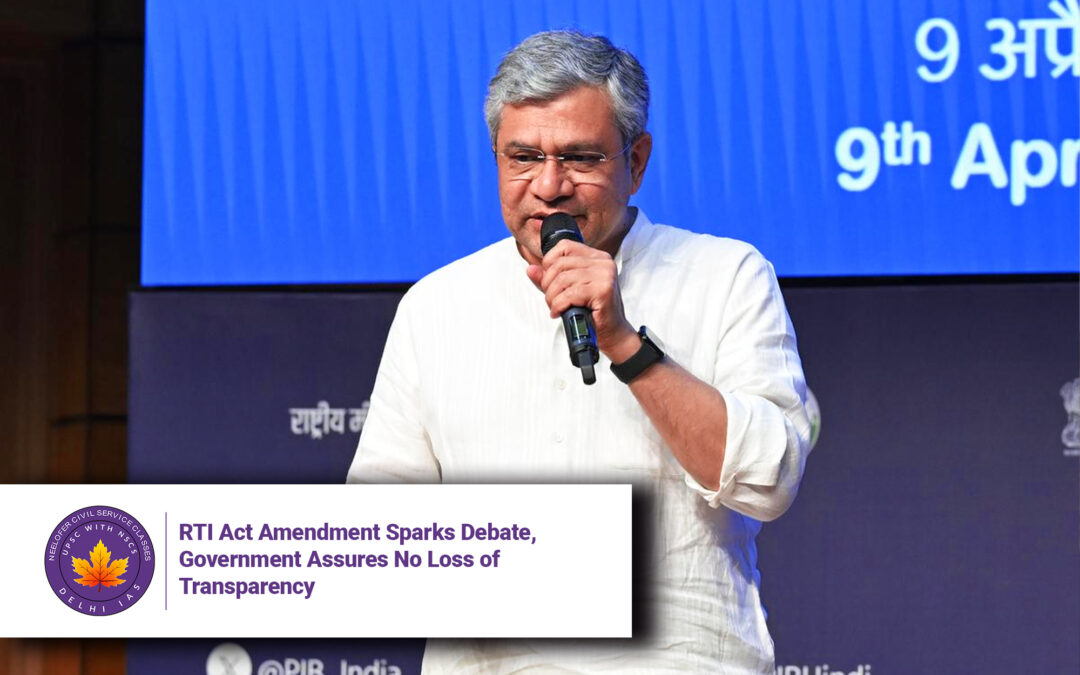
RTI Act Amendment Sparks Debate, Government Assures No Loss of Transparency
Why in News?
Union Minister for Electronics and IT, Ashwini Vaishnaw, has addressed concerns over the proposed amendment to the Right to Information (RTI) Act, 2005. He stated that the changes would not compromise transparency or restrict the disclosure of personal information in public matters. 
Introduction
The Indian government is set to implement amendments to the RTI Act, 2005, in line with the Digital Personal Data Protection (DPDP) Act. Civil society organizations, opposition parties, and digital rights activists have expressed strong concerns about these changes potentially diluting the spirit of the RTI Act. The government, however, insists that transparency in public life will remain unaffected.
Key Issues Raised
-
Concerns from Civil Society and Opposition
Congress MP Jairam Ramesh raised the alarm, suggesting the amendment could allow the government to deny access to information about subsidy disbursements and government schemes on the grounds of personal data protection. -
Government’s Assurances
In his letter to Ramesh, Minister Ashwini Vaishnaw clarified that the amendments would not “restrict disclosure of personal information” and that the need for public transparency would continue to be upheld. -
Amendment Linked to DPDP Act
The amendments are designed to align with the enforcement of the DPDP Rules, expected to be notified in the coming weeks. Critics view this as a significant blow to RTI, while the government sees it as a necessary balance between privacy and transparency. -
Activists’ Concerns
Digital rights groups and transparency advocates argue that the RTI Act is being diluted. Over 120 Opposition MPs have signed a letter to the minister demanding repeal of the amendment. -
Citing Supreme Court Precedents
Vaishnaw defended the move by referring to the 2017 Supreme Court judgment that declared informational privacy as a fundamental right under Article 21. He emphasized the importance of harmonizing the RTI with privacy laws.
Five Key Observations
-
The amendment arises from the implementation of the Digital Personal Data Protection Act.
-
Government promises it won’t block information on public schemes or allocations.
-
Concerns are mounting over curtailing transparency through privacy cover.
-
Opposition leaders and civil society are actively pushing for reconsideration.
-
The move reflects the tension between the right to information and the right to privacy.
Challenges and the Way Forward
The key challenge is ensuring that the public’s right to know is not compromised under the pretext of privacy. While data protection is essential in the digital age, safeguards must be incorporated to prevent misuse of privacy norms to withhold critical public information. Harmonizing both constitutional rights — to privacy and to information — will be the legal and policy challenge in the coming years.
Conclusion
The debate over the RTI amendment signals a crucial crossroads in India’s information regime. With stakeholders on both sides emphasizing fundamental rights — transparency versus privacy — the government must tread carefully to uphold democratic accountability without undermining privacy protections.
Q&A Section
Q1. What is the proposed amendment to the RTI Act about?
It seeks to align the RTI Act with the Digital Personal Data Protection Act by introducing changes that govern how personal data is handled in public information requests.
Q2. Why are activists and opposition leaders concerned?
They fear the amendment could be used to deny crucial public information, such as details of government subsidies or allocations, under the excuse of protecting personal data.
Q3. What has the government said in response?
Union Minister Ashwini Vaishnaw assured that the changes will not restrict transparency or the disclosure of personal information that is relevant to public interest.
Q4. How many MPs have opposed the amendment?
Over 120 Opposition Members of Parliament have signed a letter demanding the repeal of the amendment.
Q5. What constitutional issue does this amendment raise?
It raises concerns over balancing the fundamental right to information with the right to informational privacy, both protected under Article 21 of the Constitution.
