
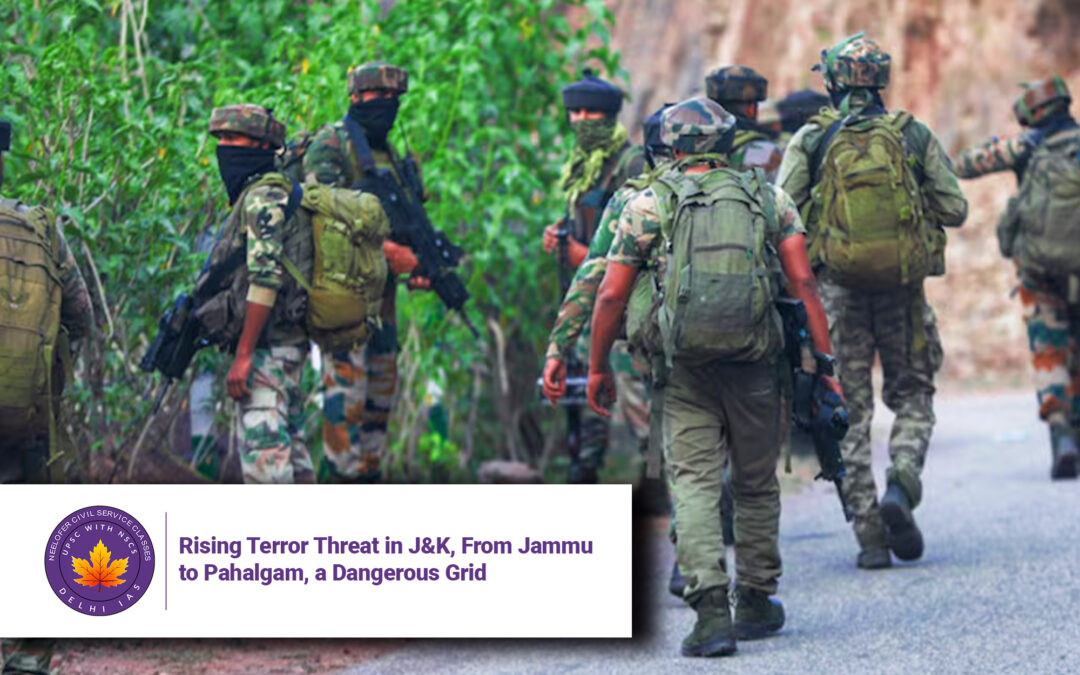
Rising Terror Threat in J&K, From Jammu to Pahalgam, a Dangerous Grid
Why in News?
A deadly terror attack in Pahalgam on April 22, 2025, which claimed the lives of at least 16 tourists, has highlighted the alarming spread and coordination of terrorist networks in Jammu and Kashmir. The incident has once again put the spotlight on Pakistan-backed terror groups operating from across the LoC. 
Introduction
The attack on civilians in the Kashmir Valley is among the deadliest since the 1980s. Despite the improved security situation in J&K in recent years, the region continues to face targeted attacks, especially on tourists and security personnel. The attack in Pahalgam reflects not only the presence of deep-rooted terror infrastructure but also a growing security gap in regions previously considered safer.
Key Issues
1. Expanding Terror Grid
Intelligence reports have shown that the People’s Anti-Fascist Front (PAFF) and Kashmir Tigers (KT) operate predominantly in the Jammu division. Their area of operations has expanded across Doda, Kathua, Rajouri, and Kashmir.
-
Between April 2024 and March 2025, at least 16 encounters were reported involving 11 terrorists and 14 security personnel.
2. Weak Security Architecture in Jammu Sector
Unlike the Kashmir Valley, where the counter-terrorism grid is robust, the Jammu region lacks a full-fledged grid. The absence of the Army and BSF deployment in some critical border areas like Samba and Kathua leaves gaps for infiltration and movement of terrorists.
3. Cross-LoC Infiltration
Most recent attacks, including the one in Pahalgam, are believed to have roots in infiltration from Pakistan-occupied Kashmir (PoK) into areas like Rajouri and Poonch. These areas serve as launching pads for terrorists entering Kashmir.
4. Challenges in Coordination
The command and coordination among security agencies—Army, BSF, CRPF, J&K Police, and Intelligence—is still evolving. There’s an urgent need for a Unified Command Structure to ensure seamless communication and counterterror operations.
5. Terrorists’ Changing Tactics
Groups like TRF and LeT are increasingly using social media to spread disinformation and recruit. TRF, a front for LeT, has claimed responsibility for the Pahalgam attack, although such claims are often strategically made for psychological warfare.
Alternative Approaches
-
Unified Command Revival: Establishing a single command structure involving Army, BSF, police, and intel agencies is essential for real-time intelligence sharing and coordinated responses.
-
Counter-radicalisation programs and digital monitoring to curb online recruitment and propaganda.
-
Enhanced Border Deployment: Strengthening the infiltration-prone areas of Jammu with greater BSF and Army presence.
-
Integrated Intelligence Grid: Connecting local and national intelligence databases for real-time threat analysis.
Challenges and the Way Forward
-
Terrain and Connectivity Issues make patrolling difficult in regions like Rajouri, Doda, and Poonch.
-
Militant Support Infrastructure, including safe houses and logistical support in border villages, needs dismantling.
-
Political Sensitivities and the complex centre-state coordination often delay decisive action.
The government must also pressure Pakistan diplomatically while bolstering domestic intelligence and counter-terrorism capacity.
Conclusion
The attack in Pahalgam is a grim reminder that despite improved security, terrorism remains a potent threat in J&K. A holistic approach involving tactical operations, border security, intelligence fusion, and international pressure is needed to dismantle the terror grid. Re-establishing a Unified Command and proactive infiltration checks are non-negotiable if peace is to be restored in the region.
5 Q&A Based on the Article
Q1. What triggered the current debate on terrorism in J&K?
A: The terrorist attack in Pahalgam on April 22, 2025, which killed 16 tourists, highlighted the increasing reach of terror groups from Jammu to Kashmir Valley.
Q2. Which terror groups are actively operating in Jammu and Kashmir?
A: Groups like the People’s Anti-Fascist Front (PAFF), Kashmir Tigers (KT), and The Resistance Front (TRF), all believed to be offshoots of Pakistan-based Lashkar-e-Taiba (LeT), are actively operating.
Q3. Why is the Jammu region particularly vulnerable?
A: Jammu lacks a full-fledged counter-terrorism grid. Absence of Army and BSF deployment in certain areas allows easy infiltration and movement of terrorists.
Q4. What steps are needed to counter the terror threat in J&K?
A: Steps include setting up a Unified Command, boosting border security in Rajouri and Poonch, curbing online radicalisation, and improving coordination among security forces.
Q5. What message does the Pahalgam attack send regarding the evolving terror threat?
A: It signals that terror groups are expanding their areas of operation, targeting soft civilian spots, and exploiting security gaps in regions once considered safer.
