
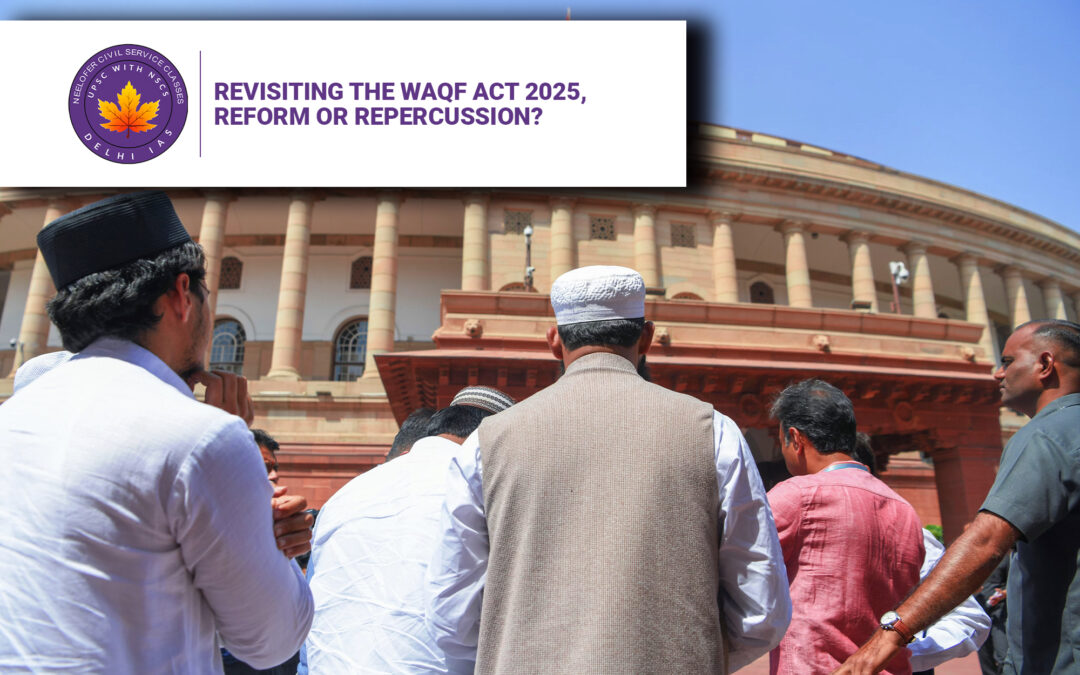
Revisiting the Waqf Act 2025, Reform or Repercussion?
Why in News?
The Waqf Act of 2025 has been enacted with the goal of leveraging community-held properties for the socio-economic advancement of Indian Muslims. As India marches towards becoming the world’s third-largest economy, this reform aims to bridge the economic gap by addressing structural inequalities faced by marginalized Muslim subgroups. 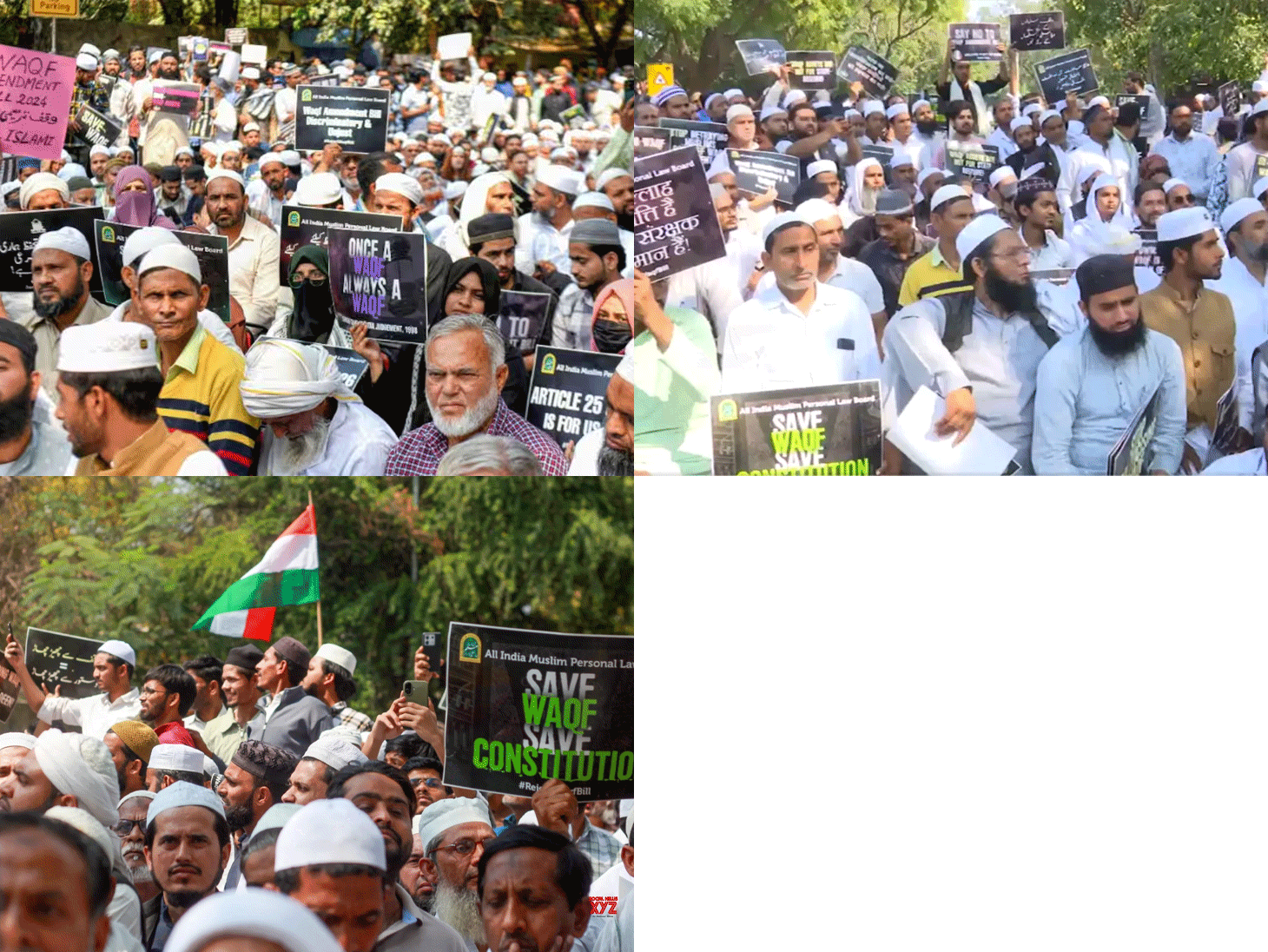
Introduction
India’s rapid economic growth has not equally benefited all communities. The Waqf Act, 2025, arrives at a crucial moment when deep-rooted inequalities—especially within Muslim subgroups—are becoming increasingly evident. The act seeks to reform the management of Waqf properties, community-owned assets historically meant for charitable or religious purposes, and unlock their potential for inclusive development.
Key Issues / Background
1. Economic Disparities Among Muslims
Data from the ICE 360° Survey (2021) reveals that Muslims as a group had an average per capita income of ₹56,715—about 14% below the national average of ₹65,859. Among Muslims, SC/ST and OBC Muslims are even more economically disadvantaged, with per capita incomes as low as ₹50,179—the lowest among all socio-religious categories.
2. The Burden of Inequality
The disparities are not just income-based. Asset ownership, education, and salaried employment lag significantly among Muslims. Only 12% of Muslims report land ownership as their primary income source, and just 14% of Muslim households have a graduate as the most educated member—far lower than Hindu Upper Castes, where 30% report the same.
3. Glimpses of Progress
Despite these challenges, certain segments have shown improvements. From 2005 to 2021, SC and ST Hindus saw a 63% rise in per capita income, and even Muslim SCs/STs recorded a 49% increase. Yet, this progress remains uneven, especially when access to education, formal jobs, and urban development remains restricted.
The Core of the Controversy: Waqf Reform
Waqf properties—many located in urban areas—are high in value but have historically been underutilized or poorly managed. The 2025 Act aims to digitize records, promote public access to data, enable audits, and encourage community-led leasing and development. However, the law is not without contention. Concerns around transparency, misuse, and exclusion remain, particularly if grassroots communities are not actively involved in governance.
Missed Perspectives
-
Women and Youth Participation: Governance reforms are incomplete without engaging women and youth in decision-making about Waqf properties.
-
Digital Divide: Digital tools must be accompanied by education and accessibility to ensure marginalized groups aren’t left behind.
-
Rural Neglect: Many Waqf properties in rural regions remain underdeveloped and disconnected from the urban-centric development narrative.
-
Employment Gaps: Without linking Waqf reforms to real job creation, the structural issues will persist.
-
Policy Cohesion: The Waqf Act must integrate with broader welfare policies—education, housing, and health—to make a tangible impact.
Conclusion
The Waqf Act, 2025, if implemented transparently and inclusively, can help shift underutilized religious endowments into engines of social mobility, particularly for Muslims at the socio-economic margins. But this will require more than legal reform—it demands community empowerment, systemic governance changes, and sustained investment in education, infrastructure, and livelihoods.
Q&A Section
Q1. What is the purpose of the Waqf Act, 2025?
The Act aims to unlock the developmental potential of Waqf properties by digitizing records, enhancing transparency, and enabling their use for education, infrastructure, and community upliftment.
Q2. Why are Waqf reforms seen as critical now?
India’s GDP growth masks the socio-economic exclusion of certain communities, particularly Muslims. Waqf assets—many of which are located in valuable urban areas—have long been underutilized. Reforming them could help close these equity gaps.
Q3. What does the ICE 360° data reveal about Muslim socio-economic status?
Muslims have the lowest average per capita income among all socio-religious groups, with particularly poor outcomes for SC/ST and OBC Muslims. They also lag behind in salaried employment and educational attainment.
Q4. What are the potential risks in implementing the new Waqf Act?
Without grassroots participation and clear governance, there’s a risk of elite or political capture of Waqf resources, continuing the cycle of underuse or misuse.
Q5. How can Waqf assets improve educational outcomes?
They could be leased or developed for building schools, hostels, and vocational training centers in underserved areas, particularly benefiting Muslim youth who face higher dropout rates and limited access to higher education.
