
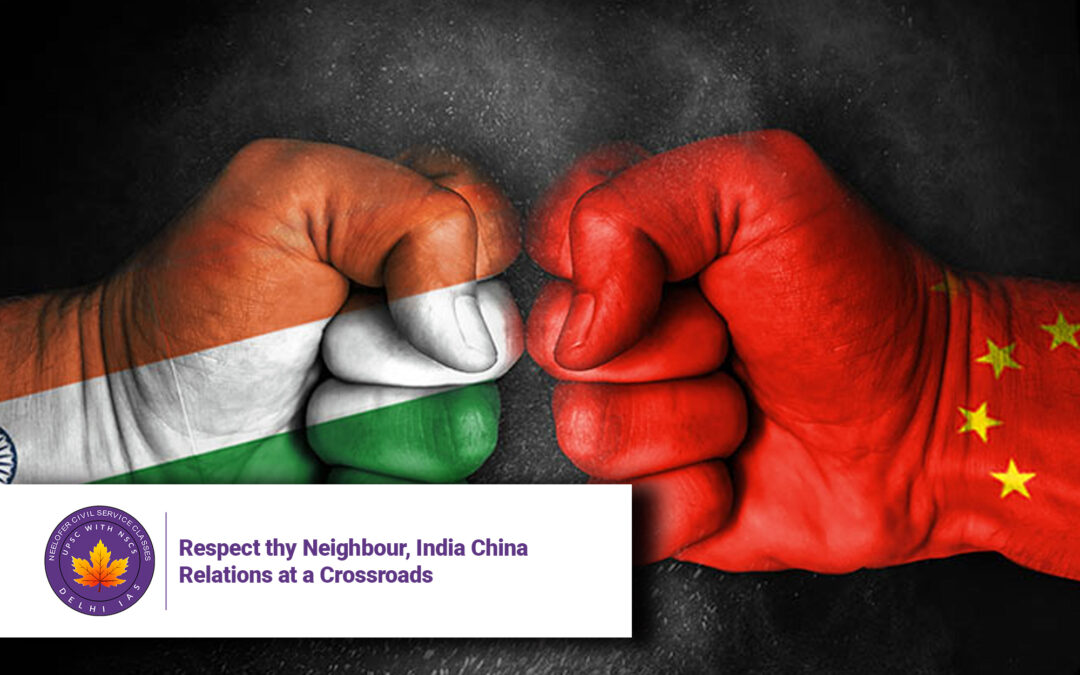
Respect thy Neighbour, India China Relations at a Crossroads
Why in News?
The recent high-level diplomatic engagements between India and China, especially the meeting between Prime Minister Narendra Modi and President Xi Jinping during the 16th BRICS Summit in Kazan, Russia (October 23, 2024), indicate a tentative shift towards improved bilateral relations after a prolonged period of mistrust following the Galwan Valley clashes of 2020. However, despite the gestures, India emphasizes that Beijing must respect its red lines, particularly concerning sovereignty and national interests, for real progress. 
Introduction
India-China relations have been on a rocky path since the deadly 2020 Galwan Valley incident, resulting in a freezing of ties and deterioration of trust. The high-level meeting between Modi and Xi in October 2024 gave new diplomatic direction, and both Defence Minister Rajnath Singh and External Affairs Minister S. Jaishankar emphasized the urgent need for de-escalation along the Line of Actual Control (LAC). However, significant challenges remain, including military disengagement, cross-border terrorism, and Beijing’s alignment with Pakistan on strategic and defense issues.
Key Issues and Background
-
LAC Tensions and the Need for De-escalation
The resumption of patrolling and grazing activities in Eastern Ladakh suggests that there is some movement towards de-escalation. But several friction points remain unresolved. India’s leadership has maintained that normalization of ties cannot occur without full disengagement along the LAC. -
China’s Strategic Ties with Pakistan
China’s “all-weather friendship” with Pakistan, particularly in the areas of defense and nuclear cooperation, remains a core issue. China continues to block efforts at the UN to blacklist Pakistan-based terrorists, undermining India’s security concerns. Beijing’s support for Pakistan on issues such as Jammu and Kashmir and its opposition to India’s entry into the Nuclear Suppliers Group (NSG) further deepens mistrust. -
The BRICS Dilemma and Mixed Signals
While India supports multipolar groupings like BRICS, the divergence on key security issues—especially terrorism—exposes fault lines. The failure to include clear language on terrorism at BRICS meetings, and China’s continued opposition to Indian positions, has frustrated New Delhi. -
Taiwan, Tibet, and India’s Red Lines
China’s repeated provocations on Taiwan and Tibet are seen in India as disrespectful. The issue of the Dalai Lama and the succession debate is particularly sensitive. Yet, Beijing fails to show reciprocal sensitivity to India’s concerns, especially on Kashmir and cross-border terrorism. -
Kailash Mansarovar Pilgrimage and Civil Society Engagement
The resumption of the Kailash Mansarovar Yatra was a positive sign, well received in India. However, Beijing’s restrictions on access and surveillance of Indian pilgrims reflect continuing unease. Similarly, issues like direct flight connections, business visas, and data access remain unresolved.
Five Key Observations / Takeaways
-
Diplomatic Re-engagement Doesn’t Equal Resolution
The Modi-Xi meeting and resumed patrols in Eastern Ladakh reflect a thaw, but not a resolution. India remains firm: without full disengagement along the LAC, bilateral relations cannot be normalized. -
China’s Dual Policy Weakens Trust
While publicly promoting peace and cooperation, Beijing continues its strategic alignment with Islamabad—supporting Pakistan diplomatically and militarily—against India’s interests. -
Transparency and Reciprocity Are Missing
China’s positions on key bilateral issues often lack transparency. Beijing’s failure to acknowledge India’s concerns or reciprocate its sensitivities reflects an asymmetrical approach to diplomacy. -
Multilateral Frictions Add to Bilateral Strains
India’s exclusion from China-led initiatives like the Belt and Road Initiative (BRI), and Chinese opposition to India’s NSG membership or efforts at the UN against terrorism, show that even multilateral platforms have become sites of contention. -
Strategic Mistrust Overrides Economic Logic
Even though both countries stand to gain from economic cooperation, mutual mistrust—especially over border and sovereignty issues—continues to act as a roadblock. Trade and connectivity have suffered, and joint initiatives have slowed down.
Challenges and the Way Forward
Challenges
-
Territorial Disputes: China’s refusal to acknowledge India’s sovereign claims along the LAC, and its military posturing, especially in Eastern Ladakh and Arunachal Pradesh, keeps tensions alive.
-
Terrorism and Pakistan Factor: China’s shielding of Pakistan from international scrutiny, particularly regarding terror financing and safe havens, directly undermines India’s national security.
-
Strategic Hostility in Multilateral Forums: China’s aggressive diplomacy in forums like BRICS, SCO, NSG, and the UN shows it is not ready to accommodate India’s rising global stature.
-
Ideological Divide: While India is a vibrant democracy, China continues to resist democratic values. This ideological chasm also informs their global outlooks, leading to further misalignment.
-
Border Infrastructure Race: China’s rapid military and civilian infrastructure development in Tibet and Xinjiang borders keeps India on alert, leading to increased defense spending and border militarization.
Way Forward
-
Respecting Red Lines: For any breakthrough, China must avoid provocative moves on India’s red lines: border status quo, cross-border terrorism, and sovereignty concerns (especially on Kashmir, Arunachal Pradesh, Taiwan, and Tibet).
-
Building Confidence Mechanisms: Regular military-to-military and diplomatic dialogues are needed. Existing agreements on border management should be enforced more effectively.
-
Reviving Civil and Cultural Diplomacy: Initiatives like the Kailash Yatra, student exchanges, and cultural forums must be insulated from political tensions and allowed to grow.
-
Strategic Autonomy and Global Balance: India must continue strengthening its strategic autonomy through diversified partnerships (Quad, I2U2, Indo-Pacific alliances) without overtly antagonizing China.
-
Economic Caution with Engagement: While trade with China continues, India must reduce over-dependence and push for domestic resilience, especially in key sectors like electronics, defense, and semiconductors.
Conclusion
India-China relations are at a complex yet decisive juncture. Despite diplomatic engagements and symbolic gestures, the shadow of Galwan and unresolved border tensions loom large. India has drawn clear red lines—territorial integrity, sovereignty, and non-support to terrorism—which Beijing must not cross if it truly seeks peaceful coexistence. Going forward, while India remains open to dialogue and cooperation, it will not compromise on core interests. Strategic patience, clarity of purpose, and insistence on mutual respect will be key to navigating this delicate relationship.
Q&A Section
1. What recent development marks a thaw in India-China relations?
Answer: The meeting between Prime Minister Narendra Modi and President Xi Jinping at the 16th BRICS Summit in October 2024 and the resumption of patrolling activities in Eastern Ladakh indicate a tentative thaw in relations.
2. Why is India skeptical of China’s intentions despite high-level meetings?
Answer: India is skeptical because China continues to align with Pakistan on strategic issues, refuses to address India’s concerns on terrorism, and fails to respect its red lines on sovereignty, especially in Jammu & Kashmir, Taiwan, and Tibet.
3. What is India’s core demand for normalization of ties with China?
Answer: India insists on full military disengagement and de-escalation along the Line of Actual Control (LAC) before normalizing bilateral relations.
4. How does China’s stance on multilateral platforms affect India-China relations?
Answer: China’s opposition to India’s efforts in platforms like the NSG, UN, and BRI, as well as its dominance in BRICS and SCO, often marginalizes India’s strategic interests and adds to mistrust.
5. What strategic approach is India likely to follow in dealing with China?
Answer: India is expected to follow a balanced approach—engaging diplomatically while reinforcing its strategic autonomy through alliances like the Quad, enhancing domestic resilience, and protecting its sovereignty uncompromisingly.
