
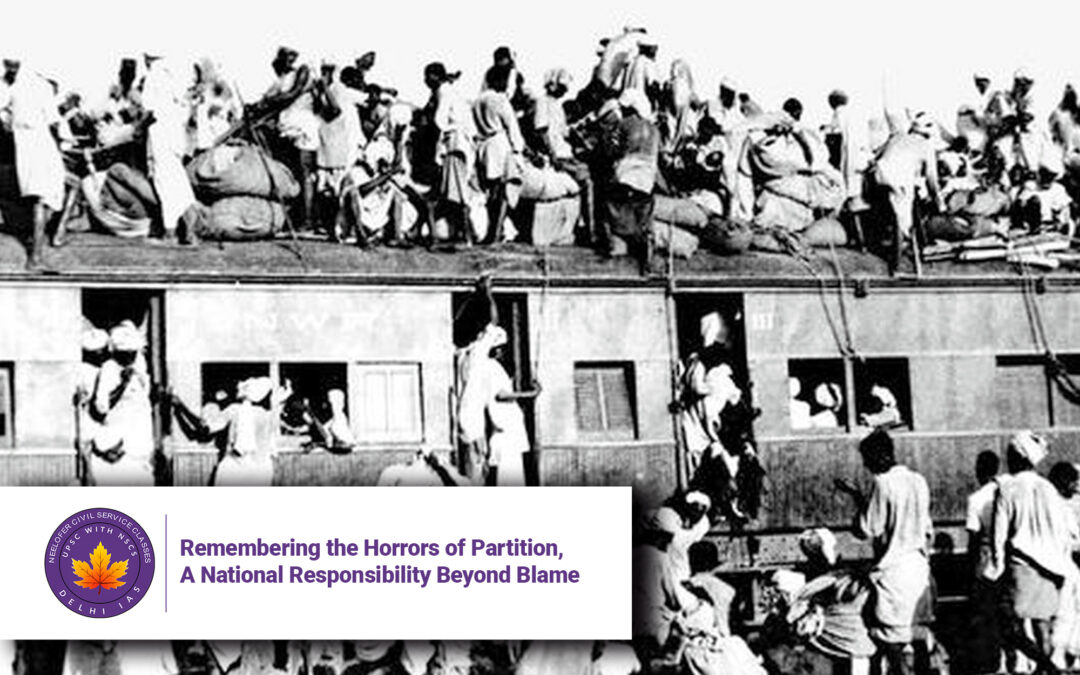
Remembering the Horrors of Partition, A National Responsibility Beyond Blame
Why in News?
On 14 August, India observes Partition Horrors Remembrance Day — a day to reflect on one of the darkest chapters in human history. The Partition of 1947 was not merely a political decision to divide territory; it was the brutal tearing apart of a civilization. It triggered the largest forced migration humanity had ever seen, accompanied by mass killings, sexual violence, and the annihilation of communities that had coexisted for centuries.
While British colonial policies and the Muslim League’s separatism played significant roles, historians and political commentators increasingly highlight the Congress leadership’s political choices as a critical factor that hastened the tragedy. The day is not just about remembering past suffering, but also about confronting uncomfortable truths, learning lessons, and ensuring that such a catastrophe never repeats.
Introduction
Partition Horrors Remembrance Day serves three vital purposes:
-
Honouring the Dead and Displaced – Millions whose lives were destroyed in 1947 deserve recognition and remembrance.
-
Teaching the Cost of Political Opportunism – It reminds us that when political leaders prioritise short-term power over social unity, the consequences can be catastrophic.
-
Countering Historical Amnesia – It prevents political and public discourse from romanticising the past by glossing over painful betrayals.
The day marks not just a historical tragedy, but a warning about the cost of divisive politics, appeasement, and unchecked lust for political dominance.
Political Backdrop and Congress’s Role
From the 1920s onwards, the Congress Party’s political strategies often placed its own advantage above national unity. A major turning point was the embrace of the Khilafat Movement (1919–1924). Intended as a show of solidarity with Indian Muslims, it was an emotional cause linked to the Ottoman Caliphate. Leaders like Mahatma Gandhi saw it as a way to mobilise Muslim support for India’s independence movement. However, this alignment with a pan-Islamic agenda ultimately deepened religious divisions.
The consequences were profound:
-
It legitimised communal politics.
-
It pushed many Muslims into a separate political identity.
-
It strengthened the Muslim League from a marginal club into a mass organisation claiming to speak for all Indian Muslims.
By 1940, with the Lahore Resolution, the Muslim League openly demanded a separate homeland for Muslims—Pakistan.
The Fatal Choice: Acceptance of Partition
When Cabinet Mission Plan (1946) offered a framework for united independence, Congress initially accepted it. But within weeks, leaders like Jawaharlal Nehru publicly dismissed key provisions, signalling unwillingness to share power with the Muslim League. This rejection weakened hopes of unity and made the League’s demand for Partition seem more reasonable to its supporters.
By 1947, Partition was not imposed overnight. It was accepted as a strategic political choice—a way for Congress to secure full power quickly rather than share governance in a coalition. This acceptance was not framed as a “last resort” but as an expedient shortcut to dominance.
The Human Cost of Political Expediency
The human tragedy that followed is almost beyond comprehension:
-
Over 15 million people were uprooted and forced to migrate across hastily drawn borders.
-
More than 2 million deaths occurred in the span of months.
-
Entire villages were burned, and trains filled with refugees arrived at their destinations carrying only corpses.
-
Women were abducted in large numbers, many killed by their own families in the name of “honour.”
-
Communities that had lived side-by-side for generations suddenly turned against each other.
Violence erupted almost immediately after Radcliffe Line demarcations were announced. The speed and chaos of the process amplified suffering, with no adequate administrative or humanitarian measures to protect civilians.
Why Remembering Partition Horrors Matters Today
Partition Horrors Remembrance Day is not just an annual ritual — it carries deep modern relevance:
-
It preserves memory against denial – Historical amnesia allows political actors to glorify the past selectively. Confronting the Partition tragedy forces a more honest view of India’s political history.
-
It teaches political responsibility – Religious identity should never be used as a bargaining tool for short-term electoral gains. The Khilafat episode and later compromises illustrate how easily political opportunism can spiral into permanent division.
-
It warns against centralising power at all costs – The lust for full political control led to choices that valued speed over safety, power over peace.
-
It strengthens social cohesion – Understanding the human suffering of 1947 should inspire modern India to safeguard pluralism and resist divisive ideologies.
Lessons for Present and Future Leaders
The Partition teaches us that:
-
Leaders must resist the temptation to gamble with national unity for political gain.
-
Dialogue, patience, and compromise — though politically costly — are far less damaging than the irreversible trauma of violent separation.
-
Historical reckoning is essential to prevent repetition. Romanticising past leaders without critical evaluation risks repeating their mistakes.
Today, the political climate often sees selective use of history for ideological advantage. Partition Horrors Remembrance Day offers a counterbalance, urging a complete and unflinching account of the past.
Conclusion
Partition Horrors Remembrance Day is a solemn reminder that independence came at a staggering human cost. For some, August 1947 symbolised freedom; for others, it was the start of exile, loss, and mourning. To honour the millions affected, India must keep their memory alive, not just in museums and speeches, but in political decision-making that prioritises unity, empathy, and accountability.
Ignoring the deeper causes of Partition—particularly the political manoeuvres of the Congress leadership—would be to lie to ourselves. True remembrance demands not only mourning the victims but also confronting the decisions and compromises that made their suffering possible.
Q&A Section
1. What is Partition Horrors Remembrance Day and when is it observed?
Partition Horrors Remembrance Day is observed on 14 August each year in India to remember the immense human suffering during the 1947 Partition, which saw the largest forced migration in history, mass killings, and communal violence.
2. Why does the article emphasise Congress’s role in the Partition?
While British colonial policies and the Muslim League’s separatism were key factors, the article highlights that Congress’s own political calculations—such as embracing communal mobilisation during the Khilafat Movement and later accepting Partition for quick power transfer—played a major role in accelerating the tragedy.
3. What were the human consequences of Partition?
Partition displaced over 15 million people and caused the deaths of over 2 million. Violence included mass killings, sexual violence, abductions, and destruction of entire communities. Trains carried only corpses, villages were burned, and families were torn apart.
4. What lessons does Partition Horrors Remembrance Day offer for present-day politics?
It warns leaders against prioritising short-term political gain over national unity, teaches the dangers of communal politics, and emphasises the need for honest historical reckoning to prevent future tragedies.
5. How can India ensure such horrors are not repeated?
By promoting pluralism, resisting divisive politics, ensuring historical education includes unvarnished truths, and prioritising inclusive governance over political expediency, India can safeguard itself from repeating the mistakes that led to 1947.

