
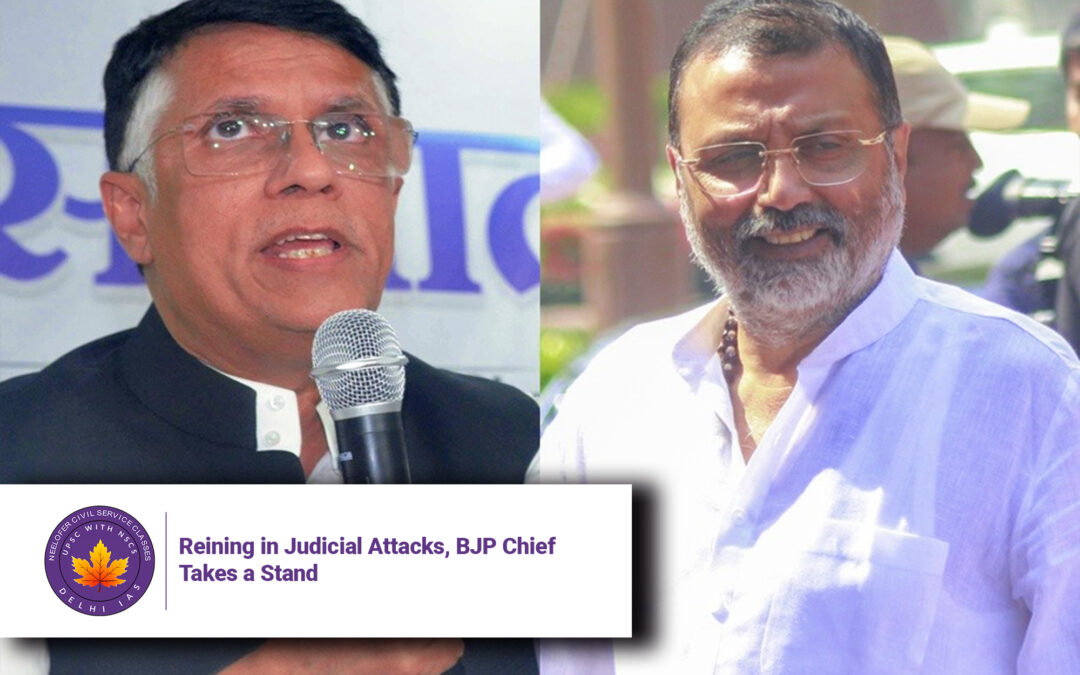
Reining in Judicial Attacks, BJP Chief Takes a Stand
Why in News?
BJP President J.P. Nadda has publicly distanced his party from crude remarks made by BJP MPs against the judiciary, particularly against the Chief Justice of India. His statement signals a rare intervention in maintaining constitutional decorum within party ranks, but critics argue more concrete action is needed.

Introduction
Recently, controversial statements by BJP MPs Nishikant Dubey and Dinesh Sharma targeting the judiciary caused widespread outrage. These remarks included direct attacks on the Chief Justice of India and the Supreme Court’s powers, prompting Nadda to issue a clarification distancing the party from their views. However, the editorial underlines that mere disapproval isn’t enough—what’s needed is firm action and internal accountability.
Key Issues / Background
-
Crude Targeting of Judiciary
-
Dubey and Sharma used derogatory language, questioning the authority of the Chief Justice and suggesting that Parliament alone should make laws, not the judiciary.
-
Dubey’s remark: “Jan manas ke manobal ko hatal diya gaya” (Public morale has been hurt) after a court ruling.
-
-
Violation of Constitutional Balance
-
MPs appeared to challenge the separation of powers by asserting Parliament’s supremacy over the judiciary.
-
Their statements questioned President and Governor appointments, flagging “aspects of the Waqf Act.”
-
-
Nadda’s Response: Limited But Notable
-
He labeled the comments “personal statements” and not reflective of the party’s view, asserting that BJP respects constitutional institutions.
-
But there was no formal disciplinary action, raising concerns about sincerity and enforcement.
-
-
Recurring Pattern of Attacks
-
This is not an isolated event. Vice President Jagdeep Dhankhar, Union ministers, and other BJP leaders have previously made adversarial statements against the judiciary.
-
The judiciary was called a “super Parliament”, and judgments were described as “complete injustice.”
-
-
Political Context: Southern Push
-
The BJP is attempting to grow its base in southern India, especially Tamil Nadu, where anti-judiciary rhetoric may alienate voters.
-
Nadda recently visited Madurai after the AIADMK’s alliance break-up, aiming to boost BJP’s presence ahead of the 2024 Lok Sabha polls.
-
5 Key Takeaways
-
BJP MPs made inappropriate, personal attacks on the Chief Justice and judiciary, causing public uproar.
-
J.P. Nadda distanced the party from their views but did not issue disciplinary action.
-
The episode reveals an ongoing pattern of judicial criticism within the BJP.
-
The timing is politically sensitive, with BJP trying to expand influence in southern states.
-
Experts call for stronger internal checks and respect for constitutional boundaries.
Challenges and the Way Forward
Challenges:
-
Maintaining internal discipline without appearing divided.
-
Balancing party rhetoric with constitutional respect.
-
Avoiding alienation in states like Tamil Nadu, where institutional respect is key.
Way Forward:
-
Enforce strict disciplinary measures against members violating constitutional norms.
-
Reiterate the BJP’s institutional respect in public forums.
-
Encourage constructive dialogue between judiciary and legislature instead of confrontation.
-
Improve internal party training on constitutional boundaries and responsibilities.
Conclusion
J.P. Nadda’s intervention is a step in the right direction, but words alone won’t suffice. At a time when India’s democratic institutions are under close watch, political leadership must match rhetoric with responsibility. The BJP must ensure that its members uphold the dignity of every constitutional pillar, including the judiciary.
Q&A Section
1. Why did J.P. Nadda issue a statement recently?
To distance the BJP from crude remarks made by its MPs targeting the Chief Justice and the judiciary, emphasizing respect for constitutional roles.
2. What did the MPs say that caused controversy?
MPs Nishikant Dubey and Dinesh Sharma criticized the judiciary using provocative language, suggesting that Parliament should override judicial decisions.
3. Has any disciplinary action been taken?
No formal action has been reported. Nadda termed the remarks as “personal statements,” which has drawn criticism for being too lenient.
4. Why is this significant for BJP’s political strategy?
The BJP is working to expand its base in southern India, especially Tamil Nadu, where respect for institutions is politically important.
5. What should political parties do to protect judicial independence?
They should enforce internal accountability, train members on constitutional roles, and promote respectful discourse about the judiciary.
