
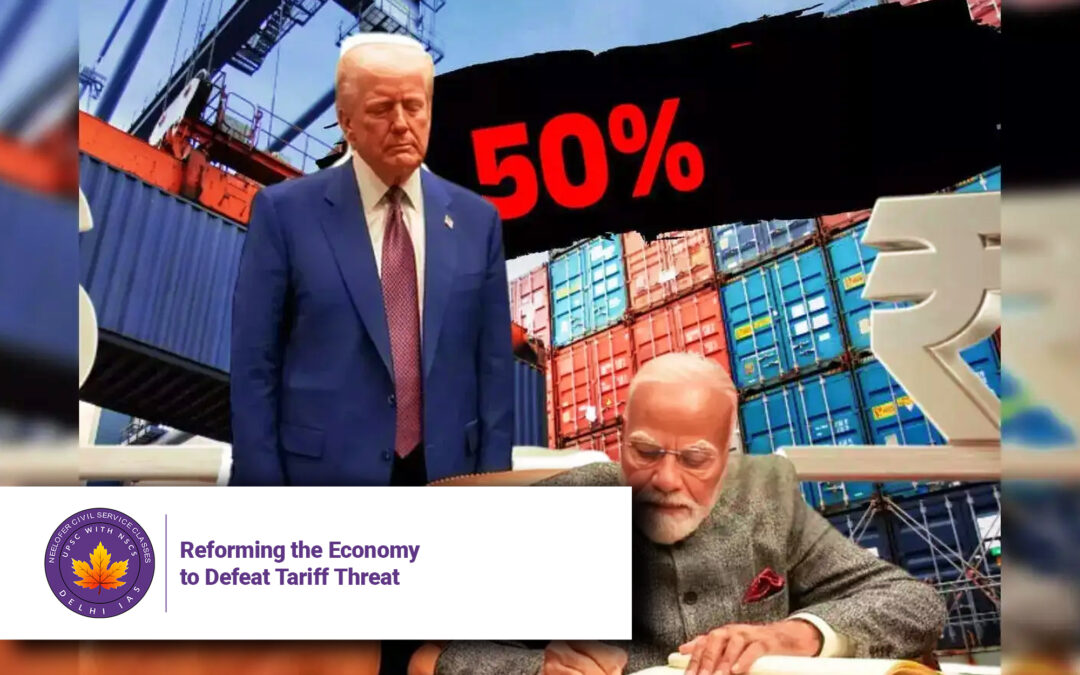
Reforming the Economy to Defeat Tariff Threat
Why in News?
India is facing a new economic challenge with the imposition of a 50% tariff on Indian goods by the United States, effective August 27. This move, part of President Donald Trump’s “reciprocal” tariff strategy, is seen as a response to India’s continued purchase of Russian oil. The development comes at a time when India is one of the world’s fastest-growing economies and is undertaking structural reforms, yet it highlights the urgent need for deep domestic reforms to remain competitive globally.
The debate is not just about tariffs—it is about India’s ability to withstand external pressures, safeguard strategic autonomy, and build an economy resilient enough to withstand global headwinds.
Introduction
The world economy today is in flux, shaped by geopolitical rivalries, trade wars, and shifting alliances. For India, the challenge has taken the form of punitive tariffs from the US, which accuses New Delhi of indirectly supporting Russia by purchasing discounted Russian oil. However, India is not alone in this—Türkiye, the European Union, and other countries also import Russian oil, yet face significantly lower tariffs.
This asymmetry signals that India’s growing economic power and its refusal to bow down to external pressures are causing discomfort in global power circles. Prime Minister Narendra Modi’s heavy investment in Indo-US ties—economic, trade, and political—is at stake, with the US’s antagonistic stance threatening future cooperation.
The larger question is: how should India respond? The answer lies in reforms, resilience, and self-reliance.
Key Issues and Institutional Concerns
1. Tariff Pressures and Strategic Autonomy
The 50% US tariff is a serious threat to India’s trade competitiveness. But India’s stance is clear: it will not compromise energy security or strategic autonomy. Historically, India has resisted external pressure, whether during the Cold War or now, and this moment demands similar determination.
2. GST Reform
The Goods and Services Tax (GST) was India’s most significant tax reform, bringing formalisation to the economy. Seven years on, collections are rising, but the system still faces challenges such as complexity, compliance burdens, and uneven rate structures.
-
There is a strong case for moving towards a two-rate GST structure.
-
GST processes must be overhauled to make compliance simpler for businesses.
-
Startups and new companies should be able to register seamlessly using digital platforms without requiring extensive physical verification.
3. Ease of Doing Business
India has already made progress in improving its ease of doing business ranking, but bureaucratic hurdles and outdated labour rules remain bottlenecks.
-
Labour law simplification is pending and should be implemented immediately.
-
States should push beyond incremental reforms to embrace true single-window clearances.
-
The National Single Window System (NSWS) should be expanded to cover more processes and remove cumbersome approvals.
4. Cost of Capital and SLR Reform
The statutory liquidity ratio (SLR), which mandates that commercial banks keep 18% of their assets in government securities, restricts loanable funds for private enterprises.
-
Bringing SLR down to zero will free up massive capital for businesses, reduce borrowing costs, and fuel entrepreneurship.
5. Liberalising Trade and Scrapping Quality Control Orders (QCOs)
India has seen a proliferation of quality control orders (QCOs) that make domestic goods uncompetitive globally by raising costs. These must be scrapped. Additionally, tariffs on intermediate goods must be reduced to help manufacturers integrate smoothly into global value chains.
6. Tourism: An Untapped Potential
Tourism in India contributes little compared to its potential. Despite rich cultural, natural, and historical assets, India’s share in international tourist arrivals is just 1.5%.
-
There has been no major branding or global marketing campaign for tourism in the past decade.
-
India needs the largest global marketing drive to position itself as a tourism hub.
7. Urban Governance and Financial Autonomy of Cities
India’s cities are the first impression global investors and tourists receive. Yet, city governance remains stuck, dependent on state and central governments for planning and financing. Constitutional amendments devolving powers to cities exist but remain poorly implemented. Making cities autonomous and financially independent is crucial.
8. Disinvestment and Public Sector Enterprise (PSE) Reform
The Union Budget of 2021-22 announced a new PSE policy aimed at reducing government presence in the economy. However, disinvestment has been slow, with only ₹10,000 crore raised in the last financial year. A new asset monetisation plan worth ₹10 lakh crore has been announced but needs urgent operationalisation.
Challenges and the Way Forward
1. Global Pressure vs National Interest
India must balance global expectations with national priorities. Just as in the past, India should remain firm on energy security, while simultaneously using this moment to accelerate reforms.
2. GST and Tax Reforms
Simplifying GST and bringing in income tax reforms will make compliance easier, attract investments, and boost revenues.
3. Lowering Cost of Business
Freeing up capital, removing redundant QCOs, and cutting tariffs on intermediate goods will reduce production costs and enhance global competitiveness.
4. Unlocking Tourism Potential
Launching a global branding campaign for tourism is crucial. With over 1,800 planes being bought by Indian airlines, attracting foreign tourists should be a top priority to avoid airlines relying solely on domestic passengers.
5. Empowering Cities
Financially independent and autonomous cities can transform infrastructure, ease of living, and global competitiveness.
6. Sustaining Economic Growth
India’s structural reforms, digital innovation, and infrastructure push have made it the world’s fastest-growing large economy. Over 250 million people have exited multidimensional poverty, and extreme poverty has fallen below 3%. Women have been central to this progress, receiving 80% of Stand-Up India loans and 68% of Mudra loans. India must continue this momentum.
7. Harnessing Technology and Green Growth
India’s Digital Public Infrastructure (DPI) has revolutionised inclusion. Investments in AI, quantum computing, and deep tech must be accelerated. The fact that India achieved its 2030 green energy target five years early shows the possibility of combining growth with sustainability.
Conclusion
India is not a “dead economy.” It is an ambitious, fast-growing nation undergoing structural transformation. While the US tariffs present a serious challenge, the solution does not lie in defensive reactions but in bold domestic reforms.
By reforming GST, simplifying business processes, freeing up capital, investing in tourism, empowering cities, and pushing forward disinvestment, India can emerge stronger. With resilience, ambition, and reform, India can turn this tariff threat into an opportunity to become the world’s easiest place to do business and a global economic powerhouse.
Q&A Section
Q1. What triggered the 50% tariff on Indian goods by the US?
The US imposed tariffs accusing India of indirectly financing Russia by buying Russian oil, despite other countries like Türkiye and the EU also doing the same but facing lower tariffs.
Q2. Why is GST reform considered urgent?
Though GST has improved collections and formalised the economy, its processes remain cumbersome. Moving to a simpler two-rate structure and digitising compliance will ease the burden on businesses.
Q3. How can India reduce the cost of doing business?
By lowering the statutory liquidity ratio (SLR), scrapping redundant quality control orders, simplifying labour laws, and ensuring true single-window clearances across states.
Q4. What role can tourism play in strengthening India’s economy?
Tourism is currently underutilised, with only a 1.5% share in global arrivals. A large-scale branding campaign and better infrastructure can make India a global tourist destination, generating jobs and foreign exchange.
Q5. How is India demonstrating resilience in the face of global challenges?
India has lifted 250 million people out of multidimensional poverty, reduced extreme poverty below 3%, achieved green energy targets ahead of time, and is investing heavily in digital and deep-tech innovations. These achievements showcase resilience, ambition, and long-term potential.

