
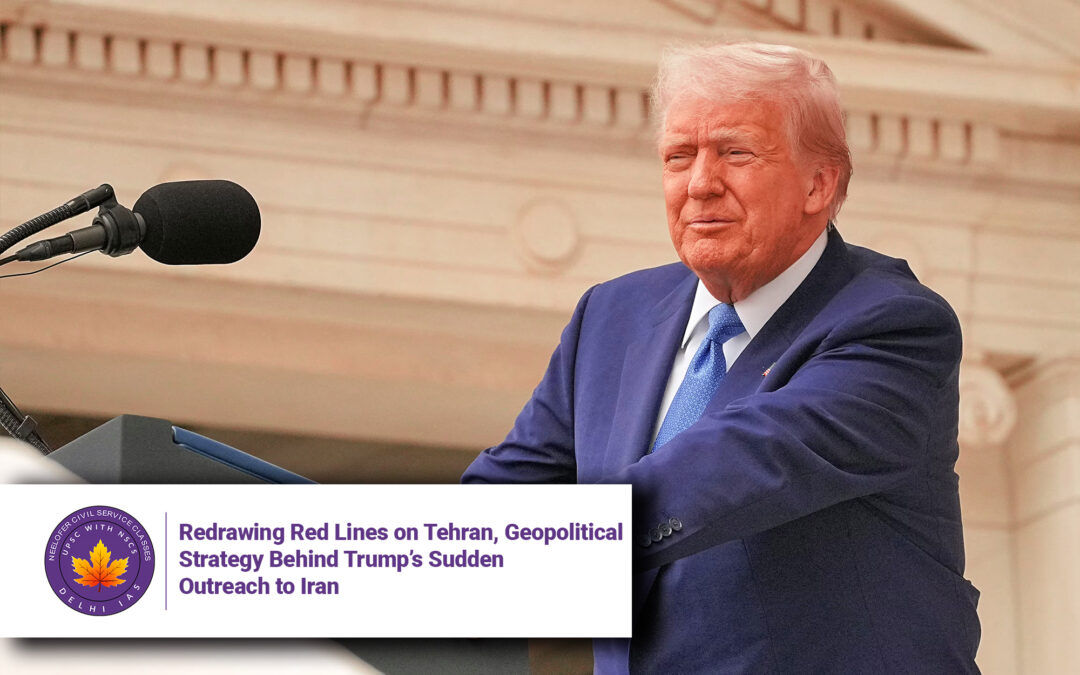
Redrawing Red Lines on Tehran, Geopolitical Strategy Behind Trump’s Sudden Outreach to Iran
Why in News?
The Trump administration’s sudden withdrawal from the Iran nuclear deal and its aggressive rhetoric against Iran marked a significant shift in U.S. foreign policy in West Asia. However, recent diplomatic signals suggest a strategic recalibration, with geopolitical and domestic interests driving the U.S.’s evolving stance towards Tehran.
Introduction
In 2018, President Donald Trump abruptly announced the U.S. withdrawal from the Joint Comprehensive Plan of Action (JCPOA), commonly known as the Iran nuclear deal. This unilateral decision surprised U.S. allies and was criticized globally, including by the deal’s co-signatories like Europe, Russia, and China. Despite this move, recent U.S. diplomatic engagements hint at a possible return to dialogue with Iran, rooted in realpolitik rather than ideological shift.
Key Developments
1. Unilateral Exit and Regional Reactions
-
Trump called the JCPOA “ineffective” and pulled out without consulting Middle Eastern allies like Saudi Arabia and Israel.
-
U.S. allies including the EU, Russia, and China criticized this action, fearing destabilization in the Gulf.
2. Strategic Realignment
-
Trump’s outreach appears driven by strategic gains, not peace ideology. He recognizes Iran’s geopolitical leverage in controlling Gulf waters and its impact on oil supplies and regional politics.
-
Iran has strong ties with regional forces, such as in Iraq, Syria, and Lebanon, offering a counterbalance to Saudi influence.
3. Domestic Political Calculations
-
Trump may also be motivated by upcoming U.S. elections, aiming to display diplomatic victories amid internal criticism.
4. Water and Security Politics
-
The Middle East’s water crisis, especially the increasing dependence on desalinated Gulf water, adds complexity to the Gulf’s geopolitical chessboard.
-
Access to this resource is now considered a strategic vulnerability, especially for Saudi Arabia and Gulf States.
5. Iran’s Nuclear and Military Capabilities
-
According to U.S. assessments, Iran has not resumed its nuclear weapons programme, which had been suspended in 2003.
-
Despite Trump’s rhetoric, intelligence reports reveal no immediate threat, suggesting that escalation may serve political purposes more than actual security threats.
Conclusion
Trump’s Iran policy reflects a blend of regional balancing, domestic politics, and long-term U.S. interests. While his administration’s erratic decisions drew criticism, they also signaled a larger game of power projection in the Middle East. Whether this redrawing of red lines leads to stability or more chaos remains to be seen, especially as Iran continues to wield strategic influence in the Gulf.
Q&A Section
Q1. What triggered the renewed U.S.-Iran tension under Trump?
Trump’s sudden withdrawal from the Iran nuclear deal (JCPOA) in 2018, labeling it “ineffective,” reignited tensions.
Q2. What was the reaction of global allies to the U.S. exit from the nuclear deal?
Countries like Germany, France, the UK, Russia, and China criticized the U.S. move, emphasizing that Iran had complied with the deal.
Q3. What are the geopolitical reasons for the U.S. to re-engage with Iran?
Iran controls strategic shipping lanes in the Gulf, holds influence in Iraq, Syria, and Lebanon, and its cooperation could help reduce U.S. dependency on Saudi Arabia.
Q4. What is the significance of water in the Iran-Saudi-U.S. equation?
The Gulf States’ reliance on desalinated water from the Gulf is becoming a strategic weakness, heightening the importance of security in the region.
Q5. Has Iran resumed its nuclear weapons programme post-2018?
No, U.S. assessments, including a March 2007 report, confirmed that Iran had suspended its nuclear weapons programme in 2003 and had not restarted it.

