
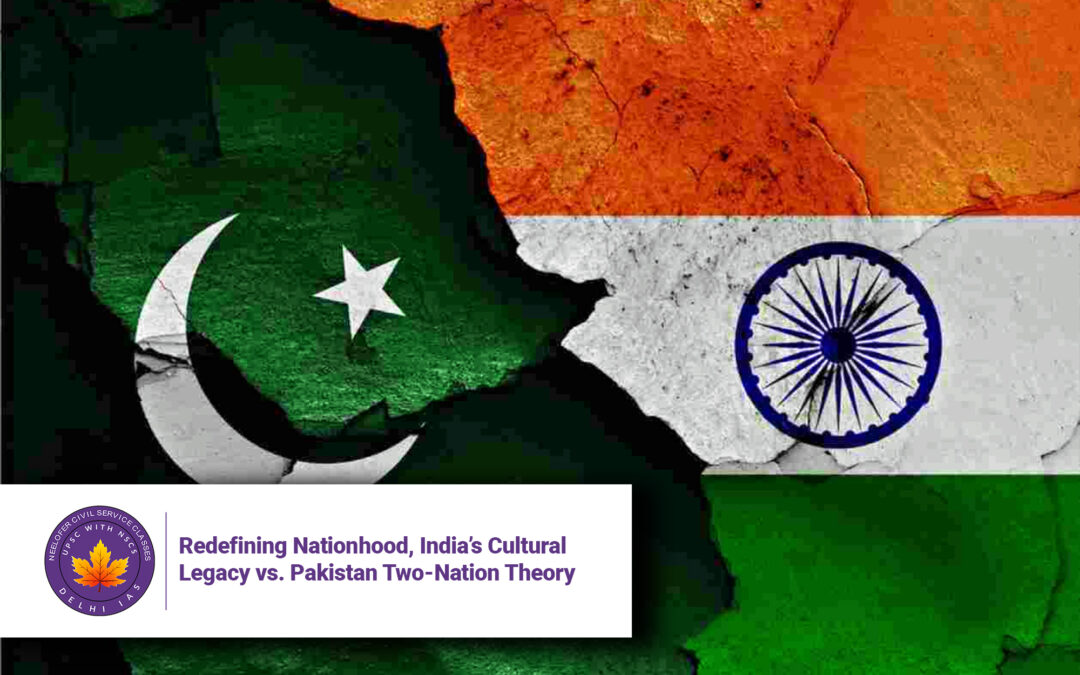
Redefining Nationhood, India’s Cultural Legacy vs. Pakistan Two-Nation Theory
Why in News?
The recent discourse surrounding national identity, triggered by terrorist incidents like the Pahalgam attack, has reignited debates about religious nationalism and India’s role in upholding its unique civilizational identity amidst global challenges and Pakistan’s persistent antagonism.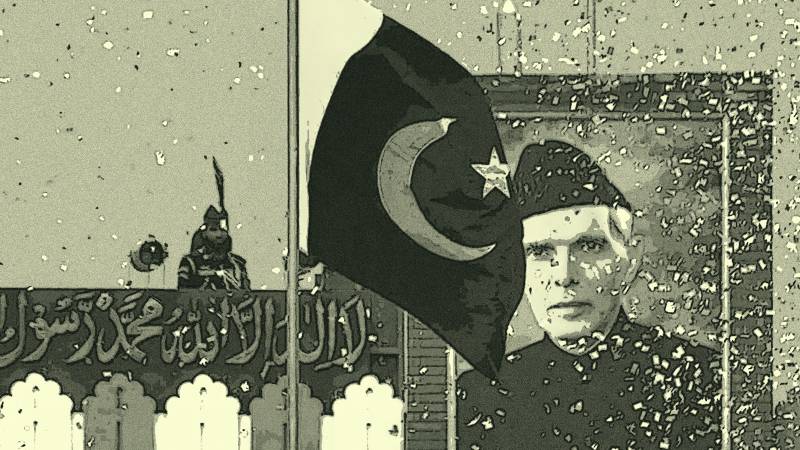
Introduction
India and Pakistan were born from the same land but took vastly different ideological paths. While Pakistan clung to a rigid, religion-based identity under the “two-nation theory,” India embraced pluralism, diversity, and unity. Today, that difference is not only a matter of policy but a fundamental determinant of regional peace and long-term coexistence.
Key Issues and Background
1. Pakistan’s Identity Crisis and Hostility
Pakistan continues to pose a complex problem not because of territorial conflicts, but due to a deeply ingrained hostility, especially from the military and terror outfits. It sees India not just as an adversary but as an ideological enemy, primarily due to its refusal to accept the two-nation theory which separates Hindus and Muslims as fundamentally incompatible communities.
2. India’s Cultural Response: True-Nation Theory
Unlike Pakistan, India stands on a legacy of celebrating—not merely tolerating—diversity. With multiple religions, ethnicities, languages, and traditions, India has evolved a complex, inclusive national identity. This stands in sharp contrast to Pakistan’s homogenized Islamic identity and offers a blueprint for peaceful coexistence in a diverse world.
3. Punjab as a Microcosm of Contrast
An interesting comparison is drawn between Indian Punjabis and Pakistani Punjabis. Despite shared ethnic roots, Indian Punjabis reflect pluralism and coexistence, while Pakistani Punjabis are often influenced by religious uniformity. The differing paths of these communities symbolize the broader ideological divergence of the two nations.
4. Two-Nation Theory: A Flawed Vision
The two-nation theory has historically failed to ensure peace, governance, or development in Pakistan. It has led to internal suppression, the marginalization of minorities, and disharmony. From Balochistan to PoK, dissent continues to rise. The theory’s collapse in real-world governance highlights the strength of India’s inclusive model.
The Core of the Concern
The editorial argues that Pakistan’s enduring hostility towards India stems from the latter’s refusal to adopt a monolithic religious identity. India’s survival and progress as a multi-religious, multilingual, and multi-ethnic society challenge Pakistan’s foundational ideology.
Key Observations
-
India celebrates its differences while Pakistan suppresses them.
-
The true test of nationhood lies in unity despite diversity, not in enforced uniformity.
-
If India reclaims its legacy of unity in diversity, it would be the strongest ideological counter to Pakistan.
-
Embracing pluralism is India’s strategic strength—not a vulnerability.
-
Coexistence, not confrontation, is the path forward in a fractured global order.
Conclusion
India must not just reject the two-nation theory politically but must actively live out and promote the cultural legacy of celebrating diversity. This is not only India’s civilizational strength but also the most potent antidote to the divisive ideologies that continue to breed instability in South Asia.
5 Questions and Answers
Q1. What is the ‘two-nation theory’ primarily based on?
A) Language
B) Religion
C) Ethnicity
D) Geography
Answer: B) Religion
Q2. According to the article, which region symbolically contrasts India and Pakistan’s ideologies?
A) Kashmir
B) Sindh
C) Punjab
D) Balochistan
Answer: C) Punjab
Q3. What cultural philosophy does India follow that contrasts with Pakistan’s ideology?
A) Monotheism
B) One-party rule
C) True-nation theory based on unity in diversity
D) Ethnic nationalism
Answer: C) True-nation theory based on unity in diversity
Q4. What does the article suggest is India’s true strength?
A) Nuclear power
B) Political alliances
C) Economic growth
D) Celebrating diversity and pluralism
Answer: D) Celebrating diversity and pluralism
Q5. What ideological fear drives Pakistan’s hostility towards India, according to the editorial?
A) Economic rivalry
B) Military imbalance
C) India’s rejection of the two-nation theory
D) Cross-border trade
Answer: C) India’s rejection of the two-nation theory

