
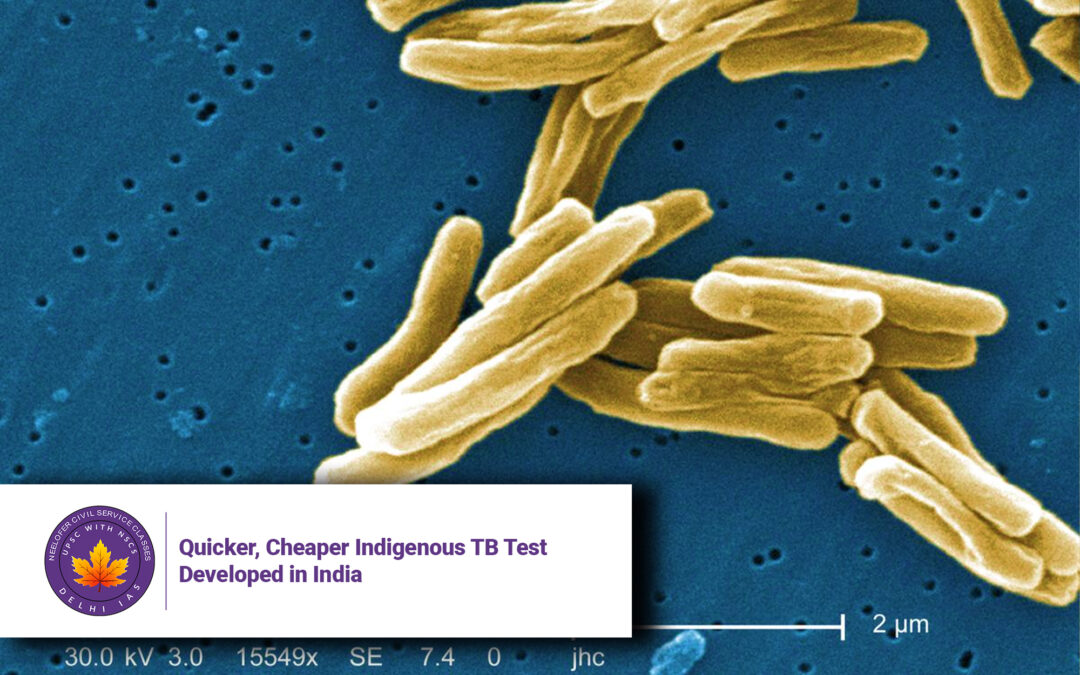
Quicker, Cheaper Indigenous TB Test Developed in India
Why in News?
Researchers at the Sree Chitra Tirunal Institute for Medical Sciences and Technology (SCTIMST) in Thiruvananthapuram have developed a cost-effective, real-time LAMP (rt-LAMP) assay for early detection of tuberculosis (TB). This indigenous test could significantly improve TB diagnosis in India. 
Introduction
Tuberculosis remains a major health challenge in India. Although molecular tests like GeneXpert and Truenat exist, they are expensive and slow. The new rt-LAMP test provides a faster, cheaper, and highly sensitive alternative, making TB detection more accessible.
Key Features of the rt-LAMP TB Test
-
High Sensitivity: Detects TB DNA even when only 10 copies are present per microlitre.
-
Speed: Results can be obtained in 10-20 minutes.
-
Cost-effective: Uses inexpensive fluorescent dye Syto 16 instead of costly dyes.
-
Single Temperature Setting: Unlike RT-PCR, it operates at a single temperature, making it simpler and faster.
-
High Amplification Rate: Uses six primers to boost amplification efficiency.
Validation and Performance
-
Tested on 350 TB sputum samples.
-
Showed 89.36% sensitivity and 94.06% specificity against microbiological reference standard (MRS).
-
Slightly better performance than GeneXpert.
-
Can run 96 or 384 tests in a single go, using existing RT-PCR machines.
-
Evaluated between October 2019 – March 2020 and January 2023 – March 2024.
Approvals and Future Scope
-
Approved by CDSCO (Central Drugs Standard Control Organisation).
-
Under ICMR validation.
-
WHO Health Technology Access Pool is reviewing it.
-
The rt-LAMP kit is designed to be open platform — works with current RT-PCR machines.
Significance for India
-
Currently, 79% of presumptive TB cases in India are diagnosed using smear microscopy, which is outdated.
-
Only 21% of TB tests in 2023 used modern molecular methods.
-
India’s molecular testing facilities rose from 5,090 in 2022 to 6,496 in 2023, moving closer to the goal set by the National Strategic Plan 2017–2025 to reduce reliance on smear microscopy.
Conclusion
The indigenous rt-LAMP assay is a big step toward affordable and accurate TB detection in India. With proper support and validation, it can help the country meet its TB control goals and reduce the burden of this infectious disease.
Q&A Section
Q1. What is the rt-LAMP test used for?
It is a molecular test used for the early detection of tuberculosis (TB).
Q2. How is the rt-LAMP test better than RT-PCR?
It works at a single temperature, is faster, and more affordable than RT-PCR.
Q3. What makes the rt-LAMP test cost-effective?
It uses a fluorescent dye Syto 16 and no probe, reducing the cost significantly.
Q4. How many tests can be processed at once using rt-LAMP?
The system can handle up to 96 or 384 tests in a single run.
Q5. What is the current status of the test’s approval?
It is approved by CDSCO, under ICMR validation, and is being reviewed by the WHO Health Technology Access Pool.
