
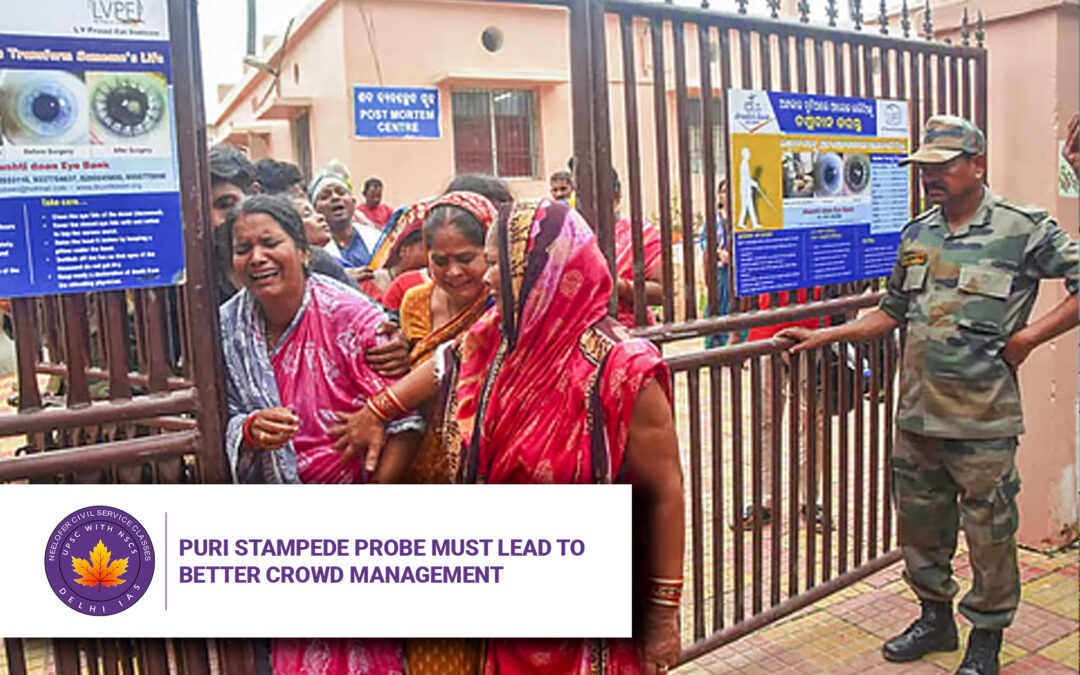
PURI STAMPEDE PROBE MUST LEAD TO BETTER CROWD MANAGEMENT
Why in News?
A tragic stampede during the Rath Yatra in Puri, Odisha, claimed three lives and highlighted serious administrative lapses in crowd management and medical response. Despite the largest deployment of police personnel in recent memory, this preventable disaster has triggered national outrage and prompted calls for urgent reforms in handling large religious gatherings. 
Introduction
The Rath Yatra is one of India’s most significant religious events, attracting lakhs of devotees to the coastal town of Puri. This year, however, the festival turned into a tragedy as a stampede on early Sunday morning claimed three lives—two of them being middle-aged women. The incident has exposed glaring gaps in planning, coordination, and emergency preparedness by the state administration and law enforcement.
What Went Wrong?
Over 10,000 police personnel and 72 IPS officers were deployed across the city, with Odisha’s top administrative officials overseeing the arrangements. Yet, eyewitnesses and survivors revealed that police presence was thin, and medical support was either delayed or missing at the most critical moments.
One of the biggest mistakes appears to be the underestimation of the crowd. On the first day of the Yatra, a state law minister reported 15 times the usual crowd size, as devotees came from across the country. The festival, which already demands tight coordination, became unmanageable under such pressure.
Despite past lessons from other mishaps, the administration failed to respond to real-time warnings and did not scale up medical resources or create emergency response corridors for the overwhelmed and injured.
Administrative Response & Political Reaction
The BJP government responded quickly by suspending the local tehsildar and removing the district collector and other key officials involved in the mismanagement. However, this action is seen as reactive, not preventive.
Chief Minister Mohan Charan Majhi announced an ex-gratia compensation of ₹5 lakh each to the victims’ families, but the lack of accountability and systemic reform continues to be a concern.
The Way Forward
This tragedy must be a wake-up call for governments across India. Religious gatherings often lack professional event management, with local police expected to manage logistics for millions with limited tools and outdated plans.
A committee has now been formed to investigate the failures. But if this investigation leads to only token actions without structural reforms, future festivals may risk similar disasters.
What’s needed is a comprehensive, professional approach to crowd control that includes:
-
Pre-festival simulation exercises
-
Smart surveillance and crowd tracking
-
Mobile medical response units
-
Coordination between central and state disaster agencies
Only then can such festivals be celebrated without fear or loss.
Q&A Section
1. What caused the stampede at Puri’s Rath Yatra?
It was caused by overcrowding, administrative mismanagement, and lack of timely medical response during the early hours of the festival.
2. How many police officers were deployed, and was it effective?
Over 10,000 police officers and 72 IPS officers were deployed, but the deployment failed to manage the crowd effectively, according to eyewitness accounts.
3. What action did the Odisha government take after the incident?
The district collector and local tehsildar were removed, and an ex-gratia of ₹5 lakh was announced for the victims’ families. A committee has also been formed for investigation.
4. What did eyewitnesses complain about?
They reported insufficient police presence, lack of crowd regulation, and delayed medical aid, which worsened the tragedy.
5. What long-term solutions are suggested?
The article recommends professional crowd management, use of smart technology, simulation drills, and trained emergency personnel to handle such mega-events.

