
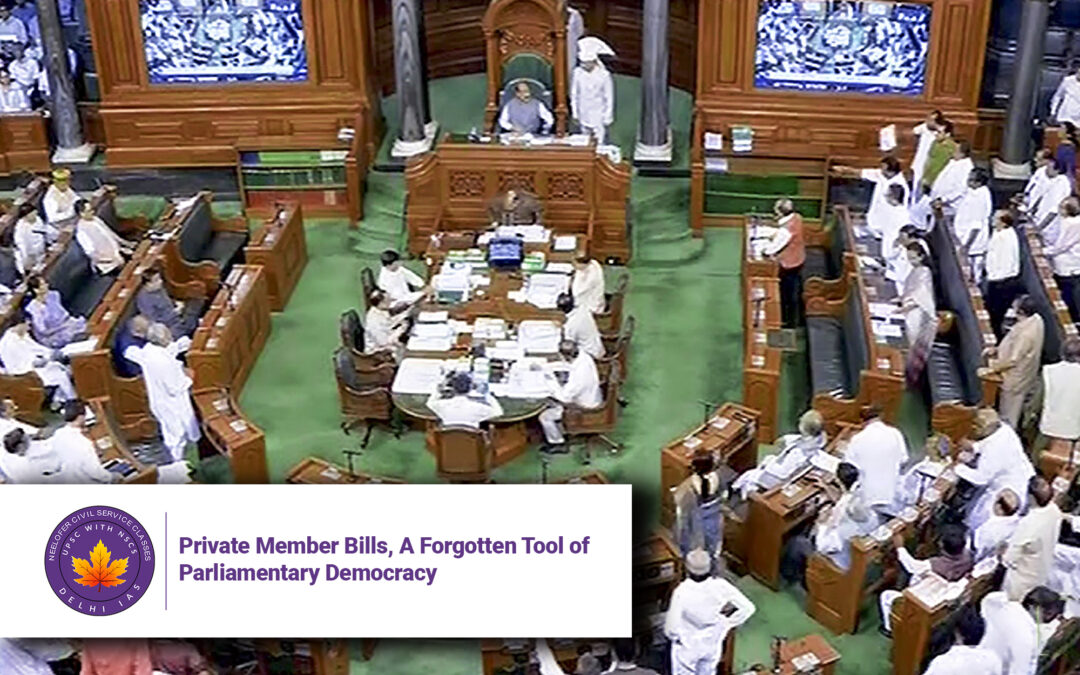
Private Member Bills, A Forgotten Tool of Parliamentary Democracy
Why in News?
There is a growing concern among scholars and parliamentary assistants over the declining role and relevance of Private Member’s Bills (PMBs) in Indian parliamentary proceedings. This concern was recently highlighted in an article that analyzed the procedural neglect of PMBs and proposed reforms to revive their significance. 
Introduction
Private Member’s Bills (PMBs) are legislative proposals introduced by MPs who are not Ministers. Unlike government bills, PMBs allow individual legislators—irrespective of party affiliations—to bring issues to Parliament, often representing citizen concerns or innovative ideas. However, their neglect in recent times has raised questions about the inclusiveness and vibrancy of India’s democratic process.
Key Issues and Background
1. Current Status and Trends
Since Independence, only 14 PMBs have been enacted into law. In recent sessions:
-
17th Lok Sabha (2019–24): 729 PMBs introduced in Lok Sabha, 706 in Rajya Sabha; only 11 and 6 respectively were discussed.
-
18th Lok Sabha (2024 session): 64 PMBs introduced, but none were discussed.
2. Systemic Challenges
-
PMBs are often sidelined due to disruptions, prioritization of government business, or symbolic debates.
-
Discussions are limited to Fridays, which are often lost to disruptions or other agendas.
-
In Rajya Sabha, even when bills are introduced, sessions are often cut short, and bills remain undebated.
3. Democratic Relevance
PMBs provide a platform for MPs to introduce legislation on emerging and overlooked issues:
-
Example: The “Right to Disconnect” Bill to reduce stress from work-related calls outside office hours.
-
Notable PMB: The “Rights of Transgender Persons Bill” introduced in 2014 by Tiruchi Siva (Rajya Sabha) became the first PMB to be passed by the Rajya Sabha in four decades.
4. Global Comparison and Best Practices
-
UK Parliament’s “Ten-Minute Rule”: Any MP can make a brief speech proposing a PMB, followed by limited time for discussion.
-
Such models can serve as a reference for Indian reforms to ensure more meaningful and regular deliberation of PMBs.
The Core of the Concern
Neglect of PMBs symbolizes a weakening of participatory democracy. While ministers dominate the legislative agenda, common MPs—despite being directly elected—get limited opportunity to shape national laws. The lack of institutional safeguards for PMBs discourages innovation and silences voices outside party lines.
Key Observations and Reforms Needed
Reforms Suggested:
-
Protect and enforce the Friday time slot for PMBs.
-
Modify Rules of Procedure to ensure mandatory discussion unless in emergencies.
-
Allocate specific time quotas (e.g., “Zero Hour” or “Discussion Hour”) for PMBs.
-
Introduce a review committee to screen PMBs for relevance and public impact.
-
Encourage fast-tracking high-impact or widely supported bills.
-
Adopt the UK’s “Ten-Minute Rule” system to create visibility and momentum for PMBs.
Conclusion
The Private Member’s Bill mechanism, though underused, is a powerful democratic tool that deserves revival. It allows MPs to voice citizen concerns, foster bipartisan legislation, and enrich democratic discourse. For a vibrant democracy, strengthening PMB processes is both a necessity and an opportunity.
5 Questions and Answers
Q1. What is a Private Member’s Bill (PMB)?
Answer: A PMB is legislation introduced by a Member of Parliament who is not a Minister, aiming to raise issues or propose reforms outside the government agenda.
Q2. Why is there concern about the decline of PMBs?
Answer: Despite a large number of PMBs introduced, very few are actually discussed or passed due to disruptions, prioritization of government business, and lack of structural support.
Q3. Which notable PMB was passed in the Rajya Sabha in recent years?
Answer: The “Rights of Transgender Persons Bill” introduced by Tiruchi Siva in 2014 was the first PMB passed in Rajya Sabha in four decades.
Q4. What reforms are proposed to improve the PMB system?
Answer: Suggestions include protecting Friday sessions for PMBs, reviewing bills for relevance, fast-tracking impactful bills, and adopting practices like the UK’s “Ten-Minute Rule.”
Q5. How can PMBs strengthen democracy?
Answer: By allowing non-minister MPs to introduce and discuss legislation, PMBs promote inclusive governance, address neglected issues, and empower diverse voices in Parliament.

