
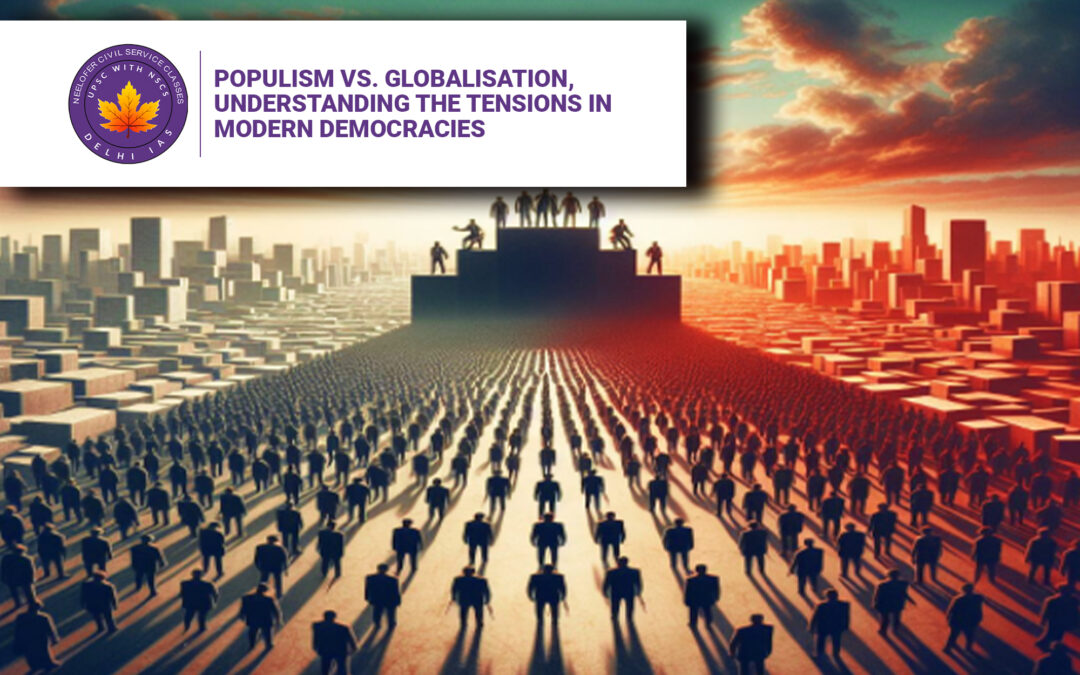
Populism vs. Globalisation, Understanding the Tensions in Modern Democracies
Why in News?
Former U.S. President Donald Trump’s imposition of tariffs has reignited a broader debate on the conflict between democracy and globalisation. As countries face rising economic inequalities and political discontent, the clash between domestic populism and global economic integration is becoming increasingly prominent.
Introduction 
Trump’s trade policies, particularly his tariff-driven protectionism, reflect a deeper ideological conflict — the incompatibility between democratic demands and the forces of globalisation. While aiming to support domestic workers and industries, such populist measures may disrupt long-standing global economic arrangements.
Key Issues and Background
1. Tariffs as a Populist Tool
-
Trump’s tariffs were a central part of his campaign to revive American manufacturing and protect domestic industries.
-
These tariffs were justified politically, but their economic logic is often debated.
-
Tariff formulas were based on complex economic models, making their effectiveness difficult to assess by the general public.
2. What Globalisation Entails
-
Globalisation promotes:
-
Free movement of capital
-
Cross-border economic freedom
-
Reduced restrictions on movement of goods
-
-
However, labour movement remains restricted, leading to inequality in benefits.
3. Populism’s Economic Reactions
-
Populist politics arise when people feel left out of global benefits, particularly in rural or economically stagnant regions like America’s Midwest and South.
-
Trump’s rhetoric aimed to represent those who felt ignored by the globally integrated elite.
The Core of the Concern
1. Job Displacement
-
Companies outsourced production to countries like China, India, Indonesia, and Vietnam due to lower wages and skilled labour availability.
-
This led to job losses in America’s industrial heartland.
2. Uneven Gains
-
While countries like India and China benefitted from trade liberalisation, developed nations saw rising inequality.
-
A large portion of the American workforce, especially in low-education segments, lost stable manufacturing jobs.
Key Observations
-
Populism thrives when people feel democracy is not delivering economically.
-
The “deep state” narrative emerges when populist leaders claim elites are sabotaging national interests.
-
There is growing disconnection between political democracy and economic outcomes, especially for the working class.
Conclusion
Globalisation has delivered economic growth, but not without social costs. As populist responses challenge liberal economic order, the key issue lies in reforming democratic systems to better redistribute the benefits of global trade. Whether this leads to a restoration of democracy’s credibility or deeper division remains to be seen.
Q&A Section
Q1. What is the main theme of Trump’s tariff policies?
They are a populist reaction to globalisation, aiming to protect domestic industries and jobs.
Q2. How has globalisation created inequality?
Capital moves freely while labour does not, causing job losses in developed countries as companies shift operations to cheaper labour markets.
Q3. Why do people support populist politics in democracies?
Because they feel left out of global benefits and believe traditional elites no longer represent their economic interests.
Q4. What are the risks of protectionist policies like tariffs?
They can reduce global trade, raise prices, and limit America’s access to global capital and innovation.
Q5. How have emerging economies benefitted from globalisation?
Countries like China, India, Indonesia, and Vietnam have gained from export-led growth and industrial expansion driven by foreign investments.
