
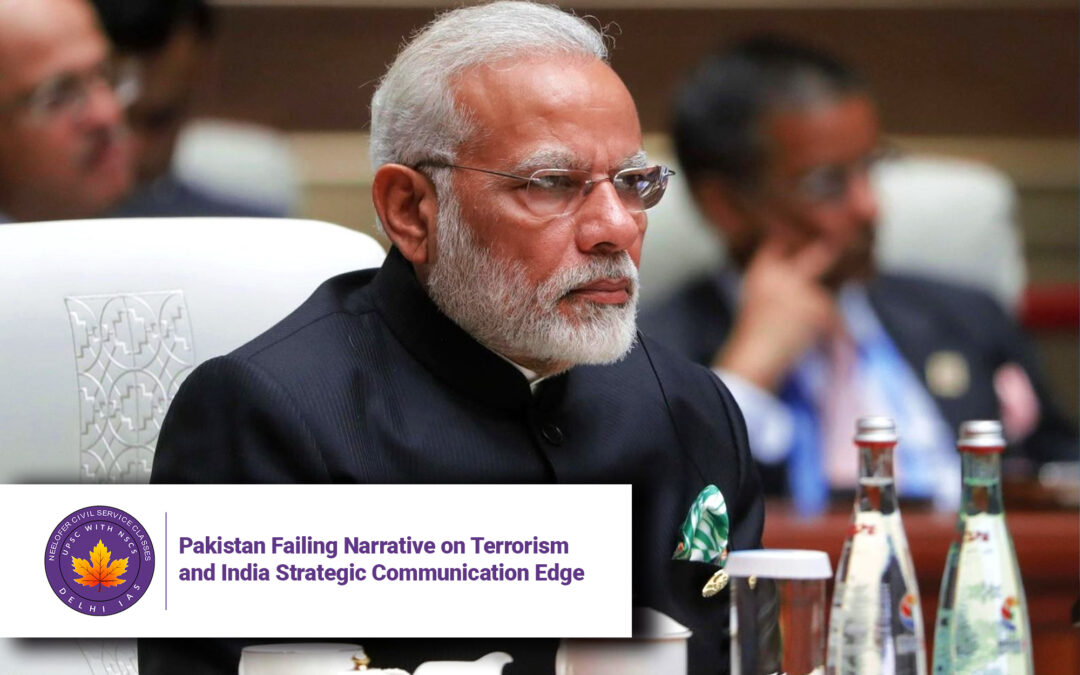
Pakistan Failing Narrative on Terrorism and India Strategic Communication Edge
Why in News?
Pakistan’s struggle to maintain a credible international narrative, particularly regarding terrorism and regional tensions, has come under sharp scrutiny. India, by contrast, has maintained a consistent, transparent, and proportionate communication strategy — especially after military confrontations. 
Introduction
Between Kargil and Poonch, Pakistan has repeatedly pushed a weak, self-contradictory narrative that attempts to deflect responsibility for terrorism. The core problem lies in its lack of coherence, loss of credibility, and internal contradictions among key stakeholders — from its government to its military.
Key Issues
1. Denial of Terrorism Links No Longer Works
-
Pakistan continues to deny involvement in terrorism in Jammu and Kashmir.
-
However, the global community no longer believes this denial.
-
The earlier excuse that terrorism was promoted by rogue elements no longer holds, as Pakistan now tries to portray itself as a victim.
2. Mixed Messages from Leadership
-
While one leader calls for peace, another warns of war.
-
Defence minister Khawaja Asif hinted at resolving tensions, while foreign minister Bilawal Bhutto amplified aggressive rhetoric.
-
This inconsistency further weakens Pakistan’s position on the global stage.
3. India’s Clear and Strategic Narrative
-
India has effectively used communication post-strike (e.g., 2016, 2019 airstrikes) to present its actions as justified and proportionate responses to terror threats.
-
India’s narrative is measured, avoids escalation, and resonates with the international community.
Pakistan’s Internal and External Failures
-
Pakistan Army’s domestic standing has declined.
-
There is public confusion over who controls foreign policy — the elected government or the military.
-
Inconsistent messaging, internal political instability, and loss of moral standing have all contributed to Pakistan’s isolation.
India’s Narrative Success
-
India’s media briefings, military statements, and official communication have been precise, timely, and effective.
-
India’s proportional response without escalation is seen as mature diplomacy.
-
Even international media (e.g., Dawn) have admitted that Pakistan’s messaging lacks transparency.
Conclusion
Pakistan is losing the battle of narratives due to a lack of credibility, internal contradictions, and a weakened military image. In contrast, India’s structured and strategic communication, backed by justified military actions and measured diplomacy, has gained international support. This shift highlights the power of narratives in modern diplomacy and counter-terror efforts.
5 Q&A Based on the Article
Q1. Why is Pakistan losing the global narrative battle on terrorism?
A: Because of contradictory statements from its leaders, continued denial of terror links, and loss of credibility among international audiences.
Q2. What approach has India taken to counter Pakistan’s narrative?
A: India has maintained a consistent, measured, and proportionate communication strategy, backed by evidence and clear justification of its actions.
Q3. What role has Pakistan’s military played in its narrative failure?
A: The military’s reduced domestic standing, unclear role in foreign policy, and inconsistent messaging have weakened Pakistan’s position.
Q4. How does the world perceive Pakistan’s stance on terrorism now?
A: The world is unconvinced by Pakistan’s repeated denials and increasingly views it as a country making excuses rather than taking responsibility.
Q5. What communication elements made India’s narrative stronger?
A: Timely military briefings, coordination with diplomatic channels, avoiding escalation, and transparency in intentions and actions.

