
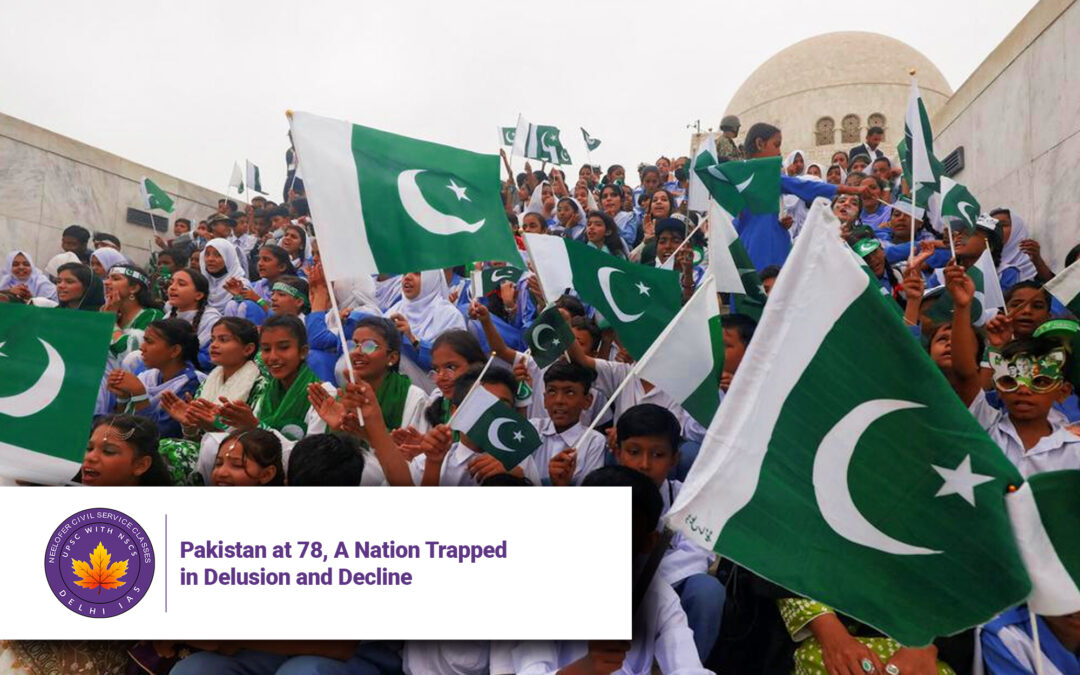
Pakistan at 78, A Nation Trapped in Delusion and Decline
Introduction
On its 78th Independence Day, Pakistan stands at a critical juncture. While its leaders celebrated the occasion with triumphalist rhetoric, the reality paints a very different picture — one of economic fragility, political instability, growing radicalisation, and an ever-deepening dominance of the military over civilian institutions. Despite decades of crises, Pakistan’s ruling elite — particularly its powerful military — continues to harbor the delusion of parity with India, while its economic and political failures push the nation into an abyss.
The recent events surrounding Pakistan’s handling of internal crises, its relationship with international players like the U.S., China, and the IMF, and its military’s response to India’s decisive Operation Sindoor expose the contradictions at the heart of the Pakistani state. At 78, Pakistan continues to embody a paradox: a nation that plays all sides geopolitically, thrives on nuclear brinkmanship, yet cannot provide economic stability or democratic governance to its citizens.
Operation Sindoor and Pakistan’s Psychosis of Parity with India
One of the central features of Pakistan’s 78th Independence Day celebrations was Prime Minister Shehbaz Sharif’s attempt to link the nation’s achievements to its four-day conflict with India earlier this year. The reference was aimed at praising the Pakistani military. Yet, the facts tell a different story.
The conflict was triggered after the horrific terrorist attack in Pahalgam, Jammu & Kashmir, which India attributed to groups operating from Pakistani soil. In retaliation, India launched Operation Sindoor, a powerful military response that successfully targeted and destroyed terror bases deep inside Pakistan. The strikes not only eliminated key militant infrastructure but also dealt significant damage to Pakistan’s military installations.
For Pakistan’s military establishment, however, this episode was rebranded as a “success story” to maintain the illusion of standing on equal footing with India. This is emblematic of Pakistan’s long-standing psychosis — the belief that it is an “equal” to India despite the vast differences in economy, governance, global influence, and military capacity.
Pakistan’s Economic Freefall
While the military projects triumphalism, Pakistan’s economic condition remains dire.
-
As of mid-2024, Pakistan’s foreign exchange reserves stand at around $14.5 billion, enough to cover only 2.5 months of imports.
-
Its total debt burden has climbed to $267 billion, creating unsustainable repayment obligations.
-
Since its inception in 1947, Pakistan has approached the International Monetary Fund (IMF) 25 times — more than almost any other country. This dependency reflects structural weaknesses in its economy.
Inflation, unemployment, and shortages of essential goods continue to haunt the ordinary citizen, while the elite — particularly the military establishment — remain insulated from the crisis. The IMF bailouts provide temporary relief but come with stringent conditions that further squeeze the lower and middle classes.
Economists argue that Pakistan’s overreliance on aid and loans, rather than structural reforms, has perpetuated a cycle of economic dependency. Rather than investing in industry, human capital, and innovation, resources are disproportionately allocated to defense and the military, reflecting the dominance of the army in policymaking.
Political Crisis and the Jailing of Popular Leaders
Pakistan’s political instability mirrors its economic decline. The country’s most popular leader, Imran Khan, remains behind bars. His imprisonment has not only fueled anger among his supporters but also deepened the crisis of legitimacy facing Pakistan’s political system.
The hybrid regime — a system where civilian governments exist but ultimate authority rests with the military — undermines democracy. Civilian leaders, including the current Prime Minister Shehbaz Sharif, remain beholden to the military brass, with generals shaping foreign policy, internal security, and often economic direction.
The jailing of popular leaders like Khan also highlights Pakistan’s inability to tolerate dissent or opposition, further eroding trust in democratic institutions. Instead of resolving political differences through dialogue and institutions, Pakistan continues to rely on authoritarian tactics under military influence.
Radicalisation and Internal Security Challenges
Pakistan today is more vulnerable to radicalisation and internal insurgencies than at almost any point in its history. Multiple provinces, including Balochistan and Khyber Pakhtunkhwa, face growing insurgencies, driven by ethnic grievances, economic neglect, and resentment against military dominance.
The rise of extremist ideologies also continues to threaten Pakistan’s internal stability. Radical groups have not only undermined social cohesion but also worsened Pakistan’s international image, deterring foreign investment and pushing it further into isolation.
The use of terrorism as a state policy has also backfired. Organizations once supported by Pakistan’s security establishment have turned against the state itself, as seen in the growing attacks by the Tehrik-e-Taliban Pakistan (TTP).
The Role of the Military: Power Without Responsibility
At the core of Pakistan’s malaise lies the disproportionate role of the military. It is both the most powerful institution in the country and the least accountable. For decades, the Pakistani military has justified its dominance on the grounds of protecting the country from India. Yet, in practice, this dominance has led to the following consequences:
-
Weak Civilian Governments: Civilian leaders operate under constant military supervision, limiting their independence.
-
Misallocation of Resources: Defense consumes a significant share of national expenditure, leaving little for development.
-
Undermined Democracy: The hybrid system ensures the army, not elected representatives, remains the real power center.
The military’s grip on power has stifled democracy and weakened governance, creating a vicious cycle of instability and underdevelopment.
Pakistan’s Geopolitical Games: Playing All Sides
One of Pakistan’s most consistent foreign policy tactics has been playing all sides — a strategy that has earned it short-term gains but long-term distrust.
-
With the United States: Recently, Army Chief General Asim Munir sought to rebuild ties with Washington, even courting former President Donald Trump. Pakistan sees the U.S. as a source of aid, military assistance, and diplomatic cover.
-
With China: Pakistan remains deeply tied to Beijing through the China-Pakistan Economic Corridor (CPEC). China’s influence in Pakistan has grown significantly, but Islamabad now seeks to hedge against Beijing’s dominance by pivoting back to the U.S.
-
With the Muslim World: Pakistan has often projected itself as the leader of Islamic causes, especially on Kashmir, but its credibility has declined as Gulf states deepen ties with India.
This “play-all-sides” approach reflects Pakistan’s desperation for survival but also its inability to build sustainable, trusted partnerships.
Nuclear Brinkmanship: Threats That No Longer Work
Another consistent feature of Pakistan’s diplomacy is nuclear brinkmanship. In recent weeks, Pakistani leaders issued open nuclear threats, warning that if pushed to the wall, Pakistan could “take half the world down with it.”
While such rhetoric once alarmed the international community, it now raises questions about the security and integrity of Pakistan’s nuclear arsenal. The fear is no longer just about confrontation with India but about the possibility of nuclear assets falling into the wrong hands amid Pakistan’s internal instability.
The credibility of Pakistan’s nuclear deterrence has weakened as the world sees through its bluffs. Instead of deterring India or the global community, such threats now reinforce Pakistan’s image as an unstable state prone to irresponsible behavior.
The Illusion of Fooling Everyone
At the heart of Pakistan’s crisis is the belief among its military elite that they can fool the world — and their own people — all the time. The army projects strength and control, yet the reality of economic collapse, political repression, radicalisation, and external isolation continues to worsen.
The assumption that nuclear weapons or temporary geopolitical hedging can indefinitely mask structural weaknesses is proving increasingly untenable. Pakistan may manage short-term survival, but without reforms, accountability, and a shift from military dominance to democratic governance, the long-term trajectory looks grim.
Conclusion
Seventy-eight years after independence, Pakistan remains trapped in a cycle of delusion and decline. Its military elite celebrates hollow victories, its economy teeters on the brink, and its people suffer under repression and radicalisation. The hybrid regime continues to weaken democratic institutions, while nuclear brinkmanship and geopolitical opportunism only deepen the distrust of the international community.
Unless Pakistan confronts its structural problems — reducing military dominance, strengthening democracy, investing in economic reforms, and addressing radicalisation — its 78-year malaise will only worsen. For now, Pakistan’s leaders may believe they can play all sides and fool the world, but the writing on the wall is clear: the world isn’t buying it anymore.
5 Exam-Oriented Q&A
Q1: What was Operation Sindoor, and how did it impact Pakistan?
A1: Operation Sindoor was an Indian military response to the Pahalgam terror attack. It successfully destroyed terror bases deep inside Pakistan and damaged military installations, exposing Pakistan’s vulnerability.
Q2: Why is Pakistan’s economy described as being in crisis?
A2: Pakistan’s forex reserves are only $14.5 billion (covering 2.5 months of imports), its total debt burden is $267 billion, and it has sought IMF bailouts 25 times since independence. Structural weaknesses, overreliance on aid, and defense-heavy spending exacerbate the crisis.
Q3: What is meant by Pakistan’s “hybrid regime”?
A3: The hybrid regime refers to a political system where civilian governments exist nominally, but ultimate authority lies with the military, undermining democracy and making the army the real power center.
Q4: How has Pakistan’s foreign policy been described as “playing all sides”?
A4: Pakistan simultaneously courts the U.S. for aid, aligns with China through CPEC, and appeals to Muslim nations on Islamic issues, but lacks sustainable, trusted partnerships due to opportunism.
Q5: Why is Pakistan’s nuclear brinkmanship losing credibility?
A5: Frequent nuclear threats have eroded their impact. Instead of deterring India or alarming the world, they now raise doubts about the security of Pakistan’s nuclear arsenal amid growing instability.

