
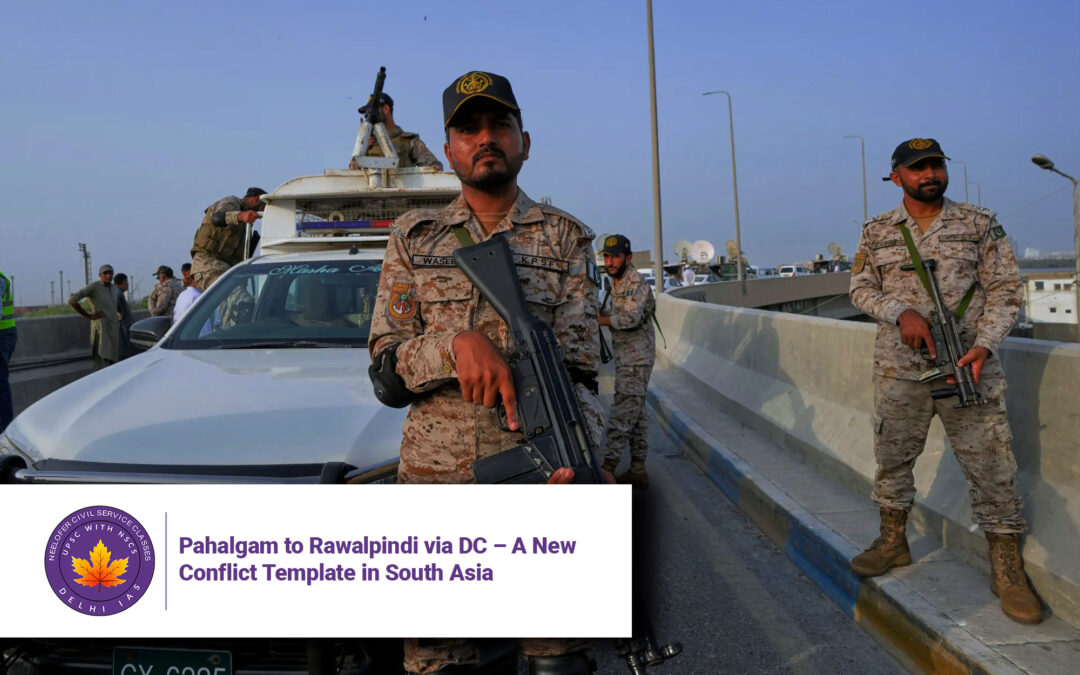
Pahalgam to Rawalpindi via DC – A New Conflict Template in South Asia
Why in News?
In a significant geopolitical development, the post-Pulwama conflict response showcased how India, Pakistan, China, and the United States interacted within a high-stakes security environment. India’s assertive military and political reaction, Pakistan’s retaliatory measures, and U.S. diplomatic involvement mark a pivotal moment in South Asian affairs.
Introduction
India’s decisive response to the Pulwama terror attack has revealed a new security template in the region. The episode reflects how India will no longer tolerate terror attacks from across the border and will retaliate with political and military strength. Meanwhile, the role of the U.S. in facilitating a ceasefire and China’s cautious positioning signal shifting power equations.
Key Developments and Background
-
Pulwama Trigger:
A suicide bombing in Pulwama (J&K), killing Indian security personnel, was carried out by a Pakistan-based group. In response, India launched airstrikes on terror camps in Balakot, deep inside Pakistan, marking a significant military escalation. -
Pakistan’s Response:
Pakistan retaliated by launching airstrikes on Indian military targets and engaging in dogfights, resulting in the downing of an Indian pilot, who was later returned. These events rapidly escalated tensions between the two nuclear-armed nations. -
India’s Strategic Shift:
India demonstrated its military preparedness, political will, and zero-tolerance policy toward cross-border terrorism. The airstrikes marked a shift from strategic restraint to proactive deterrence. -
U.S. Involvement:
President Donald Trump claimed credit for facilitating a ceasefire. The U.S. played a crucial backchannel role, urging de-escalation and acting as a mediator, especially through officials like Secretary of State Mike Pompeo and National Security Advisor John Bolton. -
China and Russia’s Role:
China did not overtly side with Pakistan, signaling strategic recalibration. India’s ties with Russia appeared more balanced, showing that India is becoming less dependent on traditional alliances and is more confident on the world stage.
Current Situation and Implications
-
Diplomatic Messaging:
India’s actions conveyed that diplomatic costs will be imposed on Pakistan for sponsoring terrorism. The internationalization of the Pulwama-Balakot crisis saw India succeed in rallying global opinion. -
Pakistan’s Position:
While Pakistan responded militarily, it was also forced to de-escalate after facing diplomatic isolation. Economic constraints and a weaker military-industrial base meant prolonged conflict would be costly. -
Geopolitical Takeaway:
The conflict showed that South Asia has entered a new era of crisis response, with India’s assertive, multi-domain approach leading the narrative. India is willing to cross borders to defend its interests, which will shape future engagements.
Conclusion
The Pulwama-Balakot episode was not just a skirmish but a turning point in India’s security doctrine. It revealed India’s willingness to act decisively, Pakistan’s limitations, and the balancing act played by global powers. The U.S. played an essential mediatory role, while China watched cautiously. This template may now become the new normal for regional conflict management.
5 Questions and Answers
Q1. What event triggered the conflict between India and Pakistan in this case?
Answer: A terrorist attack in Pulwama, Jammu & Kashmir, killed several Indian security personnel, leading to a severe Indian response.
Q2. How did India respond to the Pulwama attack?
Answer: India conducted airstrikes across the Line of Control, targeting terrorist training camps in Balakot, Pakistan.
Q3. What was the role of the United States in this conflict?
Answer: The U.S., particularly under President Donald Trump, played a central role in facilitating a ceasefire and de-escalation between India and Pakistan.
Q4. How did China react to the situation?
Answer: China maintained a cautious stance and was less vocal in support of Pakistan, reflecting a shift in its South Asia strategy.
Q5. What does this conflict signify about India’s security approach?
Answer: It highlights a new Indian doctrine of proactive and cross-border deterrence, signaling that India will no longer tolerate terrorism from Pakistani soil without retaliation.

