
Operation Sindoor, India’s Strategic Shift in Modern Warfare
Why in News?
India’s response during the recent standoff with Pakistan has spotlighted Operation Sindoor, a defining event that signals a transformation in India’s military engagement. The operation reflects a shift from conventional warfare to multi-dimensional, high-tech strategic confrontation, ushering in a new era of warfare in South Asia. 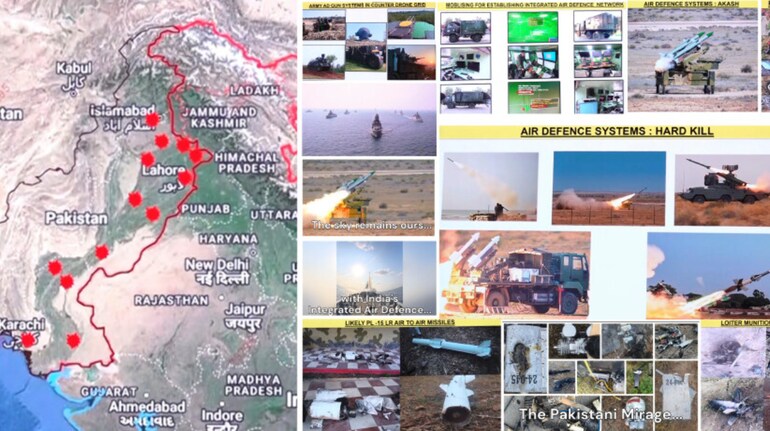
Introduction
Operation Sindoor is not just another military maneuver—it represents a paradigm shift in how India views, prepares for, and executes military confrontations. With evolving technologies like drone warfare, integrated command systems, real-time intelligence, and information manipulation, India is reshaping its defense doctrines and battlefield dynamics for the 21st century.
Key Issues and Background
-
Drone Warfare: The New Frontline
-
India intercepted Pakistan’s attempted drone intrusions using its advanced air-defense and drone intelligence systems.
-
High-precision strikes on over 36 locations showcased a technological leap.
-
The use of SkyStriker kamikaze drones marked a departure from traditional, costly warfare.
-
-
Multi-Layered Air Defense
-
India has deployed a fusion of indigenous systems like Akash and QR-SAM with imports like the S-400 and Barak-8, creating a dynamic, multi-layered shield.
-
The shift is towards low-cost, high-accuracy targeting with minimal risk to human lives.
-
-
Information, Deterrence, and Doctrinal Shifts
-
Modern warfare now involves psychological warfare, digital media, and strategic information distortion.
-
Pakistan’s use of propaganda has forced India to adapt with targeted social campaigns and counter-operations.
-
India’s military is now focused on adaptable, smart deterrence that works across multiple fronts simultaneously.
-
-
Joint Operations: The New Standard
-
Operation Sindoor marked a historic integration of Indian Army, Navy, and Air Force under the Integrated Air Command and Control System (IACCS).
-
The real-time coordination of multiple services now allows for precision strikes and intelligence-driven warfare, signaling a break from conventional siloed approaches.
-
-
Technology-Driven Strategic Control
-
India’s strategy is now shaped by AI, space tech, and cyber capabilities.
-
Projects like the hypersonic missile development, Project Kusha, and Project Vishnu show the country’s commitment to future-ready warfare.
-
Economic considerations are now embedded in military strategy, signaling warfare without total war.
-
Five Key Takeaways
-
Drone warfare and AI-based strikes are becoming central to India’s defense strategy.
-
Operation Sindoor showcased India’s readiness for multi-domain warfare with minimal collateral damage.
-
Information and psychological manipulation are now recognized as key battlegrounds.
-
Inter-service joint operations under IACCS represent a breakthrough in military synchronization.
-
India’s defense strategy now blends military goals with geopolitical, economic, and technological dominance.
Challenges and the Way Forward
Challenges:
-
Preventing misinformation from damaging domestic or international credibility.
-
Developing cost-effective technologies for wider deployment.
-
Balancing secrecy with transparency in democratic defense policy.
-
Sustaining high levels of coordination among tri-services.
-
Avoiding unnecessary escalation while ensuring preparedness.
Way Forward:
-
Enhance investments in AI, drone tech, and satellite systems.
-
Build a civil-military interface for better public awareness and resilience.
-
Continue evolving joint command doctrines for real-time operational capability.
-
Counter propaganda through proactive digital diplomacy.
-
Strengthen international alliances in tech-driven warfare standards.
Conclusion
Operation Sindoor has redefined the battlefield for India. With precision, integration, and innovation at the core, India is moving beyond traditional military doctrines. This marks not just a response to immediate threats but a strategic shift that positions India as a global power capable of deterring adversaries with intelligence, coordination, and technology, not just brute force.
Q&A Section
1. What is Operation Sindoor and why is it significant?
Operation Sindoor is India’s recent multi-domain response to provocations from Pakistan, marking a strategic shift from conventional to modern warfare involving drones, AI, and joint forces.
2. How has India changed its approach to aerial threats?
India has shifted from expensive fighter jets to a mix of drones, kamikaze UAVs, and multi-layered air defense systems, allowing high-precision attacks with minimal risk.
3. What role does information warfare play in this new strategy?
Information is now a weapon. India uses digital campaigns, media operations, and psychological tactics to counter propaganda and influence public opinion both domestically and globally.
4. What is the Integrated Air Command and Control System (IACCS)?
It is a real-time tri-service command structure that synchronizes the Indian Army, Navy, and Air Force for coordinated, fast-response warfare.
5. How does this shift position India globally?
India now aligns with modern military doctrines, combining economic strategy, cyber defense, space warfare, and real-time intelligence, making it a formidable global power in modern conflict scenarios.

