
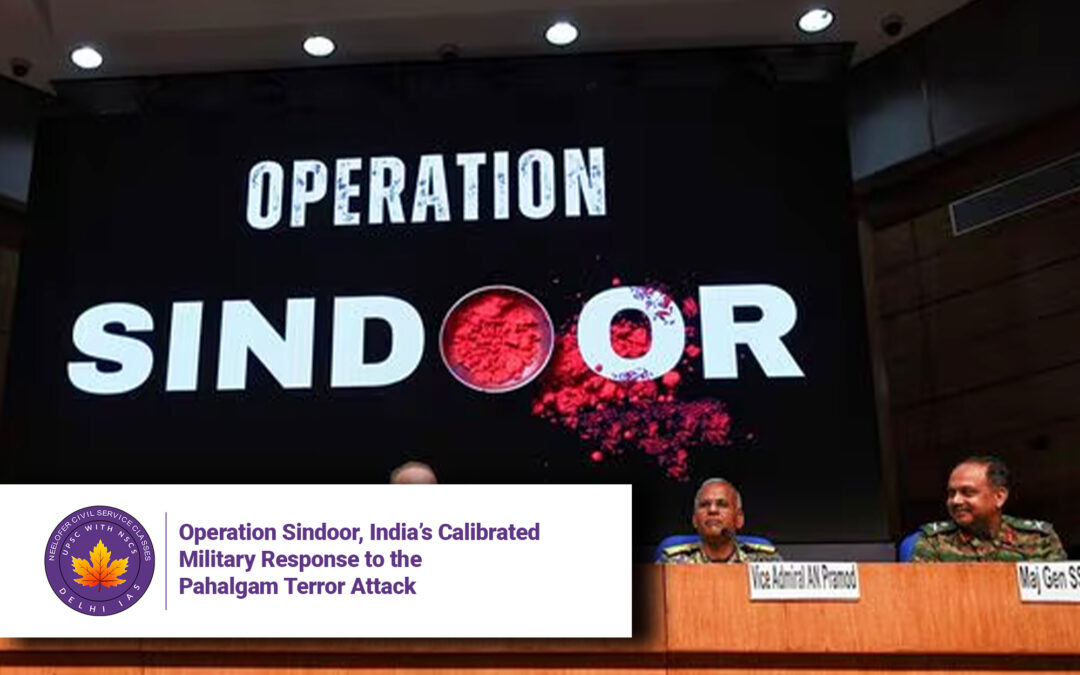
Operation Sindoor, India’s Calibrated Military Response to the Pahalgam Terror Attack
Why in News?
Following the deadly terrorist attack on Indian tourists in Pahalgam, Kashmir on April 22, 2025, India launched a targeted military response on May 7 under Operation Sindoor, drawing national and international attention. The response was widely seen as India’s calibrated retaliation aimed at deterring future cross-border terrorism. 
Introduction
The Pahalgam attack resulted in the deaths of several Indian civilians and prompted strong public calls for action. Unlike in the past, the Indian government decided against an all-out war and instead chose a precise, strategic military response targeting only terror infrastructures in Pakistan-occupied regions. This marked a notable shift from emotional retaliation to intelligent deterrence.
Key Features of the Event
-
The Attack on April 22, 2025:
A deadly terrorist attack in Pahalgam claimed the lives of innocent Indian tourists, leading to widespread condemnation and demands for retribution. -
Operation Sindoor – The Response:
On May 7, 2025, Indian forces launched missile and drone strikes on nine terror-linked targets—four in Pakistan and five in Pakistan-occupied Kashmir (PoK). These targets were believed to be key infrastructures of terrorist groups, particularly the Lashkar-e-Taiba (LeT). -
Selective and Limited Strikes:
The action was not aimed at civilian populations or military bases but rather selected terror camps and assets. The strikes were considered “calibrated, time-bound, and limited.” -
Role of Women Officers in Communication:
Two women officers—one from the Army and one from the Air Force—were fielded to brief the media on live TV, demonstrating transparency and inclusivity in strategic communication. -
Political Context and Absences:
The absence of the Prime Minister at the all-party meetings held on April 24 and May 7 was noted as a political drawback, although other ministers led the briefings.
Strategic and Political Analysis
-
Avoiding Full-Scale War:
Prime Minister Modi’s strategy avoided full-scale conflict with Pakistan, likely influenced by the ongoing Russia-Ukraine war, rising global instability, and international diplomatic pressure. -
Pakistan’s Reaction:
Pakistan responded with claims of Indian aggression, yet they did not retaliate militarily, possibly to avoid escalation or due to lack of international support. -
Terror Infrastructure Targeted:
The operation showed that India is now ready to act with precision, based on intelligence and not emotions. This reflects a strategic maturity in India’s defence posture. -
Challenges Ahead:
Terror groups may regroup, and future attacks cannot be ruled out. Long-term deterrence would depend on continued vigilance and diplomatic isolation of Pakistan-sponsored terror.
Conclusion
Operation Sindoor reflects India’s shift toward a more strategic and restrained approach to national security threats. While the loss in Pahalgam was tragic, the response—precise and calculated—sends a clear message to terror outfits and their patrons. However, political unity and long-term counter-terrorism efforts remain essential for ensuring peace in the region.
5 Questions and Answers
Q1. What triggered Operation Sindoor?
Answer: The operation was launched in response to the terrorist attack on Indian tourists in Pahalgam, Kashmir, on April 22, 2025.
Q2. What was the nature of India’s military response?
Answer: India conducted selective missile and drone strikes on May 7, targeting nine terror infrastructure sites in Pakistan and PoK, avoiding civilian and military bases.
Q3. Which group was primarily targeted in these strikes?
Answer: The Lashkar-e-Taiba (LeT), a Pakistan-based terror group, was the primary target of the strikes.
Q4. What was notable about the media briefing following the operation?
Answer: Two young women officers—one from the Army and one from the Air Force—briefed the media live, showing gender inclusivity and transparency.
Q5. Why was the government’s response considered calibrated and limited?
Answer: It avoided all-out war, targeted only terror camps, and was designed to deliver a strategic message without escalating regional tensions.

