
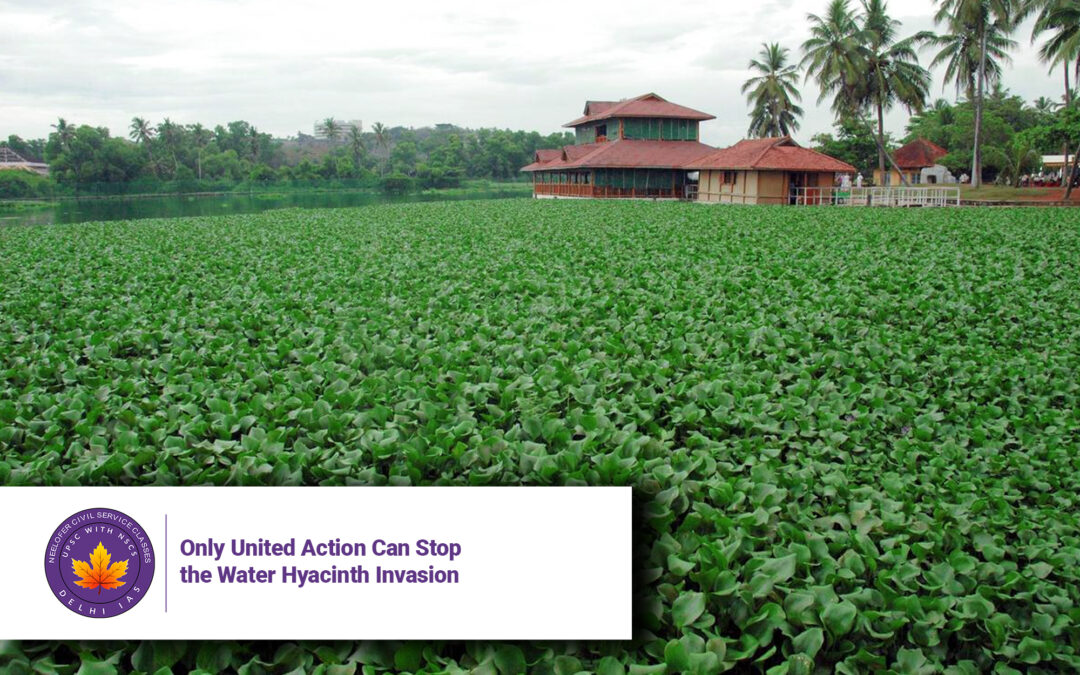
Only United Action Can Stop the Water Hyacinth Invasion
Why in News
Every year with the arrival of the monsoon, India’s waterways face a dangerous but often overlooked ecological menace — the water hyacinth (Eichhornia crassipes). What may appear as a delicate aquatic plant with violet-blue flowers hides a destructive capacity that threatens agriculture, fisheries, tourism, biodiversity, and even climate resilience. Its unchecked proliferation has particularly devastated Kerala’s backwaters and Vembanad Lake, one of the most vital wetland ecosystems in India.
The problem has now escalated into a national environmental and livelihood crisis, covering nearly 2,00,000 hectares of inland waters nationwide. The water hyacinth is not just suffocating ecosystems but also choking rural economies and endangering food security. Policymakers, academic institutions, and grassroots innovators are calling for coordinated and united action at the national level to treat this invasive species not merely as a pest but as a challenge that can be transformed into a sustainable opportunity.
Introduction
The water hyacinth, a native plant of the Amazon Basin, was introduced to India during the colonial era as an ornamental species for its attractive flowers. However, it soon turned invasive, spreading aggressively across rivers, lakes, and wetlands. Its dense mats block sunlight, deplete oxygen in water, disrupt aquatic biodiversity, and hinder economic activities such as fishing and agriculture.
Kerala, known for its backwaters and rice cultivation, has become the epicenter of this crisis. For farmers in the Kuttanad region — often called the “rice bowl of Kerala” — water hyacinth has made irrigation increasingly difficult, escalated costs, and reduced productivity. Fishermen are equally affected as the plant hampers boat movement, destroys native fish populations, and undermines traditional fishing practices.
Beyond livelihoods, the unchecked growth of water hyacinth has grave ecological consequences. Its decay releases methane, a greenhouse gas over 25 times more potent than carbon dioxide, thereby adding to climate change concerns. The menace has also begun threatening eco-tourism and transport systems, with iconic sites like Vembanad Lake losing their ecological balance.
Key Issues and Background
1. Historical Context
-
Introduced in India during colonial times as an ornamental plant.
-
Spread unchecked across rivers, lakes, and wetlands due to lack of natural predators.
-
Once seen as decorative, it has become a symbol of ecological imbalance.
2. Scale of Spread
-
Over 2,00,000 hectares of inland waters in India are currently affected.
-
Kerala is among the worst-hit states, especially in the Kuttanad paddy fields and Vembanad Lake.
3. Livelihood Crisis
-
Farmers face rising input costs as irrigation canals are blocked.
-
Fishermen lose income as fish nurseries collapse and boats cannot move through thick mats.
-
Local communities struggle with damaged biodiversity, loss of native species, and reduced water quality.
4. Ecological Impact
-
Dense mats prevent sunlight from reaching underwater ecosystems.
-
Leads to oxygen depletion, causing the death of aquatic plants and fish.
-
Methane release during decomposition accelerates global warming.
5. Lack of Coordinated Policy
-
Current responses are fragmented across multiple departments: agriculture, irrigation, fisheries, and environment.
-
Interventions are often piecemeal and short-term, lacking a unified strategy.
-
Absence of a single-point accountability mechanism prevents sustained solutions.
Specific Impacts or Effects
1. Impact on Farmers
-
Paddy cultivators in Kerala face blocked irrigation channels.
-
Increased labor and mechanical costs to clear water hyacinth.
-
Crop yields decline due to water stagnation and ecosystem degradation.
2. Impact on Fishermen
-
Traditional fishing practices rendered impossible.
-
Native fish species destroyed by lack of oxygen and space.
-
Boats and nets frequently get entangled and damaged.
3. Impact on Biodiversity
-
Aquatic flora and fauna experience ecological asphyxiation.
-
Food chains collapse as smaller organisms die out.
-
Native species face extinction risks in affected lakes.
4. Impact on Tourism and Transport
-
Vembanad Lake, a Ramsar-recognised wetland of international importance, is under threat.
-
Tourism boats find it difficult to navigate dense mats.
-
Eco-tourism revenue and livelihoods are at risk.
5. Climate Impact
-
Water hyacinth decay emits large amounts of methane.
-
Intensifies India’s already significant vulnerability to climate change.
Challenges and the Way Forward
Major Challenges
-
Fragmented responsibility among government departments.
-
Lack of financial incentives to scale up local innovations.
-
Short-term removal methods without scientific sustainability.
-
Insufficient private sector participation.
-
Minimal awareness campaigns at the community level.
Way Forward
-
National Policy Framework
-
Establish a single accountability authority for managing water hyacinth.
-
Frame a region-specific implementation strategy to address local challenges.
-
-
Scaling up Innovations
-
Odisha: Self-help groups convert hyacinth into handicrafts and furniture.
-
Assam & West Bengal: Transformed into paper and biogas.
-
These models must be scaled up nationwide.
-
-
Incentives and Partnerships
-
Financial incentives for innovators and community groups.
-
Encourage private sector collaboration in biofuel, biogas, and craft industries.
-
-
Scientific and Technological Interventions
-
Research into viable products (biofuels, compost, textiles).
-
Mechanised removal using eco-friendly methods.
-
-
Community Awareness and Education
-
Campaigns led by academic institutions like Jain University, Kochi.
-
Promote water hyacinth as a resource, not just a pest.
-
Conclusion
The water hyacinth crisis is more than an ecological challenge; it is a multi-dimensional threat impacting agriculture, fisheries, biodiversity, climate resilience, and rural livelihoods. India cannot afford piecemeal responses or isolated experiments. Instead, what is urgently needed is a unified national mission that integrates government, academia, local innovators, and communities into a collective movement.
If tackled strategically, the menace can be transformed into a resource that generates sustainable livelihoods and reduces ecological harm. With united action, India’s lakes and rivers can be freed from this suffocating invader, ensuring both environmental sustainability and economic resilience.
5 Questions and Answers
Q1. What is the water hyacinth, and why is it considered a threat?
The water hyacinth (Eichhornia crassipes) is an invasive aquatic plant introduced to India during colonial times. While visually attractive, it spreads rapidly, blocking waterways, choking ecosystems, and threatening livelihoods.
Q2. Which region of India is most severely affected by water hyacinth?
Kerala, particularly the Kuttanad region (known as the rice bowl of Kerala) and Vembanad Lake, is among the worst-affected areas due to its dense network of backwaters and paddy fields.
Q3. What are the ecological impacts of water hyacinth?
It blocks sunlight, prevents oxygen penetration, destroys aquatic biodiversity, and on decomposition, releases methane — a greenhouse gas 25 times more harmful than CO₂.
Q4. What innovative uses of water hyacinth have been developed in India?
-
Odisha: Women’s self-help groups create handicrafts and furniture.
-
Assam & West Bengal: Converted into paper and biogas.
These examples show potential if scaled up with policy support.
Q5. What steps are recommended to tackle the crisis effectively?
A national policy with region-specific strategies, financial incentives, private sector partnerships, large-scale research into product development, and community awareness campaigns are key to addressing this challenge sustainably.

