
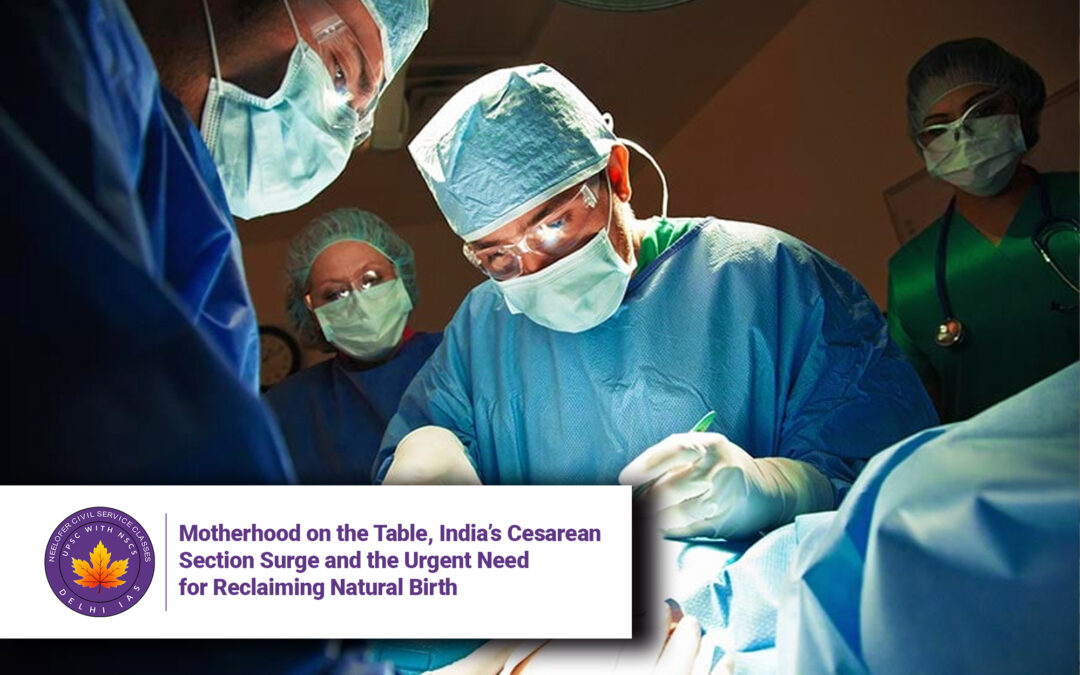
Motherhood on the Table, India’s Cesarean Section Surge and the Urgent Need for Reclaiming Natural Birth
Why in News?
India is witnessing a rapid and concerning rise in cesarean section (C-section) deliveries, especially elective and non-medically indicated ones. The latest data from the National Family Health Survey (NFHS-5, 2019–21) reveals that C-section births now account for 21.5% of all deliveries in India — a significant increase from 17.2% recorded in NFHS-4 (2015–16). This growing trend is reshaping the way childbirth occurs in the country, raising important medical, ethical, and social concerns.
Introduction
Cesarean section, when performed for medical necessity, is a lifesaving procedure for both the mother and the baby. However, its increasing usage in situations lacking medical justification is gradually altering childbirth experiences, particularly in urban and private healthcare settings. This shift isn’t merely statistical — it’s deeply personal and systemic.
Through both anecdotal experiences and empirical data, it is becoming evident that childbirth in India is at a crossroads: between evidence-based natural labor and medically unnecessary interventions driven by convenience, fear, and institutional pressures. The normalization of planned C-sections without true medical need is not only transforming maternal healthcare practices but also raising new concerns about long-term implications for both mothers and newborns.
Understanding the Cesarean Surge: Trends and Triggers
1. Statistical Overview: Alarming Growth
According to NFHS-5 data:
-
21.5% of all deliveries in India now occur via C-section.
-
This marks a steep rise from 17.2% in the 2015–16 survey.
-
Among 36 states and union territories, 28 exceed the WHO’s recommended C-section threshold of 10–15%.
-
Only Nagaland (5.2%), Meghalaya (8%), and Bihar (9.7%) remain within the safe limits.
-
Kerala has over 70% of institutional births via cesarean in private hospitals.
This rise isn’t just confined to medically justified cases. Instead, it includes a growing number of planned C-sections for non-medical reasons.
2. Role of Private Healthcare
One of the most striking findings from the NFHS-5 and NHFS-5 Public vs Private Sector Divide is:
-
47.4% of births in private hospitals are C-sections.
-
In contrast, only 14.3% of births in public hospitals are C-sections.
Multivariate analysis reveals that private healthcare increases the odds of C-section delivery by nearly four times compared to public facilities. The reasons are often related more to convenience and profit than genuine medical need.
3. Socio-Demographic Determinants
Several factors contribute to the higher C-section rates:
-
Older maternal age
-
Urban residence
-
Higher education levels
-
Better antenatal care access
For example, in Bihar’s wealthiest quintile, the odds of cesarean birth are nearly 13 times higher than the poorest households. Similarly, Tamil Nadu shows a 3-fold difference in C-section rates based on income levels.
4. Cesarean as a Choice of Convenience
In urban and affluent states, especially in private healthcare setups, C-sections are frequently planned in advance. Common justifications include:
-
Avoidance of labor pain
-
Better scheduling for doctors and hospitals
-
Fear of birth complications (often medically unjustified)
-
Pressure from family or societal norms
Studies show that in Kerala, around 70–73% of C-sections occur as elective surgeries. A German study even linked pre-labor C-sections to a 21% increased risk of acute lymphoblastic leukemia and 29% increased risk of certain cancer subtypes.
Biological and Emotional Dimensions of Birth
The Butterfly and the Cocoon: A Lost Metaphor
There’s a parable cited by Manorama Bakshi — the butterfly struggles to emerge from its cocoon, a struggle that strengthens it. When that struggle is taken away (like a planned, easy C-section), what emerges may be weaker and unready.
Natural labor prepares both the mother and baby emotionally, biologically, and physiologically. It facilitates the transfer of maternal microbiota to the baby, helping train the infant’s immune system. Cesarean babies, especially those not exposed to vaginal microbes, miss out on this vital microbial exposure.
The Science of Vaginal Seeding
Vaginal seeding — swabbing newborns born via C-section with vaginal fluids — has shown promise in partially restoring the baby’s microbiota. A study by NYU Langone’s Department of Nature Medicine reported that microbiota in seeded infants resembled those of vaginally delivered infants.
However, the American College of Obstetricians and Gynaecologists currently does not recommend this practice outside clinical trials due to infection risks. Still, the research underscores what’s being lost when C-sections are unnecessarily prioritized.
Ethical Medical Practices and Systemic Barriers
Transparency and Consent
Medical professionals must ensure:
-
Transparent communication with expecting mothers
-
Honest discussion of risks and benefits
-
Consideration of VBAC (Vaginal Birth After Cesarean)
-
Collaboration with midwives and doulas to empower natural birth
Currently, many surgeries proceed without genuine informed consent, with women being discouraged from trying natural labor due to fear, misinformation, or institutional routines.
Public Health Recommendations
The Government of India, WHO, and UNICEF jointly advocate for:
-
Institutional tracking of C-section rates
-
Promotion of midwife-led and respectful maternal care
-
Strengthening public hospitals with respectful, evidence-based maternal services
However, implementation lags behind. Many institutions still perform cesareans not out of necessity, but because they are:
-
Predictable
-
Time-efficient
-
More profitable
C-sections, as the article clarifies, are not the enemy. But their overuse as a convenient tool—especially in urban private setups—is.
Conclusion: Reclaiming Birth as Empowerment
India’s growing dependence on planned, non-medical C-sections presents an urgent call for reform. As we modernize maternal healthcare, it is vital to:
-
Return to evidence-based birthing practices
-
Invest in public health systems and midwife training
-
Challenge the commercialisation of birth
-
Empower women with choices grounded in science and compassion
When we allow time, trust, and presence in the labor process, we not only give strength to newborns but restore dignity to motherhood.
Cesarean sections are a critical medical tool when needed. But when misused, they become symbols of a system that values speed and efficiency over health and empowerment. As Manorama Bakshi insightfully states: “We must honour labour not as a burden but as a blueprint. When we wait — with patience, presence, and trust — we give wings not only to babies but to the women who bring them forth.”
Q&A Section
1. What does NFHS-5 data reveal about cesarean section trends in India?
NFHS-5 (2019–21) shows that 21.5% of all deliveries in India are now via cesarean section, up from 17.2% in NFHS-4 (2015–16). The rate is particularly high in private hospitals (47.4%) and urban areas, indicating a shift toward elective, non-medical C-sections.
2. Why are private hospitals associated with higher C-section rates?
Private hospitals often prioritize scheduled C-sections for efficiency, predictability, and profit. Data shows that delivering in a private facility increases the odds of a C-section nearly fourfold compared to public hospitals.
3. What are the health risks associated with non-medical C-sections?
Non-medical C-sections can expose infants to higher risks of microbial imbalance, allergies, type 1 diabetes, and some cancers. Mothers may also face longer recovery times and increased risks in subsequent pregnancies.
4. What is “vaginal seeding” and is it recommended?
Vaginal seeding involves exposing C-section newborns to maternal vaginal microbes to restore lost microbiota. Though early studies show benefits, major health organizations like the ACOG do not currently recommend it outside clinical trials due to potential infection risks.
5. What policy interventions are being recommended to address the C-section surge?
The Government of India, WHO, and UNICEF recommend tracking C-section rates, promoting midwife-led care for low-risk pregnancies, and strengthening respectful maternity care in public health systems. Transparency in medical advice and expanding access to VBAC are also key strategies.

