
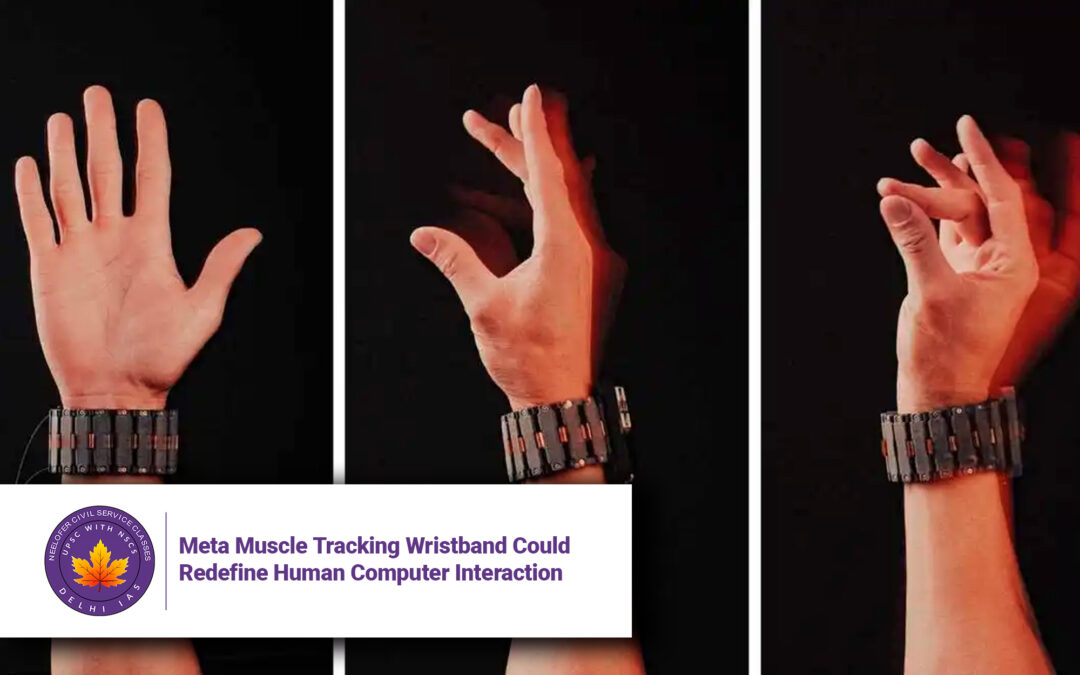
Meta Muscle Tracking Wristband Could Redefine Human Computer Interaction
Why in News?
Meta’s Reality Labs has unveiled a groundbreaking wristband that translates electrical signals from the forearm muscles into computer commands. This technological leap could fundamentally change the way we interact with digital devices by reducing dependency on traditional input methods like keyboards, mice, or joysticks. The innovation is based on deep-learning models and real-time muscle signal interpretation, offering an alternative, intuitive computing experience for a wide range of users.
Introduction
The fusion of neuroscience, AI, and wearable technology is no longer a concept of the distant future. Meta, the parent company of Facebook, has pushed the boundaries with the development of a new wristband that listens to the electrical signals in a user’s forearm to control a computer. This development by Reality Labs—the research division of Meta—is the latest step toward seamless integration between humans and machines.
The wristband, lightweight and intelligent, doesn’t rely on cameras or voice commands. Instead, it uses bio-signals emitted by the muscles in the arm to control digital actions like moving a cursor, typing, or even zooming in or out on a screen. These movements, which were once purely mechanical or screen-based, are now being executed via subtle muscle signals—making interaction more natural and even more accessible for those with physical impairments.
The Technology Behind the Wristband
At the core of this innovation lies a process called electromyography (EMG), which detects the tiny electrical signals that occur when our muscles move. Reality Labs has trained deep-learning models using EMG signals recorded from thousands of volunteers. The artificial intelligence embedded in the wristband then decodes these signals and translates them into commands understandable by a computer.
What makes this device revolutionary is its adaptability. Unlike earlier muscle-based interfaces that required lengthy training periods and individual calibration, Meta’s band works almost immediately for new users. This level of generalization is made possible by the deep-learning model that learns to predict intentions based on a massive dataset of human interactions.
Performance and User Experience
Initial tests of the wristband’s typing capability showed that users could type at a speed of 20.9 words per minute using just muscle signals—without touching a keyboard. Although this is still lower than the typical average of 36 words per minute on a conventional keyboard, the technology is still in its early stages. With time and refinement, it is expected to become faster, more accurate, and more intuitive.
Moreover, this wristband allows users to perform a variety of digital tasks without any contact-based input. Tasks like scrolling, zooming, clicking, and typing can all be achieved through muscle movements. This could transform how we interact with computers, especially in settings where hands-free operation is essential.
Accessibility and Inclusivity
One of the most significant implications of this development is its potential to empower individuals with disabilities. For users who find it difficult or impossible to use a traditional keyboard or mouse, this wristband offers an entirely new way to control their devices.
The system’s ability to learn from minimal input and adapt across users also means that even individuals with motor impairments could operate it with little training. It opens doors to a more inclusive tech landscape, ensuring that more people can participate in the digital world without barriers.
Applications Across Industries
This wristband is not just a novelty—it has profound applications across various sectors:
-
Gaming and Virtual Reality (VR): With seamless control using just wrist movements, gamers can immerse themselves more deeply into VR worlds. It reduces the need for bulky controllers and allows for more natural interaction.
-
Healthcare and Rehabilitation: Patients undergoing physical therapy could use the wristband as both a diagnostic and assistive tool. It could monitor muscle performance and also help users regain control over their motor functions.
-
Remote Work and Productivity: In a world that increasingly values flexible working environments, this technology could allow users to operate digital tools while walking, exercising, or engaging in other activities.
-
Assistive Technology: For individuals with disabilities, this band can serve as an alternative interface for controlling smart devices, computers, or even robotic arms.
-
Industrial Use: Workers in environments where hand movements are restricted or gloved (e.g., labs, factories) could use wristband-based control to operate systems without compromising safety.
The Future of Human-Computer Interaction
Meta’s wristband is part of a broader movement toward the development of intuitive, invisible computing. The ultimate goal is to make technology fade into the background, where users don’t have to think about operating a device—the device simply understands their intent.
This vision aligns with Meta’s broader ambitions in the metaverse, where physical movement and real-time responsiveness are crucial. The wristband could become a core input tool in these virtual spaces, replacing touchscreens, voice commands, and gesture recognition with something faster and more intuitive.
Challenges and Limitations
Despite the promise, there are still hurdles:
-
Speed and Accuracy: While 20.9 words per minute is a promising start, it needs to match or exceed current methods to become a real alternative.
-
Signal Interference: Muscle signals can vary from user to user and day to day. Factors like sweat, fatigue, or movement could affect accuracy.
-
Privacy Concerns: Collecting and interpreting biological signals raises important questions about data privacy and ethical use.
-
User Fatigue: Long-term usage of a muscle-controlled interface may cause strain if not ergonomically designed.
-
Cost and Accessibility: For this to be transformative, it must be affordable and available globally, not just limited to tech enthusiasts.
Conclusion
Meta’s muscle-tracking wristband is a significant milestone in the journey toward more natural and inclusive human-computer interaction. While the technology is still evolving, it has already demonstrated how wearable AI can bridge the gap between intention and digital action. As the line between the physical and digital continues to blur, innovations like this will play a crucial role in shaping the future of work, communication, and digital living.
With continuous improvement, this interface may well replace many current tools—making computing not only faster but also more human.
Q&A Section
1. What is the main function of Meta’s new wristband developed by Reality Labs?
The wristband detects feeble electrical signals in the forearm muscles and uses them to control a computer—enabling actions like moving a cursor, typing, and zooming without touching traditional input devices.
2. How does the wristband interpret muscle signals?
It uses deep-learning models trained on recordings from thousands of volunteers. These models decode electrical signals from the muscles and convert them into computer commands.
3. What is the typing speed achieved using the wristband, and how does it compare to a traditional keyboard?
Users could type at 20.9 words per minute using the wristband, compared to the average 36 words per minute using a standard keyboard.
4. What makes this wristband more user-friendly than earlier muscle-controlled interfaces?
Unlike older interfaces that required user-specific calibration, Meta’s band works out-of-the-box for new users due to its generalized machine learning model trained on diverse datasets.
5. What are the broader implications of this technology?
It could revolutionize how people interact with technology across sectors like healthcare, gaming, remote work, and assistive tech. It may especially benefit individuals with physical impairments and enhance accessibility.
