
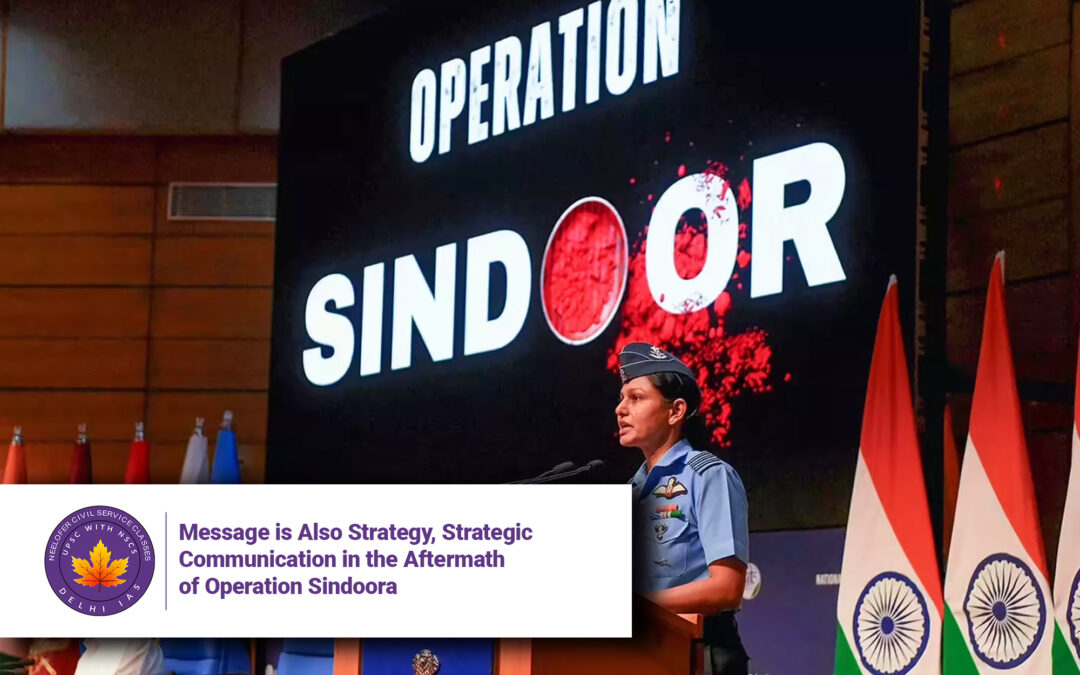
Message is Also Strategy, Strategic Communication in the Aftermath of Operation Sindoora
Why in News?
In the aftermath of Operation Sindoora, the article titled “Message is also Strategy” by Sanjaya Baru, a former media advisor to the Prime Minister, sheds light on the lessons learned from the Vajpayee and Manmohan Singh governments. The article offers insights into how India’s military actions are not just defined by their battlefield victories but also by how the government communicates those actions to the public and the world. The piece revisits the strategic communication challenges India faced during Operation Sindoora and underlines the importance of coherent messaging in matters of national security and foreign policy. 
Introduction
In modern warfare, communication has become as important as combat. Sanjaya Baru’s commentary emphasizes that the government’s failure to craft a clear and effective narrative around Operation Sindoora weakened the strategic impact of the military success. It also highlights how the governments of Atal Bihari Vajpayee and Manmohan Singh dealt with similar challenges in the past and successfully implemented strategic communication mechanisms to manage perception, both domestically and globally.
Key Issues and Background
-
Lack of Clarity Before the Operation:
-
Experts questioned the ambiguity in government communication before Operation Sindoora began.
-
It was not made clear whether the Indian Army would be targeting terrorist camps across the LoC or if the mission had a broader strategic intent.
-
There were no statements clarifying the government’s objectives, which led to heightened expectations and eventual disappointment among the public and media.
-
-
No Communication During the Conflict:
-
The government did not clearly explain what was happening on the ground.
-
There was confusion about the reasons for the ceasefire, its terms, and whether the operation was over or just paused.
-
Prime Minister Narendra Modi’s unclear statement that Operation Sindoora had not ended but was on hold only raised further questions.
-
-
Proliferation of Counter-Narratives:
-
In the absence of official updates, foreign media and anti-India narratives filled the gap.
-
Pro-Modi media outlets attempted to control the narrative but often lacked coordination with government sources, weakening the credibility of information.
-
-
Lessons from the Past:
-
The Vajpayee and Manmohan Singh governments faced similar challenges and developed robust media strategies.
-
The establishment of the National Security Advisory Board (NSAB) and its media sub-committee ensured controlled, accurate, and strategic dissemination of information.
-
-
Need for Professional Media Management:
-
The success of military operations relies on a parallel success in strategic messaging.
-
An absence of a professional communication approach leads to public confusion, diplomatic misunderstandings, and diminished strategic advantage.
-
Key Observations
-
Military and Civil Disconnect:
-
There is often a lack of alignment between the military leadership and the civilian government in managing national messaging during conflict scenarios.
-
This disconnect causes confusion in the media and among the public, who look to the government for clarity.
-
-
Strategic Communication is Not Optional:
-
Strategic communication is not just about public relations; it is a key element of national security strategy.
-
Failure to communicate effectively can dilute the impact of military operations, both at home and abroad.
-
-
NSAB’s Role in the Past:
-
Under Vajpayee’s leadership, NSAB’s sub-committee included experienced diplomats, media advisors, and military officials who crafted consistent daily briefings and dealt with media professionally.
-
This proactive strategy helped ensure that India’s position was understood and supported internationally.
-
-
Evolving Role of Media:
-
Today’s 24×7 media cycle demands immediate, accurate, and coordinated responses from the government.
-
With the absence of structured communication, media outlets—often driven by ideology—can distort the narrative, leading to misinterpretation of India’s objectives.
-
-
Importance of Trained Communicators:
-
Individuals like Raminder Singh Jassal, who briefed the media during Kargil, demonstrated the value of having a skilled, credible spokesperson during crises.
-
Jassal’s role helped build trust and keep international opinion aligned with India’s cause.
-
Challenges and the Way Forward
Challenges:
-
Media Confusion and Misinformation:
Without a centralized communication command, fragmented narratives take over. This was evident in Operation Sindoora, where bombastic claims were made by political leaders without a coordinated strategy. -
Unrealistic Public Expectations:
Due to lack of briefings and mixed messages, public expectations soared. When results did not match those expectations, disappointment turned into criticism. -
Poor Integration Between Agencies:
The Indian media strategy often fails because military, political, and diplomatic arms work in silos. There is little coordination in terms of crafting a united, well-thought-out narrative. -
Underutilization of Strategic Think Tanks:
Institutions like the NSAB are not given enough prominence in real-time decision-making and communication planning.
The Way Forward:
-
Establish a Unified Communication Command:
India must create a central unit comprising military, diplomatic, and media professionals to handle crisis communication. -
Bring Back NSAB Media Sub-Committee Model:
The media strategy model created by the NSAB in the early 2000s can be revived and adapted to today’s digital-first media environment. -
Designate a Skilled Spokesperson:
A single point person should handle all briefings, ensuring consistency and credibility. -
Prepare Before Action:
Even before military operations begin, the communication strategy must be in place. Clear articulation of objectives, potential outcomes, and implications can prevent chaos and speculation. -
Training and Media Literacy:
Both bureaucrats and military officials should receive media training to interact effectively with journalists and ensure information is not distorted.
Conclusion
Operation Sindoora was an important military undertaking, but its strategic impact was weakened due to poor messaging and lack of clarity. In the age of information warfare, battles are won not just with guns and boots, but also with narratives and perception. As Sanjaya Baru illustrates through examples from the Vajpayee and Manmohan Singh governments, strategic communication is not an afterthought—it is a pillar of national strategy. For India to project power and protect its interests on the world stage, it must invest in professional, coordinated, and proactive communication frameworks that accompany its military and diplomatic efforts.
5 Q&A for Better Understanding
Q1. What is Operation Sindoora and why is it significant?
A: Operation Sindoora refers to a recent military initiative by India targeting cross-border threats. While its full objectives were never clearly articulated by the government, it was believed to involve targeted strikes across the LoC. The operation drew national and international attention but was marred by communication gaps that affected public perception and strategic impact.
Q2. What were the key communication failures during the operation?
A: The main failures included the lack of clear messaging before and during the operation, inconsistent statements from leaders, absence of daily briefings, and failure to explain the ceasefire terms. These gaps led to confusion, unrealistic expectations, and a vacuum that was filled by speculative media narratives.
Q3. How did the Vajpayee and Manmohan Singh governments manage communication during similar events?
A: Both governments adopted a structured and professional approach to media management. They relied on trained spokespersons, regular briefings, coordination between agencies, and utilized the NSAB’s media sub-committee to ensure coherent messaging. This helped maintain national and international support during events like the Kargil War and interactions with Pakistan.
Q4. What is the role of the National Security Advisory Board (NSAB) in strategic communication?
A: The NSAB played a crucial role in creating a media sub-committee that advised the PMO, framed key messages, and coordinated briefings. It included experienced diplomats, military personnel, and media professionals who ensured that India’s narrative was accurately represented during times of crisis.
Q5. What lessons can be drawn for future operations?
A: The key lessons are: strategic communication should be planned alongside military operations; there should be a designated media spokesperson; messages must be consistent and credible; and India should invest in long-term structures like the NSAB media unit to manage crisis communication efficiently.
