
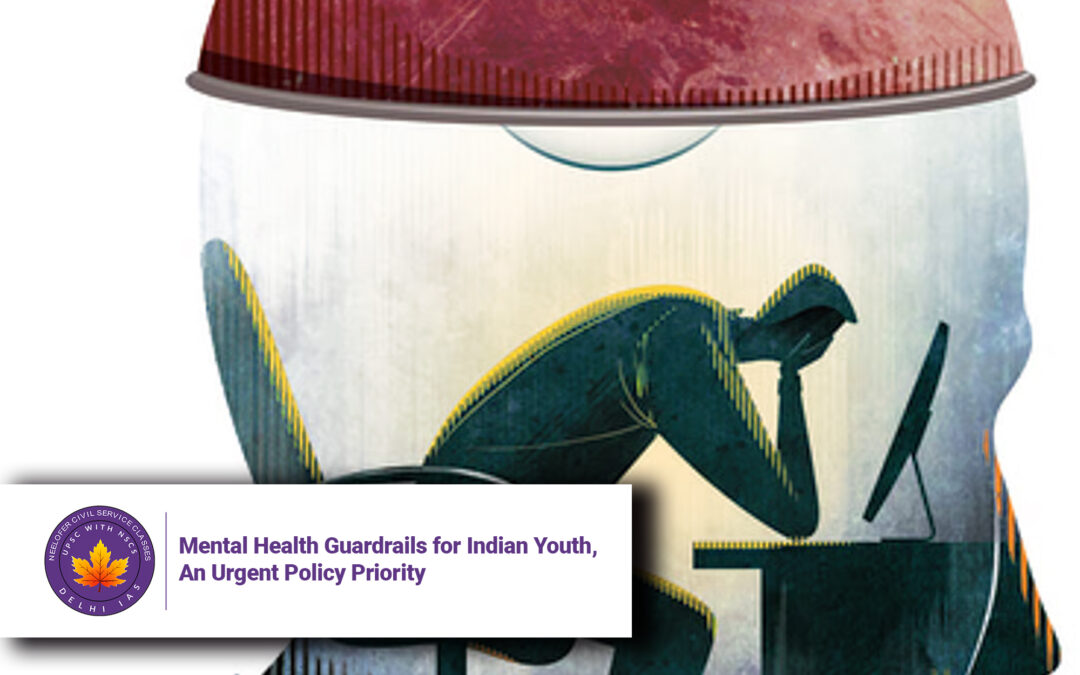
Mental Health Guardrails for Indian Youth, An Urgent Policy Priority
Why in News?
For the first time, the Economic Survey 2024 has acknowledged mental health as a factor affecting productivity. It estimated that 10.6% of Indian adolescents are affected by mental disorders. Amid increasing academic stress, social pressure, and digital addiction, the mental well-being of India’s youth is emerging as a national concern. 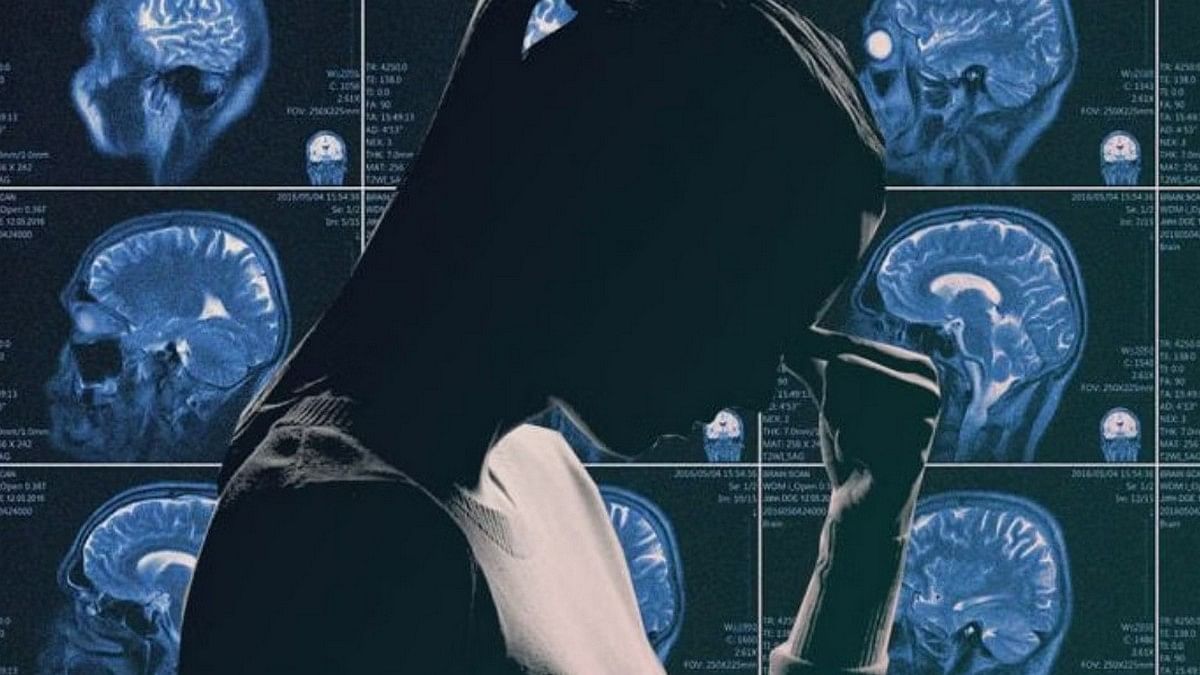
Introduction
India’s demographic dividend lies in its vast population of young people. Yet, this strength is being undermined by a growing mental health crisis among the youth. With rising academic pressure, reduced opportunities, toxic online influences, and the absence of real-life mentorship, India’s younger generation is facing alarming levels of stress, anxiety, and depression.
Key Highlights from the Editorial
1. Mental Health and Productivity
-
The Economic Survey 2024 has recognized the loss of productivity due to mental health issues.
-
The WHO estimates that mental health concerns could cost India $1.03 trillion from 2012–2030.
2. High-Pressure Academic Culture
-
High competition, coupled with fewer opportunities, is exhausting students emotionally.
-
Students feel the system is loaded against them, and meritorious students are also falling victim to depression.
-
India’s crackdown on US student visas post-pandemic has increased pressure on students seeking international education.
3. Digital Exposure and Social Media Risks
-
Excessive online engagement contributes to low self-esteem, isolation, and cyberbullying.
-
The rise of toxic influencers and obsession with virtual lives has blurred reality.
-
Teenagers need real-life mentors, not Instagram celebrities.
4. Socio-Economic Inequality
-
Mental health issues are more pronounced in disadvantaged groups and state-run schools, as seen in Kerala.
-
Lack of career counselling and school support systems makes the problem worse.
5. The Role of Schools and Society
-
Schools need to act as first responders, with teachers trained to detect signs of mental distress.
-
Parents and teachers must guide children emotionally, not just academically.
-
Mental health should be de-stigmatized, with accessible support services in every school.
Conclusion
The youth of India are not just future citizens; they are current assets of our nation. Mental health cannot be treated as an afterthought. From policymakers and educators to parents and peers, every stakeholder must act. Building resilience, offering mentorship, de-stigmatizing help-seeking, and providing institutional support are no longer optional—they are essential to safeguarding India’s future.
Q&A Section
Q1. What did the Economic Survey 2024 say about mental health?
It noted, for the first time, that mental health issues are leading to a loss in productivity and that 10.6% of Indian adolescents suffer from mental disorders.
Q2. What are the key causes of mental health problems among students?
High academic pressure, fewer career opportunities, online addiction, social media influences, and lack of mentorship are the main causes.
Q3. How does social media affect the youth’s mental health?
Social media creates unrealistic comparisons, promotes toxic influences, and can cause low self-esteem, isolation, and depression among teenagers.
Q4. What role should schools play in addressing this crisis?
Schools must act as first responders, with trained teachers, active counselling systems, and destigmatization of mental health issues.
Q5. What solutions does the article suggest?
It recommends reforms in education, greater support for counselling, parenting involvement, teacher training, and the creation of safe, non-judgmental spaces for students.

