
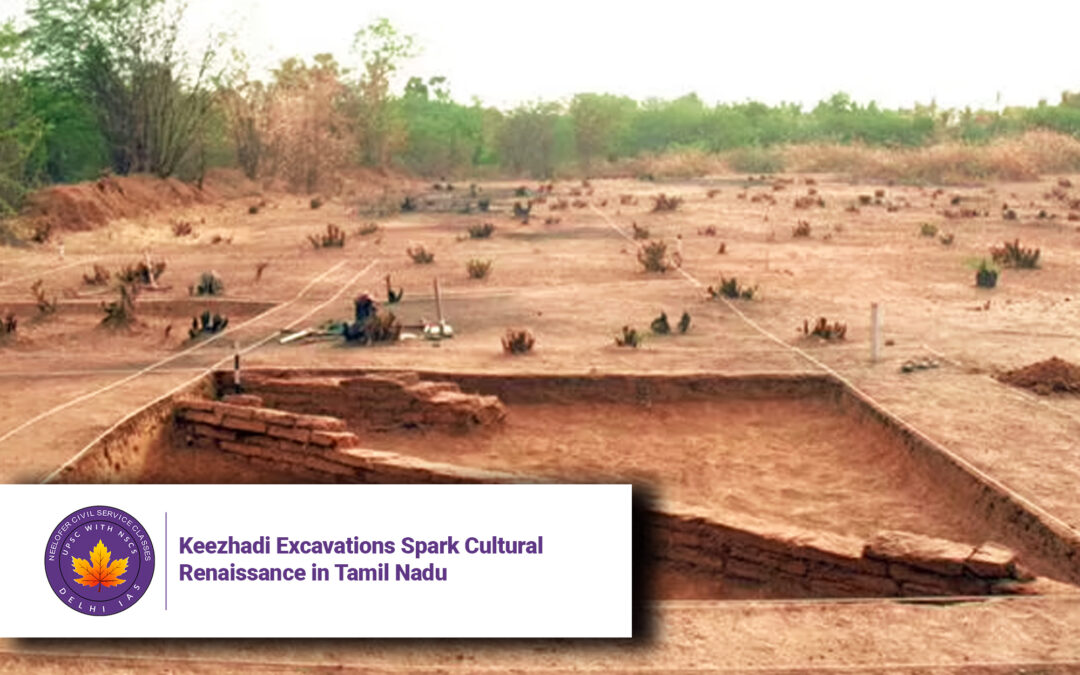
Keezhadi Excavations Spark Cultural Renaissance in Tamil Nadu
Why in News?
The ongoing archaeological excavations at Keezhadi, a village in Tamil Nadu’s Sivaganga district, continue to provide compelling evidence of an advanced urban civilization dating back to the Sangam Age. This discovery not only deepens the historical roots of Tamil culture but also has significant political, cultural, and academic implications. 
Introduction
Keezhadi has become the epicenter of India’s historical and cultural discourse. The excavation findings—from brick structures to artifacts indicating literacy, trade, and urbanization—have bolstered claims of a highly developed Tamil civilization during the early historic period, especially the Sangam era (circa 3rd century BCE to 3rd century CE).
Key Developments
-
Political and Cultural Importance
-
The Tamil Nadu government, led by the DMK, has embraced the Keezhadi findings as a cornerstone of Tamil identity, using them to counter the North Indian-centric historical narratives.
-
Chief Minister M.K. Stalin inaugurated a museum at the excavation site to promote cultural pride and academic study.
-
-
Findings Supporting Urban Civilization
-
Archaeologists discovered remains of an urban settlement, including brick structures, drainage systems, and artifacts like pottery with Tamil-Brahmi script.
-
Reports from the Tamil Nadu State Department of Archaeology and the Archaeological Survey of India (ASI) point to a sophisticated society with literacy, trade, and urban planning.
-
-
Contestation with the Centre
-
The state and central governments have been at odds regarding the acknowledgment and promotion of Keezhadi.
-
The Tamil Nadu government accuses the Centre of ignoring southern archaeological achievements in favor of northern narratives, furthering linguistic and cultural tensions.
-
-
Academic Backing
-
The discovery of materials such as etched potsherds, gaming counters, spindle whorls, and beads supports theories of a literate, urban society.
-
Experts say such finds challenge older beliefs that urban civilization flourished only in northern India.
-
-
National vs. Regional Narratives
-
The excavation has been framed within the broader political narrative of reclaiming Tamil identity and resisting the perceived imposition of Hindi and Aryan cultural supremacy.
-
Challenges and the Way Forward
Challenges:
-
Political tussles between the state and central governments may limit national academic and financial support.
-
Concerns about scientific neutrality and historical objectivity amid politicization.
-
Delay in international recognition of findings.
Way Forward:
-
Collaboration between ASI and Tamil Nadu Archaeology Department to ensure credible dissemination of findings.
-
Inclusion of Keezhadi’s history in national academic curricula.
-
Increased funding for future excavations and museum development.
5 Q&A Section
Q1. What is the Keezhadi excavation site known for?
Keezhadi is known for revealing evidence of an ancient urban civilization in Tamil Nadu that dates back to the Sangam Age, including brick structures, Tamil-Brahmi inscriptions, and urban planning elements.
Q2. Why has Keezhadi become politically significant?
It supports the Dravidian identity narrative promoted by the Tamil Nadu government, countering the dominant Aryan-North Indian-centric view of ancient Indian history.
Q3. What challenges are involved in the recognition of Keezhadi’s findings?
There’s resistance from the central government, delayed national acknowledgment, and tension over historical narratives being shaped by political ideologies.
Q4. How do the findings affect our understanding of Indian history?
They expand the scope of early Indian civilization beyond the traditionally emphasized northern regions and suggest simultaneous urban growth in the south.
Q5. What’s the government’s next step regarding Keezhadi?
The Tamil Nadu government plans to continue excavations, promote the site globally, and push for its inclusion in academic syllabi and heritage circuits.
Conclusion
The Keezhadi excavations have unearthed more than just ancient structures—they have uncovered a cultural identity long overshadowed in mainstream narratives. As Tamil Nadu asserts its place in the subcontinent’s early history, Keezhadi serves as both an archaeological milestone and a symbol of regional pride.

