
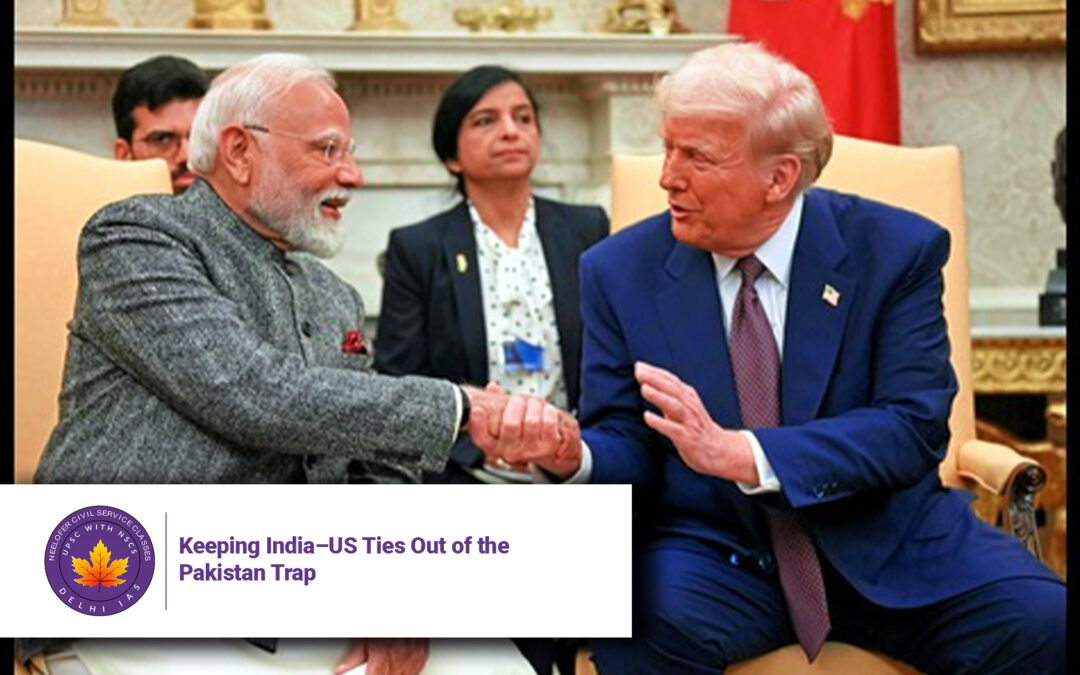
Keeping India–US Ties Out of the Pakistan Trap
Why in News?
The strategic dynamics between India and the United States are evolving amidst renewed discussions about Pakistan’s role and influence in shaping US policy. With the world in flux, and major powers redefining partnerships, it is important for India to engage with the US beyond the narrow prism of Pakistan-related security concerns. 
Introduction
India–US relations have seen considerable progress in recent decades, driven by shared democratic values, economic interests, and strategic goals. However, recurring attempts—especially during crises involving Pakistan—to view India through a regional lens have limited the scope of bilateral cooperation. It is essential now more than ever to reframe the relationship with a long-term global vision.
Key Issues and Background
1. Legacy of the Pakistan Lens
Historically, the US has viewed India–Pakistan relations through a narrow security perspective. This was particularly visible in Donald Trump’s mediation comments on Kashmir and past US administrations’ engagement with Pakistan over counterterrorism concerns.
2. Transformation Under Recent Administrations
Despite these historical patterns, the last two decades have seen a transformation:
-
The US–India nuclear deal in 2008 under President George W. Bush.
-
Strategic partnerships under Barack Obama and Donald Trump.
-
Increased defence trade, technological cooperation, and joint military exercises.
3. Policy Shifts Post Pulwama and Balakot
Following the 2019 Pulwama attack and Balakot airstrikes, India successfully communicated its red lines to the US. In December 2019, under Trump, the US declared India’s position on Kashmir as an internal matter—a shift from earlier positions equating India and Pakistan.
4. Role of Institutional Approaches
Think tanks and institutional voices in Washington often revert to an older playbook during India–Pakistan tensions. This affects broader policy decisions and dilutes the focus on long-term India–US cooperation.
Specific Impacts or Effects
-
Security Cooperation Delays: India–US defence and counterterrorism collaboration gets sidetracked when Pakistan-related crises dominate headlines.
-
Perceptional Imbalance: India is often unfairly equated with Pakistan, despite its democratic credentials and responsible global behaviour.
-
Reduced Trust: India’s strategic community grows cautious when the US re-engages Pakistan for short-term regional needs.
Challenges and the Way Forward
Challenges
-
Recurring influence of Cold War-era and post-9/11 policies.
-
Washington’s desire to balance ties with Pakistan for Afghanistan-related concerns.
-
Misunderstandings in domestic US debates over South Asia.
Steps Forward
-
India must focus on de-hyphenating its US relationship from Pakistan by emphasizing tech, trade, climate, and regional security beyond South Asia.
-
The US must avoid falling back into the ‘subcontinental trap’ and recognize India as a global strategic partner.
-
Promote strategic autonomy: India should continue its policy of non-alignment and issue-based partnerships without aligning fully with US or Chinese camps.
-
Encourage public diplomacy and consistent messaging to educate stakeholders on the evolving nature of India–US relations.
Conclusion
India–US ties should not be defined by what happens in Pakistan. The relationship must be approached with realism, clarity, and a vision that sees India not just as a South Asian power, but as a critical player in shaping the future of a multipolar world. The strategic partnership must be protected from outdated lenses and recalibrated to reflect global responsibilities, not regional insecurities.
5 Questions and Answers
Q1: What is meant by the ‘Pakistan trap’ in India–US relations?
A: It refers to the tendency of US policymakers to view India primarily in relation to Pakistan, especially during regional crises.
Q2: How did India respond to this historically?
A: India has consistently resisted this framework, especially post-Pulwama, by asserting its strategic autonomy and focusing on broader bilateral cooperation.
Q3: What shift happened under Donald Trump’s administration?
A: Trump declared Kashmir an internal matter of India and reduced reliance on Pakistan, signaling a break from earlier practices.
Q4: Why is this lens problematic for India?
A: It reduces India’s global role to a regional conflict and limits the strategic depth of India–US ties.
Q5: What is the proposed way forward?
A: Both countries should focus on a forward-looking partnership emphasizing tech, trade, climate change, and global security, while avoiding regional traps.
