
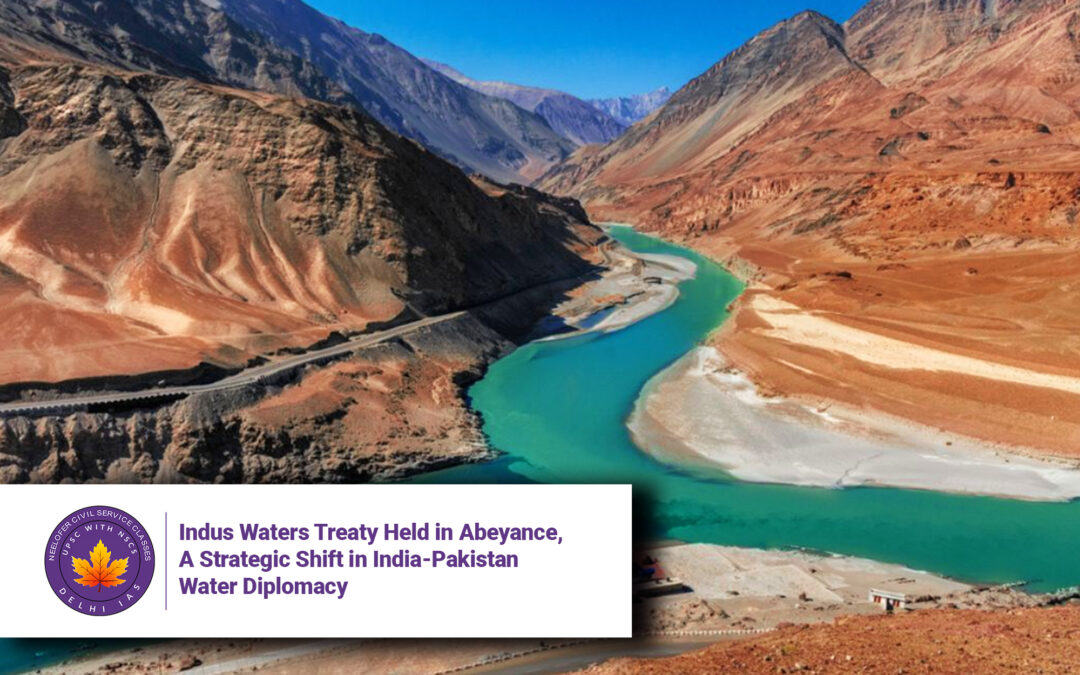
Indus Waters Treaty Held in Abeyance, A Strategic Shift in India-Pakistan Water Diplomacy
Why in News?
On April 24, 2024, India announced that it would place the Indus Waters Treaty (IWT) of 1960 in “abeyance” until Pakistan ceases support for cross-border terrorism, particularly in light of the Pahalgam terror attack on April 22. 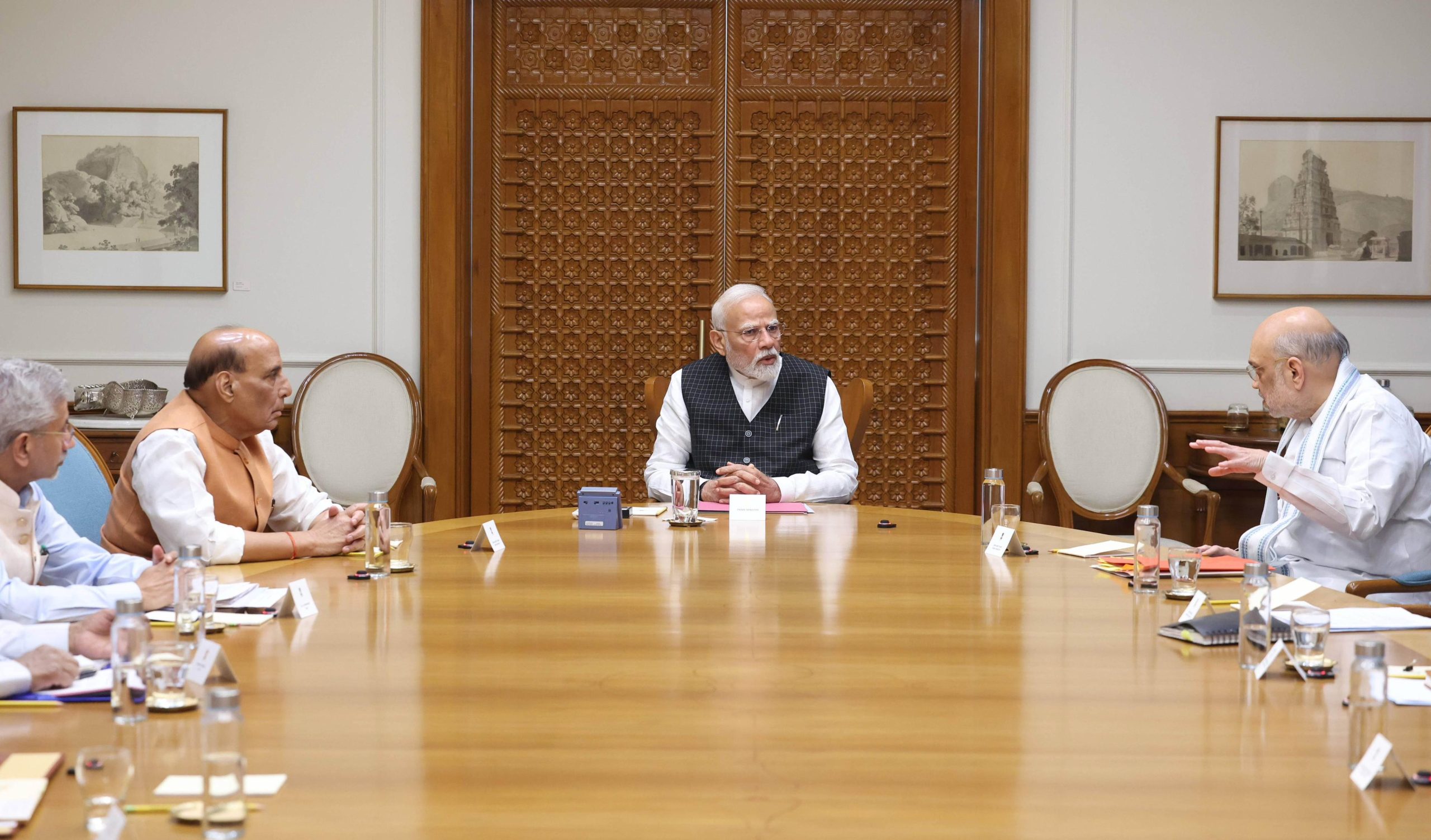
Introduction
The decision to hold the IWT in abeyance signals a major shift in India’s diplomatic posture towards Pakistan. While India has always upheld the treaty despite bilateral tensions, this temporary suspension reflects the growing influence of national security considerations in foreign policy.
Key Issues and Background
1. Meaning and Legal Basis of ‘Abeyance’
“Abeyance” means temporary suspension, not termination. India has not withdrawn from the IWT but has invoked the term to signal a pause. The move draws on principles from the Vienna Convention on the Law of Treaties (VCLT) — though India hasn’t ratified it — particularly Article 62 (suspension due to fundamental change in circumstances) and Article 60 (material breach). These articles are cited to justify the suspension if cross-border terrorism continues.
2. IWT: Structure and Scope
The IWT provides India control over eastern rivers (Ravi, Beas, Sutlej) and Pakistan over the western rivers (Indus, Jhelum, Chenab), with certain rights retained by India. It also includes dispute resolution mechanisms and mandates mutual treaty revision. Any long-term withdrawal or amendment would legally require bilateral consent.
3. Domestic and Strategic Implications
India’s move could be part of a “two-level game.” Domestically, it sends a signal of strong action post-terror attack. Internationally, it asserts India’s position that Pakistan must stop supporting terrorism. The Cabinet Committee on Security may have made this decision under time pressure, impacting details around water-sharing decisions.
4. Leveraging Water as a Strategic Tool
India may consider maximizing its use of western river water and delaying clearance of Pakistan-oriented projects. This could potentially deprive Pakistan of some water flow, at least temporarily, to signal a cost for its hostile actions. However, experts warn that such actions may have limited long-term benefit and could breach constitutional principles and environmental norms.
5. Risks and Future Directions
The move invites legal, diplomatic, and ecological risks. Water treaties, especially bilateral ones like IWT, are cornerstones of transboundary peace. Unilateral decisions may set undesirable precedents. India must now balance short-term retaliation with long-term strategy, ensuring it does not weaken its global image of rule-based diplomacy.
The Core of the Concern
India’s invocation of “abeyance” reflects deep frustration with Pakistan’s support for terror but raises legal and ethical questions about treaty obligations. It also tests the limits of water diplomacy in the age of asymmetric warfare.
Key Observations
-
The IWT has survived three wars and multiple crises since 1960.
-
India’s decision marks a rare deviation from a historically respected agreement.
-
Legal experts question the enforceability of abeyance under the IWT framework.
-
Water has now become both a diplomatic and strategic lever.
-
The move may affect India’s credibility as a responsible regional power.
Conclusion
The abeyance of the IWT reflects India’s evolving diplomatic toolkit, where water is no longer just a resource but a means of messaging. While the move may offer short-term strategic leverage, it carries risks to international norms and constitutional governance. A careful recalibration will be needed to uphold India’s long-term credibility while addressing immediate security concerns.
5 Questions and Answers
Q1. What is the Indus Waters Treaty (IWT) and when was it signed?
Answer: The IWT is a water-sharing agreement between India and Pakistan, signed in 1960, allocating control over six rivers from the Indus basin.
Q2. Why has India placed the IWT in abeyance?
Answer: India cited Pakistan’s continued support for cross-border terrorism, especially after the April 22 Pahalgam attack, as the reason for the temporary suspension.
Q3. What does ‘abeyance’ mean in the context of this treaty?
Answer: ‘Abeyance’ refers to a temporary suspension without formal termination, allowing for possible reinstatement if conditions improve.
Q4. What legal frameworks support or challenge this move?
Answer: The Vienna Convention on the Law of Treaties (VCLT), particularly Articles 60 and 62, is cited to justify abeyance; however, interpretations are contested and India hasn’t ratified the VCLT.
Q5. What are the risks and implications of this move?
Answer: It risks diplomatic tensions, undermines treaty stability, and could impact India’s global image while testing the limits of using water as a strategic weapon.

