
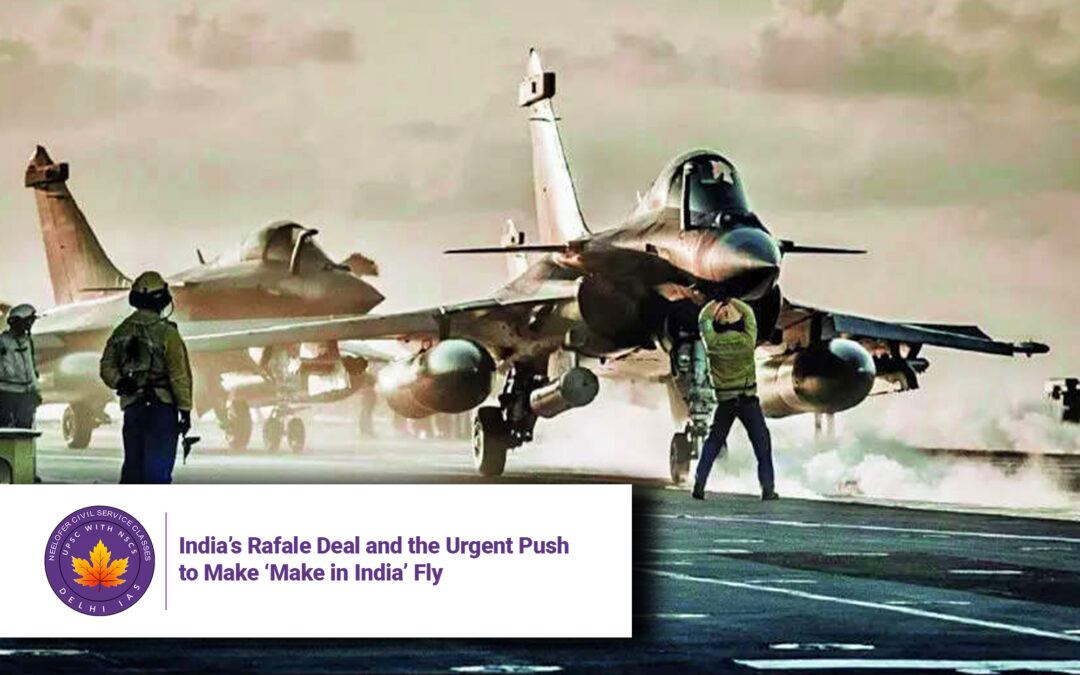
India’s Rafale Deal and the Urgent Push to Make ‘Make in India’ Fly
Why in News?
The Indian government recently approved the ₹83,000 crore purchase of 26 Rafale M fighter jets from France. The deal includes manufacturing components and subsystems in India by Dassault and Thales through local partnerships—signaling a new effort to strengthen the Make in India initiative in the defense sector. 
Introduction
With rising emphasis on defense indigenization, the Rafale deal comes amid discussions around the C-295 aircraft project and the government’s broader aim to build advanced fighter jets, missiles, and defense equipment in India under the ‘Buy and Make’ and ‘Buy (Global-Manufacture in India)’ categories. The article highlights critical policy gaps and reforms needed to boost true localization in India’s defense manufacturing.
Key Issues and Background
1. The Rafale and C-295 Deals
-
India approved the purchase of 26 Rafale M jets with partial local manufacturing by French firms.
-
Earlier, the C-295 military aircraft deal with Airbus aimed to be a model for localized production but has since been removed from Defence Acquisition Procedure (DAP) 2020.
2. Policy Shift in Procurement Categories
-
Old categories like ‘Buy and Make’ were replaced by ‘Buy (Global-Manufacture in India)’, aimed at allowing foreign OEMs to build in India.
-
However, MoD’s (Ministry of Defence’s) press releases show a narrow scope, mostly related to indigenizing imported systems, not full tech transfers.
The Core of the Concern
1. Tech Transfer Gaps
-
In many deals, like the C-295, the foreign OEM (Airbus) retains control over designs and rights.
-
Often, Indian participation is limited to assembly, not actual R&D or manufacturing capability.
2. Limited Success with Make-I Projects
-
India has struggled with the Make-I category—projects where MoD funds 90% of the prototype.
-
Only 2 of 46 projects under this have made progress.
Key Observations
-
India wants to build systems like the MRFA (Multi-Role Fighter Aircraft) and Medium Transport Aircraft (MTA) but lacks self-reliant manufacturing strength.
-
FDI in defense is allowed up to 74% in JVs and 100% in select cases with approval, but FDI cap at 49% for ‘Buy Global-Manufacture in India’ limits control and enthusiasm from foreign players.
-
The Make-II category (industry-funded prototypes) has seen better traction, especially in MSMEs and startups.
Conclusion
While India is steadily expanding its defense capability through big-ticket deals like Rafale and C-295, true self-reliance will require policy corrections, better clarity on tech transfer, and more effective execution of Make-I/Make-II projects. Only then can “Make in India” truly fly in the defense manufacturing sector.
Q&A Section
Q1. What was recently approved by the Indian government related to defense?
India approved a ₹83,000 crore deal to buy 26 Rafale M fighter jets from France, with a component of local manufacturing.
Q2. What is the issue with the C-295 aircraft program now?
The C-295 deal, once hailed as a Make in India model, has been excluded from the new procurement category under DAP 2020.
Q3. What are the ‘Buy (Global-Manufacture in India)’ and ‘Buy and Make’ categories?
These are procurement models where foreign OEMs can manufacture or co-develop products with Indian firms; however, execution often lacks tech transfer depth.
Q4. Why has ‘Make-I’ not been successful so far?
Out of 46 Make-I projects, only 2 have made significant progress, mainly due to unclear processes and limited funding utilization.
Q5. What reforms are needed to boost defense indigenization?
Clear policy reforms, easing FDI caps, real tech transfer, and successful execution of Make-I and Make-II programs are critical.
