
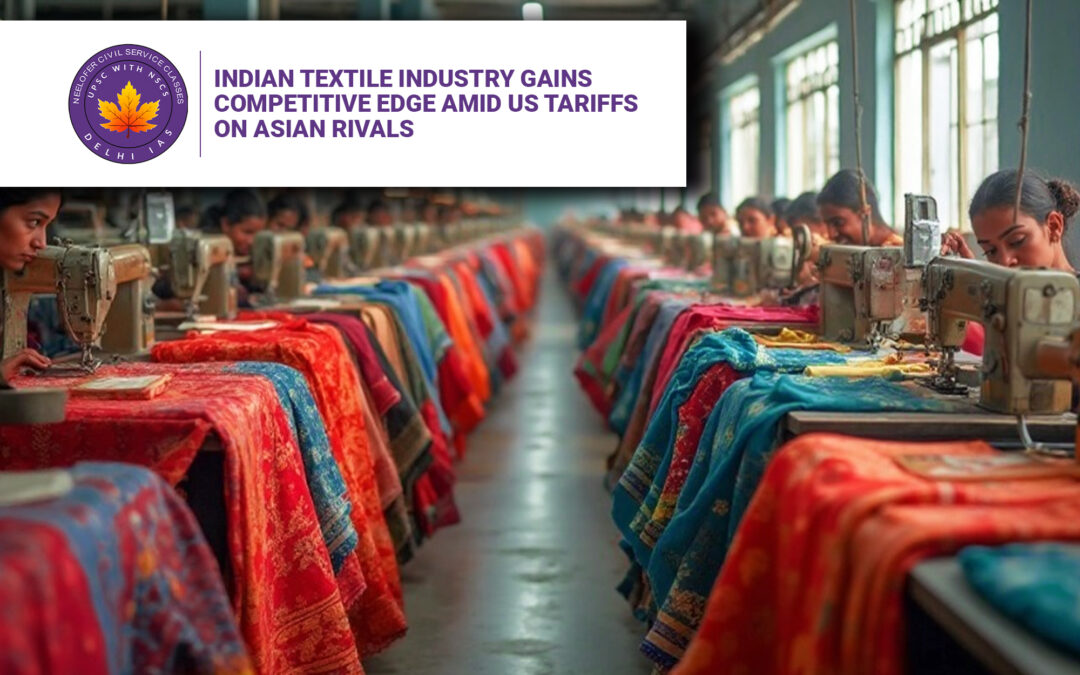
Indian Textile Industry Gains Competitive Edge Amid US Tariffs on Asian Rivals
Why in News?
The Trump administration’s recent tariff hike on textile and apparel imports into the United States has created new opportunities for Indian exporters. India now faces a relatively lower tariff compared to key Asian competitors, potentially offering a competitive edge. 
Introduction
As the United States increases tariffs on textiles and garments from major Asian exporters, India stands to benefit due to a lower tariff rate. This policy shift may pave the way for increased Indian textile exports, strengthening the country’s global market position.
Key Features
-
Comparative Tariff Rates:
-
China: 54%
-
Vietnam: 46%
-
Bangladesh: 37%
-
Sri Lanka: 44%
-
Thailand: 36%
-
Cambodia: 49%
-
Pakistan: 29%
-
India: 27%
-
-
US Textile Imports:
-
Between April 2024 and February 2025, India exported $10 billion worth of textiles to the US, a significant share of the total $33 billion.
-
-
Cost Disadvantage for US Firms:
Making Americans manufacture low-paid textiles or garments will raise production costs by 20%. -
Strategic Opportunity:
India could leverage zero-duty cotton imports to the US in exchange for export benefits in garments and home textiles.
Specific Impacts or Effects
-
Market Expansion:
India is now better positioned to expand its market share in the US thanks to its lower tariff rate. -
Trade Negotiation Leverage:
The Indian government may use the opportunity to negotiate a Bilateral Trade Agreement (BTA) while maintaining the current tariff level of 10%. -
Labour-Intensive Sector Benefits:
Garments, home textiles, and leather—key labour-intensive sectors—may see export growth. -
Retail Market Volatility:
Consumer behavior in the US, especially at the retail level, will play a key role in shaping demand.
Challenges and the Way Forward
Challenges
-
Short-term buying slowdown expected if tariffs remain for an extended period.
-
Consumer sentiment and demand fluctuations in the US could impact exports.
Steps Forward
-
Expedite BTA negotiations with the US.
-
Offer duty-free cotton imports in return for market access.
-
Monitor US consumer behavior to predict export demand.
Conclusion
India’s textile sector stands at a strategic advantage due to the US tariff hikes on other Asian nations. With thoughtful policy responses, trade negotiations, and leveraging this competitive edge, India could significantly grow its textile exports and create new employment opportunities in labour-intensive industries.
Q&A Section
Q1. Why is India expected to benefit from US tariffs on textiles?
Because India faces a lower tariff (27%) compared to higher tariffs on other Asian countries like China (54%) and Vietnam (46%).
Q2. How much did India export to the US from April 2024 to February 2025?
India exported nearly $10 billion worth of textiles to the US.
Q3. What strategic trade move could help India further?
India may offer zero-duty cotton imports in return for sector-specific export benefits under a potential Bilateral Trade Agreement (BTA).
Q4. What sectors stand to gain the most from this shift?
Labour-intensive sectors like garments, home textiles, and leather.
Q5. What short-term challenges does India face in this context?
A potential slowdown in retail buying in the US if tariffs remain and rising uncertainty around US consumer sentiment.
