
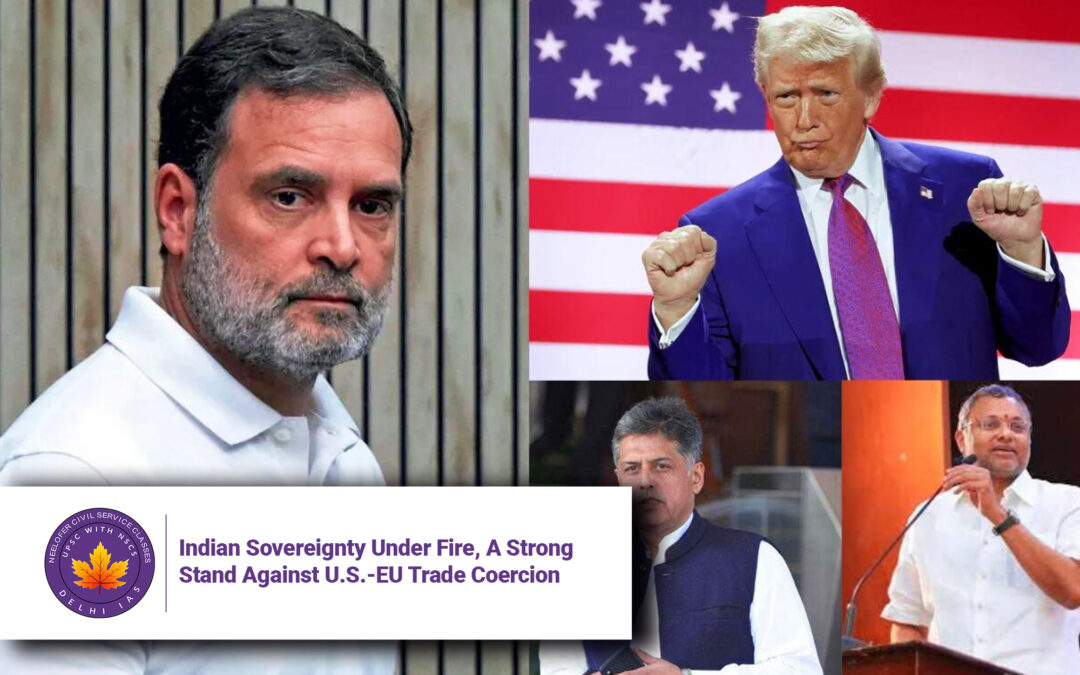
Indian Sovereignty Under Fire, A Strong Stand Against U.S.-EU Trade Coercion
Why in News?
India’s Ministry of External Affairs (MEA) has issued a rare and strong statement opposing what it described as targeted and coercive trade actions by the United States and the European Union. This comes in the wake of the U.S. imposing heavy penalties on India’s import of Russian oil and the EU announcing sanctions on India’s Vadinar refinery. The timing of these moves — amid heightened tensions surrounding the Ukraine conflict — has reignited a larger debate about India’s economic sovereignty and freedom to determine its trade partnerships.
The MEA’s statement marks a significant departure from New Delhi’s traditional diplomatic forbearance and signals India’s growing frustration with the West’s selective moralism and double standards in international trade and energy relations.
Introduction
In a multipolar and increasingly confrontational world, India is being asked to choose sides. Whether it’s the Russia-Ukraine war, trade policy with China, or oil deals with Iran or Russia — global powers have often attempted to manipulate or influence India’s choices. However, as a sovereign nation and rising global power, India has drawn a clear red line: “India alone will decide its trade partners.”
The statement released by the MEA on Monday, following aggressive U.S. and EU sanctions targeting India’s purchase of Russian oil, is both timely and bold. It conveys India’s intent to safeguard its national interests and asserts that foreign pressure — even from close partners — will not dictate its sovereign economic decisions.
Background: The Triggering Events
The U.S. recently announced penalty tariffs against India, significantly above the existing 25% rate, targeting India’s import, processing, and resale of Russian oil. These sanctions came just a day after a senior Trump aide accused India of “financing” Russia’s war in Ukraine.
Not to be outdone, the European Union added fuel to the fire by announcing sanctions on India’s Vadinar refinery — a facility partially owned by Russia — and added secondary sanctions that would impact other Indian refiners as well.
The MEA’s firm rebuttal followed closely after these moves, describing the actions as:
-
“Unjustified and unreasonable.”
-
Hypocritical, given that both the U.S. and EU themselves continue extensive trade with Russia — particularly in sectors like LNG, nuclear fuel, and critical minerals.
The MEA’s Message: Sovereignty is Non-Negotiable
The government’s response carried several powerful messages:
-
India’s Russian oil purchases are a “vital national compulsion” due to the global energy crisis triggered by the Ukraine war.
-
The U.S. itself had encouraged India to buy Russian oil earlier to stabilize global markets.
-
India will “safeguard its national interests and economic security,” regardless of Western pressure.
This is the first time since the beginning of the Ukraine conflict that India has issued such a direct and public criticism of Western coercive diplomacy.
The Bigger Picture: U.S. Hostility Beyond Oil
India’s relations with the United States have grown more complicated in recent months. Trade tensions have only been one part of the equation. The U.S. has also:
-
Opposed India’s stance on immigration and visas.
-
Objected to India’s BRICS membership expansion efforts.
-
Raised objections over Operation Sindoor (India’s anti-terror offensive).
-
Maintained a soft approach to Pakistan, even as India faces cross-border terrorism.
-
Delayed trade talks and mini-deals over agriculture and dairy-related protections, which are vital for Indian farmers.
President Trump’s remark that India has not been a “good trading partner” further escalated tensions. His comment suggests possible failure in trade negotiations and indicates an attempt to publicly isolate India for not toeing the U.S. line on key issues.
The EU’s Selective Sanctions: Economic Arm-Twisting
The European Union, meanwhile, announced fresh sanctions against India’s Vadinar refinery, despite the fact that the refinery is not fully Russian-owned and services India’s critical energy needs. This reflects the EU’s increasing use of sanctions as a tool of diplomacy, often in contradiction to its own continued imports of Russian gas and other commodities.
India’s message is clear: You cannot claim moral high ground while indulging in economic hypocrisy. Both Washington and Brussels are being called out for their double standards — punishing India for what they themselves continue doing behind closed doors.
Reclaiming Strategic Autonomy in Global Politics
India’s sharp tone, seen through both the MEA statement and Union Commerce Minister Piyush Goyal’s comments, signals a broader realignment in how India views its engagement with global powers.
For years, India has quietly absorbed pressure from the West in the hope of deeper economic integration and global goodwill. But repeated provocations — particularly on strategic matters like oil, defense trade, and technology transfer — have created a consensus within India’s foreign policy establishment that strategic autonomy must be asserted more clearly and publicly.
Visits by National Security Adviser Ajit Doval and External Affairs Minister Dr. S. Jaishankar to Moscow indicate this recalibration. The upcoming visit of the Russian President to India is also being framed as a counter-narrative to growing Western bullying.
Why India Buys Russian Oil: The Reality
India’s dependence on Russian oil is not ideological — it is economic and strategic. Russia offered Indian refiners steep discounts at a time when global oil prices soared due to the war in Ukraine. With inflation a major concern and energy security a national priority, India had no choice but to diversify suppliers.
The government rightly pointed out that India’s oil purchases are tied to:
-
Vital national interest
-
Economic stability
-
Price-sensitive domestic markets
-
Global supply chain disruptions
Moreover, India’s purchases are still small in proportion compared to Europe’s LNG and gas imports from Russia.
Navigating the Multipolar Reality
India’s stand is not about aligning with Russia or confronting the West. It is about protecting its right to chart an independent course in global affairs.
This new assertiveness comes amid several global developments:
-
U.S.-China trade war escalation
-
EU’s carbon border tax threatening Indian exports
-
Chinese expansion in South Asia
-
Fragmentation in the multilateral trading system (WTO, UN)
India has decided that it will not be a pawn in these geopolitical games.
The Road Ahead: Assertive, Not Aggressive
While India will continue to negotiate trade pacts with both the U.S. and EU, it has made it clear that coercion will not work. This is in line with India’s traditional non-alignment-plus strategy — engaging all but being dictated by none.
With increasing alignment in Global South forums, strengthening ties with Russia, Africa, and ASEAN, and greater interest in currency diversification (like using rupee-rouble for trade), India is building the foundations of an independent trade ecosystem.
Conclusion
India’s bold stand against U.S. and EU pressure reflects a new phase in its foreign policy: one rooted in sovereignty, realism, and strategic clarity.
Gone are the days when India would remain silent in the face of unjust pressure. As the global order becomes more fragmented and interest-driven, India must defend its space as a sovereign power capable of making autonomous decisions.
The MEA’s statement is not just a response to oil tariffs — it is a declaration of intent. India will engage, cooperate, and negotiate — but on its own terms. No power, no matter how large, can dictate who India trades with.
Questions and Answers Section
Q1. Why did the Ministry of External Affairs issue a strong statement against the U.S. and EU?
A1. The MEA pushed back after the U.S. imposed high tariffs on India’s Russian oil imports and the EU sanctioned India’s Vadinar refinery. The statement called these actions unjustified and hypocritical, given the West’s own continued trade with Russia.
Q2. What did India highlight as the reason behind buying oil from Russia?
A2. India cited “vital national compulsion” due to the Ukraine war’s impact on global oil supply and price. Russian oil was offered at discounted rates, helping India maintain price stability and energy security.
Q3. What other areas of disagreement exist between India and the U.S.?
A3. Apart from oil, tensions exist over immigration, Operation Sindoor, trade talks on agriculture and dairy, BRICS expansion, and Washington’s passive stance on Pakistan’s terror links.
Q4. What message is India trying to send through this statement?
A4. India is asserting that its foreign policy and trade decisions are sovereign matters. Neither the U.S. nor the EU can dictate India’s partners. India will protect its economic and national interests without external pressure.
Q5. What could be the implications of India’s new assertive posture?
A5. India may deepen ties with non-Western powers like Russia, increase trade with the Global South, and advocate for reforms in global institutions. However, it could also face delayed trade deals with the West and increased diplomatic friction.

