
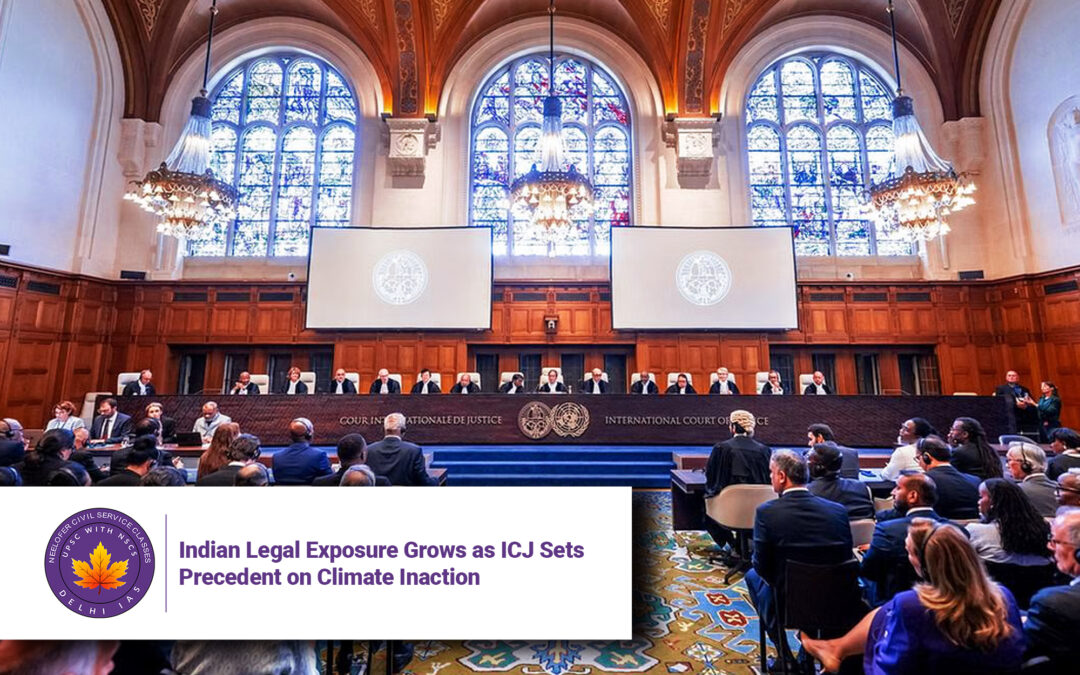
Indian Legal Exposure Grows as ICJ Sets Precedent on Climate Inaction
A Landmark Advisory Opinion Sparks Global Repercussions and a Call for Strategic Rethink
On 23 July, the International Court of Justice (ICJ) issued a groundbreaking advisory opinion on climate action that could reshape global climate governance and legal accountability. The opinion, which outlines states’ responsibilities in addressing climate change, does not carry binding enforcement power but sets a potent legal and ethical precedent that is already putting pressure on national governments—including India—to urgently reassess their climate policies.
What the ICJ Opinion States
The ICJ advisory opinion asks all states to undertake two major obligations:
-
Prevent Significant Environmental Harm: States must meet a due diligence standard, which includes enacting and enforcing legal, regulatory, and administrative frameworks to ensure sustained emission reductions.
-
International Cooperation: States are required to collaborate in good faith with others through information-sharing, joint climate mitigation efforts, and technology transfer. These obligations fall under customary international law, applying universally, whether or not a country has ratified specific climate treaties.
This ruling reinforces the goals of the 2015 Paris Agreement and underscores the responsibilities of all nations, irrespective of their developmental status.
India Under the Spotlight
India, while being a signatory to the Paris Agreement, may face heightened scrutiny. The ICJ ruling recognizes the principle of Common But Differentiated Responsibilities (CBDR) but questions the outdated binary classification of “developed” vs. “developing” countries. As India aspires to achieve developed-nation status by mid-century, its obligations under international climate law are poised to become more stringent.
While India has made commendable progress in expanding renewable energy capacity, the overall trajectory toward net-zero emissions remains concerning. According to recent assessments by independent NGOs such as Climate Analytics, India’s climate commitments under its Nationally Determined Contributions (NDCs) are highly insufficient. The nation is on track for a warming scenario of 3°C—far exceeding the 1.5°C or 2°C goals set under the Paris framework.
India’s alignment with its own 2070 net-zero goal is also considered poor. These shortfalls could expose the country to legal challenges, particularly if international climate negotiations tighten accountability mechanisms based on the ICJ ruling.
Legal Risks from Domestic and International Fronts
As climate impacts become more visible and devastating—such as extreme weather events and rising temperatures—citizens, civil societies, and local governments are beginning to turn to the courts for recourse. One such development is the Supreme Court of India’s recent observation in a Himachal Pradesh case, which cautioned that unchecked infrastructure development, particularly in the fragile Himalayan ecosystem, could make the entire state “vanish.”
The Court emphasized that environmental conservation cannot be sacrificed for economic revenue, supporting a broader “de-growth” movement that advocates for environmentally conscious development models.
In parallel, India’s continued reliance on fossil fuels, especially coal and oil, raises serious legal vulnerability. The lock-in effects of heavy investments in fossil fuel-based infrastructure could create “stranded assets” that threaten India’s economic stability and environmental standing.
The Corporate Accountability Angle
The ICJ ruling also places the onus on states to regulate private sector activity. Companies involved in fossil fuel production, imports, and related infrastructure are now under increased scrutiny. Internationally, the number of climate-related lawsuits has nearly tripled since the Paris Agreement was signed in 2015.
As of September 2024, among the 86 major climate lawsuits filed against the world’s largest fossil fuel firms:
-
38% demanded compensation for damages due to extreme weather events.
-
16% targeted companies for greenwashing and misleading advertising.
-
12% focused on the failure to adopt or implement emission reduction plans.
These trends suggest an expanding legal frontier where both governments and corporations could be held liable for failing to meet their climate responsibilities.
Implications for India’s Policy Strategy
India faces multiple legal and strategic risks:
-
It may no longer be able to rely on its developing country status to soften climate obligations.
-
The threat of stranded assets and economic loss from fossil fuel lock-ins is rising.
-
Public and judicial pressure on governments and businesses is intensifying.
-
International expectations are evolving quickly, and India must keep pace.
The ICJ’s opinion serves as a wake-up call for India to urgently review—and possibly redefine—its climate strategy. Legal tools are becoming central to climate governance, and failure to adapt could lead to significant legal, financial, and geopolitical repercussions.
India’s legal defense will need to rely not just on future pledges but demonstrable, immediate, and effective action. This means:
-
Updating its NDCs to reflect higher ambition.
-
Creating binding domestic laws aligned with international norms.
-
Transitioning decisively toward renewable energy and away from fossil fuel dependence.
In this new era, climate policy cannot be separated from legal risk management.
Q&A Section
1. What is the significance of the ICJ’s advisory opinion on climate action?
The ICJ opinion, although not enforceable, sets a powerful legal precedent by outlining states’ duties under customary international law. It mandates that all nations prevent environmental harm and engage in international cooperation, regardless of treaty signatory status. This marks a major evolution in international climate law.
2. How could this affect India’s climate policy?
India may be subjected to stricter legal scrutiny. The ICJ ruling undermines the traditional “developing country” defense and could hold India to higher standards as it transitions toward a developed nation status. India’s current NDCs and continued fossil fuel dependency could be challenged in legal forums.
3. What are the domestic legal risks for India?
Domestically, Indian courts are already taking note. The Supreme Court’s warning on reckless development in Himachal Pradesh highlights increasing judicial activism. As citizens face worsening climate impacts, lawsuits against both government policies and corporate practices are likely to rise.
4. Why is the private sector also under pressure?
The ICJ ruling emphasizes the need for state regulation of corporate climate conduct. This aligns with global trends, where fossil fuel companies are being sued for damages, greenwashing, and failure to reduce emissions. Inaction by Indian regulators could lead to domestic and international legal liabilities.
5. What steps should India take to safeguard itself?
India must urgently:
-
Revise its NDCs to align with global temperature targets.
-
Regulate fossil fuel industries more rigorously.
-
Implement legal frameworks that enforce climate goals.
-
Collaborate with international bodies to ensure compliance.
-
Transition faster to renewable energy sources to mitigate legal and financial risks.

