
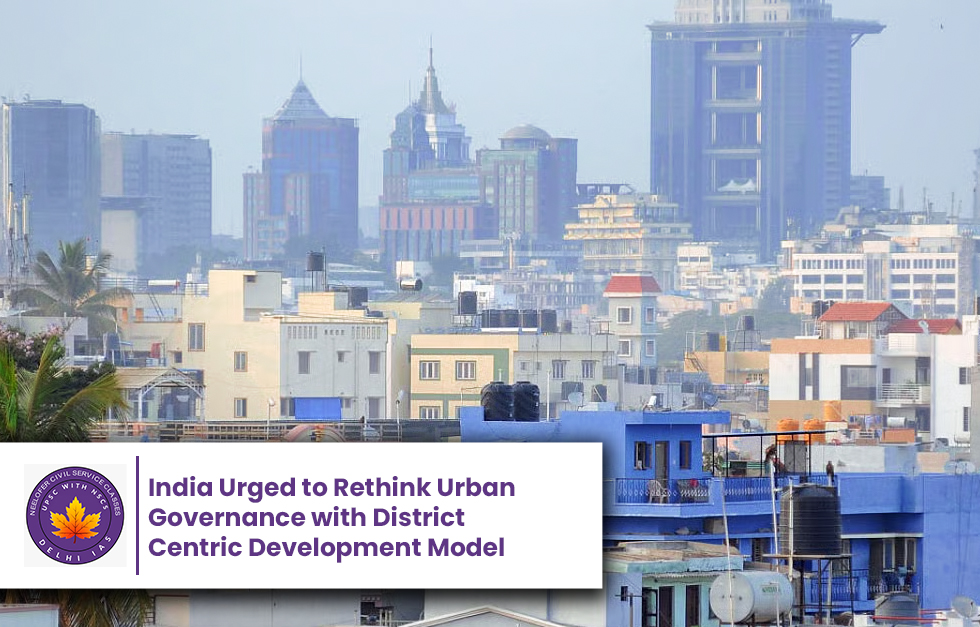
India Urged to Rethink Urban Governance with District-Centric Development Model
Why in News?
With urbanisation accelerating in India and the Global South, policy experts are calling for a fundamental shift in how urban governance is structured. A recent model from Kerala offers an alternative approach—merging urban and rural planning through integrated district-level development. This shift challenges the outdated, city-centric governance model and promotes a more functional, inclusive system that reflects how people actually live and how economies operate. 
Introduction
Traditional urban governance in India has treated cities as self-contained entities. This framework is increasingly outdated as cities grow, overlap with rural areas, and become complex, interconnected systems. The time has come to move from a “sunny-side up” model of governance to one that uses the district as the core functional unit—spanning both urban and rural needs.
Key Issues and Background
1. The “Sunny-Side Up” Fallacy in Urban Planning
The “sunny-side up” metaphor, where the city is seen as the bright, yolk center and the rural areas as a disconnected periphery, fails to reflect reality.
Urban governance today still focuses almost entirely on municipal corporations, ignoring the significant role of rural areas and peri-urban zones in the daily functioning of cities. This leads to:
-
Fragmented service delivery
-
Poor infrastructure integration
-
Rising inequality
2. Not a Coherent Urban Unit Anymore
Indian cities do not grow in neat, administrative units. Expansion leads to:
-
Overlapping jurisdictions
-
Hybrid and non-uniform urban areas
-
Technically urban but functionally rural zones
The current system cannot cope with these complexities because constitutional divisions (like Urban Local Bodies vs. Panchayati Raj Institutions) do not reflect the on-ground realities anymore.
3. District as a Functional Unit
Districts represent a more realistic unit for planning, as they span both urban and rural areas and encompass how services like transport, education, and healthcare are actually delivered.
They also reflect:
-
Administrative responsibilities (police, courts, education)
-
Shared economic and social systems
-
Governance systems that cross urban-rural boundaries
4. Kerala’s Integrated Model
Kerala has restructured its Local Self-Government Department (LSGD), unifying urban and rural planning under a Principal Directorate. Key highlights:
-
Separate wings for Urban and Rural LSGDs under a single department
-
Better alignment of planning across the Panchayat Directorate and Urban Development Directorate
-
Empowerment of District Planning Committees (DPCs) to streamline planning
This model offers greater administrative efficiency and equity in service delivery.
5. Legal and Constitutional Mandates
The Indian Constitution already supports integrated planning via Article 243ZD, which mandates:
-
Creation of District Planning Committees (DPCs)
-
Preparation of draft district development plans consolidating both urban and rural perspectives
However, most states have not implemented these reforms effectively, and DPCs function largely in an advisory role.
Specific Impacts or Effects
-
Disconnected governance causes inefficiencies in transport, housing, water, and waste systems.
-
Rapid urban sprawl increases the complexity of delivering services.
-
Local governments face coordination issues between municipalities and panchayats.
-
Infrastructure investments are poorly targeted without integrated planning.
Challenges and the Way Forward
Challenges
-
Institutional resistance to structural reforms
-
Lack of clarity in rural-urban jurisdiction boundaries
-
Weak or non-functional DPCs in many states
-
State-level reluctance to devolve planning authority
Steps Forward
-
Legally empower District Planning Committees (DPCs) and give them operational authority
-
Move away from municipal corporation-centric planning
-
Align urban and rural governance under a unified department, as Kerala has done
-
Redraw planning boundaries based on population, land-use, and economic linkages
-
Integrate service delivery systems across jurisdictions for efficiency
Conclusion
India needs a new governance model that reflects today’s realities—where urban and rural are no longer binary but interconnected. The district-level model provides a more effective framework for planning, service delivery, and development, aligning with people’s lived experiences. Kerala’s approach offers a promising roadmap, and states across India must consider similar transitions to ensure sustainable and inclusive growth.
5 Questions and Answers
Q1: Why is the traditional model of urban governance being questioned?
A: Because it treats cities as self-contained entities, which no longer reflects the interconnected and hybrid nature of urban-rural regions.
Q2: What is the “sunny-side up” fallacy in governance?
A: It refers to focusing development only on formal city cores while neglecting surrounding rural and peri-urban areas.
Q3: How does Kerala’s model differ from conventional urban governance?
A: It unifies rural and urban governance under a single department and empowers district-level planning through DPCs.
Q4: What constitutional provision supports district-level planning?
A: Article 243ZD, which mandates the formation of District Planning Committees to integrate urban and rural development.
Q5: What is the role of DPCs?
A: DPCs are intended to consolidate plans from panchayats and municipalities into a single district development plan, but they currently function mostly in an advisory capacity.

