
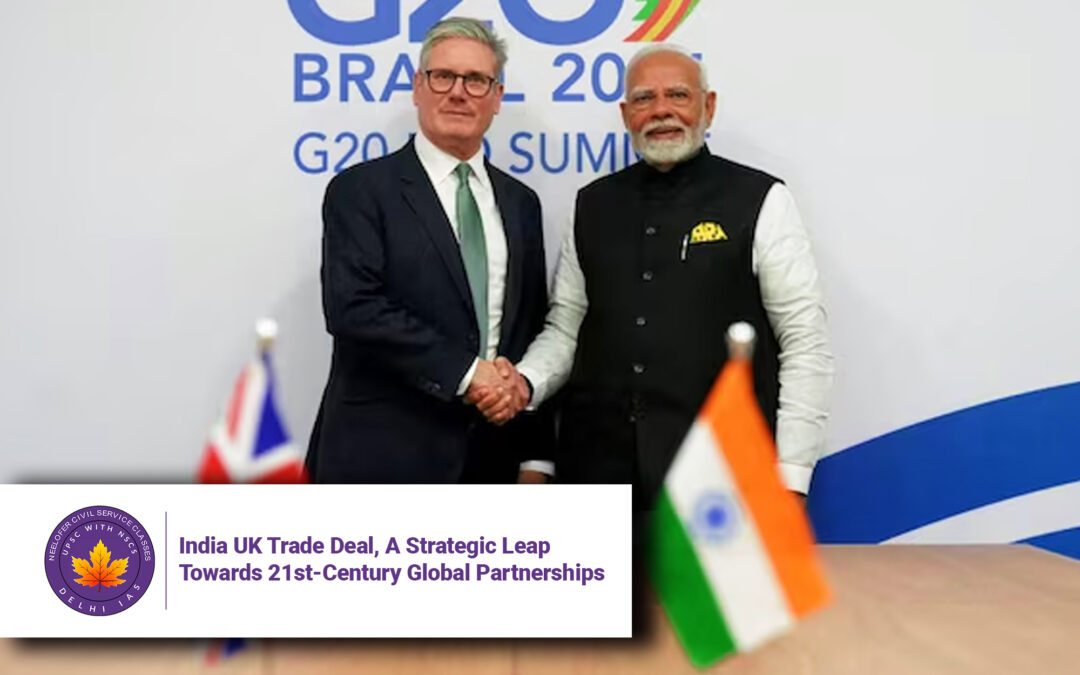
India UK Trade Deal, A Strategic Leap Towards 21st-Century Global Partnerships
Why in News?
India’s recent signing of the India-UK Comprehensive Economic and Trade Agreement (CETA) has positioned the country among global leaders adopting modern trade frameworks. As global trade shifts from tariff-centric models to broader structural partnerships, this FTA is a landmark agreement redefining India’s trade trajectory in the 21st century.
Introduction
In an era dominated by protectionism and tariff wars—especially during the Trump administration—India’s pivot towards structural trade engagement through the India-UK CETA signals a bold and timely transformation. The deal emphasizes non-tariff issues like services, digital trade, sustainability, and investment—traits of new-age trade agreements akin to the Comprehensive and Progressive Trans-Pacific Partnership (CPTPP).
Key Highlights of the India-UK CETA
1. A Modern Trade Blueprint
The India-UK CETA reflects what future global trade should embody—flexible rules, digital economy integration, and deep market access. It reflects a shift from traditional metrics like tariffs and MFN (Most Favored Nation) rates to more value-driven, strategic trade priorities.
2. India’s Growing Role in Global Trade
The agreement aligns India with developed nations like the UK that are adapting to modern trade norms. It gives India enhanced credibility as a future partner in progressive economic platforms such as the CPTPP.
3. Strategic Market Access Wins 
India gains access to markets traditionally closed to foreign players:
-
Lowered automobile tariffs (down to 10% gradually).
-
Entry into professional services such as auditing, accounting, and legal.
-
Market access for key sectors: textiles, leather, footwear, organic chemicals, machinery, food, and medical devices.
-
Improved access for Indian IT and service professionals in the UK.
4. Mutual Commitments and Structural Changes
-
The UK offered reciprocity in services, allowing Indian firms fair competition.
-
Both sides agreed to digital trade rules, environmental standards, and sustainability goals.
-
UK shared social security contributions benefits for temporary Indian workers.
5. Potential Future Link to the CPTPP
Given the similarities with CPTPP standards and commitments, India’s participation in the India-UK CETA sets a clear pathway toward possible future entry into global mega trade pacts like CPTPP—comprising countries such as Australia, Japan, Canada, and the UK.
Conclusion
The India-UK CETA is not just a trade deal—it is India’s graduation into the league of progressive global economies. As tariffs lose prominence, 21st-century FTAs prioritize sustainability, digital integration, and structural equity. India’s proactive role in such pacts may pave the way for joining global economic leadership frameworks like the CPTPP.
Q&A Section
Q1. What is the India-UK CETA and why is it important?
A1. The India-UK Comprehensive Economic and Trade Agreement is a modern FTA focusing on market access, services, and structural trade changes. It aligns India with developed countries and promotes 21st-century trade principles.
Q2. How is this FTA different from older trade agreements?
A2. Unlike older deals focused mainly on tariffs, this agreement prioritizes digital trade, environment, services, professional access, and non-tariff structural reforms.
Q3. What sectors will benefit most from the India-UK CETA?
A3. Key sectors include IT services, automobiles, textiles, food processing, footwear, electronics, medical devices, and professional services.
Q4. How does this FTA connect India to other global trade platforms?
A4. The India-UK CETA aligns with the CPTPP standards, increasing the likelihood of India joining such trade blocs in the future.
Q5. What major structural commitments has the UK made in this deal?
A5. The UK has offered reduced auto tariffs, professional service access, social security parity for Indian workers, and opened its domestic service markets for Indian businesses.

