
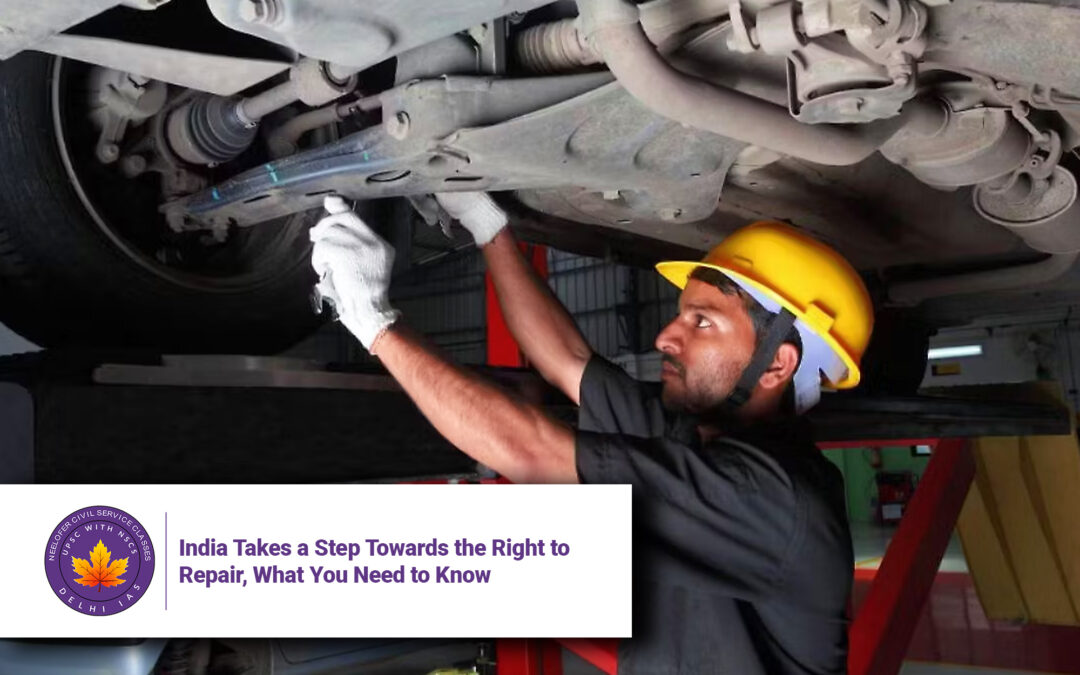
India Takes a Step Towards the Right to Repair, What You Need to Know
Why in News?
The Department of Consumer Affairs (DoCA) has announced the submission of a report to the government proposing a “Framework on Repairability Index (RI) in Mobile and Electronic Sector.” This marks a significant move in advancing the Right to Repair movement in India. 
Introduction
Under the proposed framework, electronic appliances and mobile devices will be rated on their repairability—based on the availability of spare parts, access to repair manuals, affordability of repair, software support, and more. This score will guide consumers in making informed decisions and encourage sustainable practices.
Key Issues and Background
1. What is the Repairability Index?
-
The Repairability Index is a scoring system that rates products based on how easy they are to repair.
-
The index considers factors such as:
-
Availability of spare parts
-
Ease of disassembly
-
Access to repair information/manuals
-
Software support
-
Cost of repairs
-
2. Why is Repairability Important?
-
Products like washing machines used to last for years, but planned obsolescence—the practice of making products that wear out quickly—has reduced product life spans.
-
Companies now design electronics in ways that discourage repair, forcing users to buy replacements more frequently.
-
This trend leads to greater electronic waste, environmental damage, and financial pressure on consumers.
3. International Comparisons
-
In the U.S., consumer advocacy has been strong. Consumers have demanded repair rights, especially against companies that monopolize repair services.
-
Laws in countries like France already require product manufacturers to display repair scores.
-
Apple and Samsung have both made some adjustments under global pressure, including repair manuals and self-service kits.
4. Challenges in India
-
India’s framework is still in its early stages.
-
One concern is that the RI committee was dominated by industry representatives, especially from electronics manufacturers, raising fears about bias.
-
There’s a risk that the final implementation may not fully favor consumers.
5. Government and Industry Response
-
The Indian government aims to ensure that RI “won’t stifle innovation or ease of doing business.”
-
Indian repair culture is evolving slowly. For example, McDonald’s ice cream machines are cited as problematic due to frequent breakdowns and lack of third-party servicing—highlighting issues of accessibility and monopolization of repair.
Conclusion
The introduction of the Repairability Index in India is a promising move toward empowering consumers and promoting sustainability. However, active participation from unbiased consumer advocates and strict oversight will be necessary to ensure the framework does not become a toothless policy controlled by manufacturers.
5 Questions and Answers
Q1. What is the purpose of the Repairability Index in India?
A: To rate electronic and mobile devices on how easy they are to repair based on spare part availability, manuals, software updates, and cost.
Q2. Why has the ‘Right to Repair’ movement become important globally?
A: Because many manufacturers design products to wear out quickly and restrict repair access, leading to increased waste and consumer expenses.
Q3. How does India’s repair framework differ from countries like France or the U.S.?
A: While France mandates repair scores on electronics, India’s system is in the proposal stage, and its committee includes many manufacturers, raising concerns about bias.
Q4. What is ‘planned obsolescence’?
A: It refers to the intentional design of products to have a shorter life span, making them less durable and harder to repair.
Q5. How have major global companies responded to right to repair pressure?
A: Companies like Apple and Samsung have slowly started releasing repair manuals and parts, though often only after strong consumer and legal pressure.

