
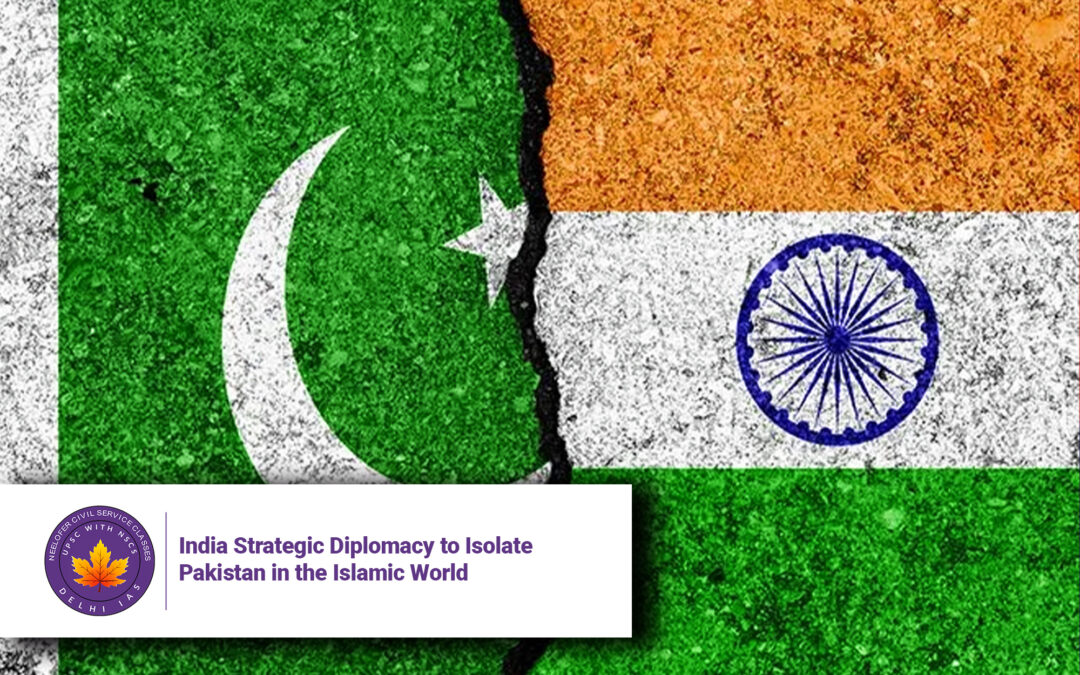
India Strategic Diplomacy to Isolate Pakistan in the Islamic World
Why in News?
Amid renewed tensions following the Pahalgam terror attack, India has intensified its diplomatic outreach to key Islamic nations—Saudi Arabia, UAE, and even the Taliban in Afghanistan—to isolate Pakistan globally, especially within the Islamic world.
Introduction
In the wake of a potential military escalation post-Pahalgam terror incident, India’s foreign policy has entered an assertive phase. New Delhi is now strategically engaging Muslim-majority nations that have traditionally supported or sympathized with Pakistan. This shift underscores a calculated effort to reframe Pakistan not just as a security threat, but as an exporter of terror even within Islamic circles.
Key Issues and Background
1. Diplomatic Dialogue with Saudi Arabia
-
During a brief visit to Jeddah, Prime Minister Narendra Modi received news of the terror attack and discussed it in detail with Saudi Crown Prince Mohammed bin Salman.
-
Their joint statement strongly condemned terrorism and rejected linking it to any race, religion, or culture.
-
This interaction is part of a deeper India-Saudi strategic partnership, initiated with the 2006 Delhi Declaration and expanded in 2010 with the Strategic Partnership Agreement.
2. Saudi Arabia’s Help in Anti-Terrorism Cooperation
-
In 2012, Saudi Arabia helped India arrest Sayed Zabiuddin Ansari alias Abu Jundal, involved in the 26/11 Mumbai attacks.
-
This signaled a shift in Saudi support, moving away from financing radical groups to backing India’s anti-terror cause.
3. Strengthening Ties with the UAE
-
Since the 2017 Strategic Partnership, there have been at least six high-level visits from UAE to India.
-
Cooperation has expanded from economic to strategic areas, including counter-terrorism and extradition talks (e.g., Dawood Ibrahim).
-
UAE played a critical role in foiling hijack attempts and aiding in intelligence sharing.
4. Engaging with the Taliban
-
Recently, India’s MEA held meetings with Taliban foreign minister Muttaqi, following a visit to Kabul.
-
Taliban categorically condemned the Pahalgam killings, a major departure from past Taliban-Pakistan proximity.
-
Though caution is warranted, this shows growing discomfort in the Islamic world with Pakistan’s cross-border terrorism.
The Core of the Concern
India is recalibrating its West Asia policy to challenge Pakistan’s traditional influence in Islamic geopolitics. By deepening ties with powerful Islamic nations and engaging even historically adversarial groups like the Taliban, India is creating a unified front against terrorism, portraying Pakistan as a pariah.
Key Observations
-
The shift in Islamic countries’ stance—from reluctant neutrality to outright support for India’s anti-terror efforts—is historic.
-
This also highlights India’s matured diplomacy and increasing weight in global counter-terror dialogues.
-
The promised $100 billion Saudi investment and UAE support symbolize a strengthening India-Gulf alliance.
Conclusion
India’s attempt to isolate Pakistan is bearing fruit as Islamic nations—once Pakistan’s stronghold—are increasingly siding with New Delhi on terrorism. This evolution not only improves India’s global stature but also brings new diplomatic, economic, and strategic opportunities. The solidarity shown in condemning terrorism marks a turning point in India’s West Asia engagement.
5 Questions and Answers
Q1. What triggered India’s intensified diplomacy in the Islamic world recently?
Answer: The Pahalgam terror attack and fears of military escalation prompted India to garner support from Islamic nations to diplomatically isolate Pakistan.
Q2. Which three countries are central to India’s outreach?
Answer: Saudi Arabia, the United Arab Emirates (UAE), and Afghanistan (under Taliban leadership).
Q3. How has Saudi Arabia supported India in past counter-terror efforts?
Answer: Saudi Arabia helped India arrest 26/11 handler Abu Jundal and now partners in intelligence sharing and anti-extremism cooperation.
Q4. What role has the UAE played in strengthening ties with India?
Answer: UAE has expanded cooperation through multiple high-level visits and supported India in security and extradition matters.
Q5. Why is India’s meeting with the Taliban significant?
Answer: It marks a diplomatic breakthrough, with the Taliban condemning the Pahalgam attack, signaling a potential drift from Pakistan.

