
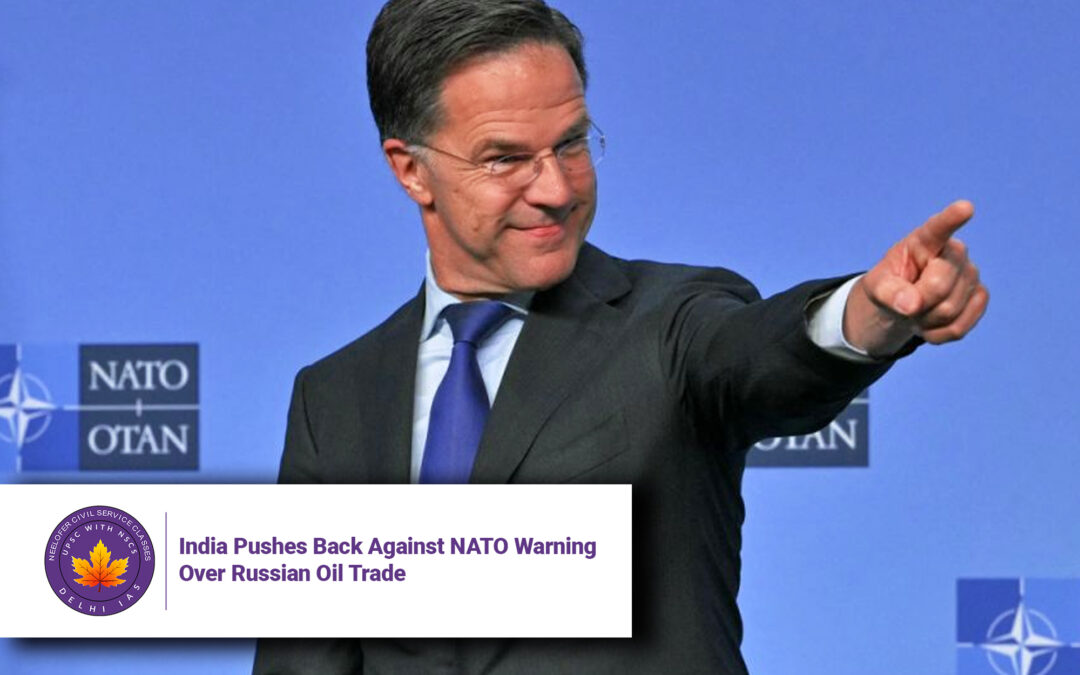
India Pushes Back Against NATO Warning Over Russian Oil Trade
Why in News?
India has strongly opposed recent remarks by NATO Secretary General Mark Rutte, who warned that nations like India, China, and Brazil could face secondary sanctions if they continue business ties with Russia. This development comes amid rising geopolitical tensions, especially concerning oil imports. 
Background
Mark Rutte’s threat centers on the idea that countries importing Russian oil or goods may be penalized with secondary tariffs, a move largely backed by US lawmakers. Recently, bipartisan US senators proposed a 500% tariff on Russian goods, and former US President Donald Trump pledged 100% tariffs on Russia’s trade partners should a peace deal with Ukraine not emerge within 50 days.
India has called this hypocritical, pointing to the fact that European Union nations continue importing Russian oil, gas, and processed products, even while promoting sanctions against Russia. India’s government emphasized that strategic autonomy in energy policy is non-negotiable, regardless of global pressure.
India’s Energy Landscape
India is the third-largest oil importer globally, and its trade with Russia has grown rapidly due to discounted crude. Between January and June 2025, India imported 1.75 million barrels per day (bpd) of Russian oil, covering nearly 35% of its total oil needs. In June alone, imports increased to nearly 2 million bpd, from 1.7 million bpd the previous month.
Despite the warnings, Indian refiners are expected to stock up on cheap Russian crude before potential sanctions come into effect — as they had done previously during the Israel-Iran conflict.
Government’s Stand & Strategy
Oil Minister Hardeep Singh Puri assured that India can meet its oil requirements from alternative suppliers if sanctions on Russia intensify. He cited increased sourcing from countries like Guyana, Brazil, and Canada, noting that India has diversified its supplier base from 27 to 40 countries.
However, these alternatives come with a heavier price tag — $4–$5 more per barrel compared to Russian oil. This will likely inflate India’s import bill significantly, raising concerns about energy security and trade deficits.
Global Implications
Secondary sanctions differ from primary ones by targeting all trade with countries doing business with Russia, not just the Russian entities themselves. This could have a cascading effect on Indian merchandise exports and could even derail India-US trade negotiations currently underway.
The US and NATO’s actions appear to be aimed at throttling Russia’s war financing. However, this tactic could hurt major oil-importing nations like India, forcing them into economic trade-offs.
Conclusion
India’s firm stance on maintaining energy independence and pushing back against Western double standards highlights its commitment to safeguarding national interests. However, if secondary sanctions materialize, India could face tough choices, balancing between affordable energy and strategic partnerships with the West. The next few weeks will be critical as global leaders navigate diplomacy, energy policy, and shifting alliances.
Quick Q&A
Q1. What are secondary sanctions?
A1. Sanctions targeting countries that trade with a sanctioned nation—in this case, nations importing goods from Russia.
Q2. How much Russian oil is India importing?
A2. Around 1.75 million barrels/day, or 35% of India’s total oil needs.
Q3. What is the US proposing?
A3. Massive tariffs (up to 500%) on Russian goods and 100% tariffs on Russia’s trade partners.
Q4. Can India shift away from Russian oil?
A4. Yes, but at a higher cost. New suppliers like Brazil, Canada, and Guyana offer oil at $4–$5/barrel more.
Q5. What could be the broader impact?
A5. A higher import bill, potential disruption of India-US trade talks, and risks to India’s merchandise exports.
