
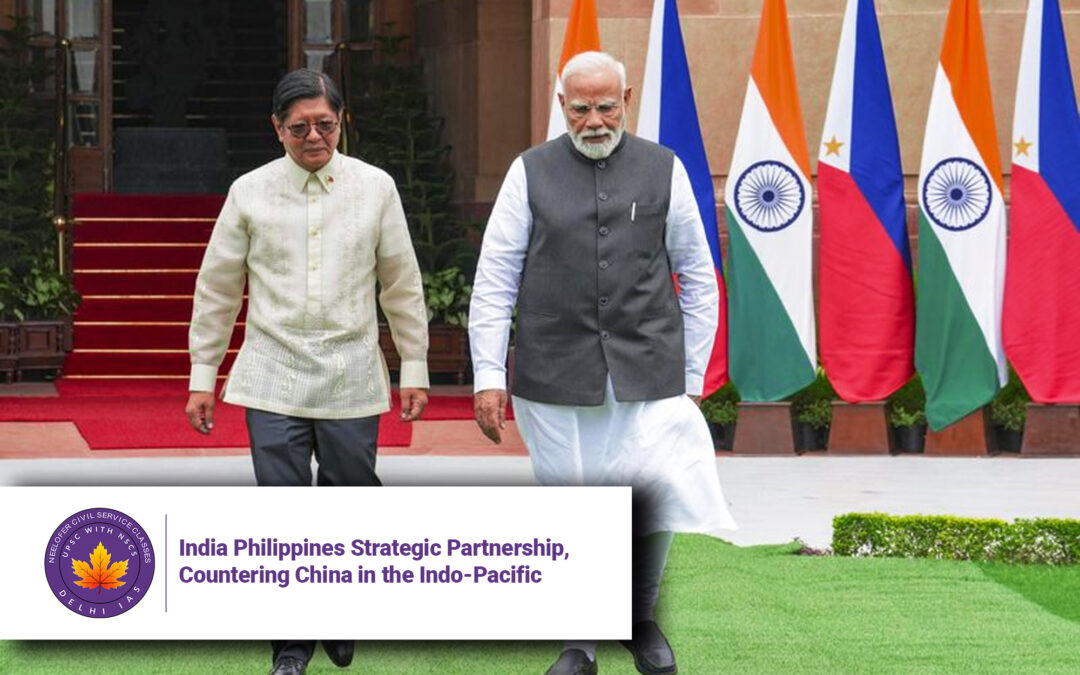
India Philippines Strategic Partnership, Countering China in the Indo-Pacific
Introduction
The recent state visit of Philippines President Ferdinand Marcos Jr. to India marks a pivotal shift in Asia’s geopolitical landscape. With the signing of a Strategic Partnership Agreement, joint naval drills in the South China Sea, and discussions on BrahMos missile exports, India and the Philippines are forging a united front against China’s maritime expansionism. This partnership—rooted in shared democratic values and mutual security concerns—could redefine power dynamics in the Indo-Pacific.
This article examines:
-
Key outcomes of Marcos’ visit (defense, trade, ASEAN ties)
-
Why the Philippines is crucial to India’s Indo-Pacific strategy
-
China’s reaction and the South China Sea flashpoint
-
The BrahMos deal and its strategic implications
-
A 5-point roadmap for deepening India-Philippines relations
Why in News?
-
Philippines President Marcos Jr.’s India visit (March 2025) culminated in a Strategic Partnership Agreement.
-
First India-Philippines naval exercises in South China Sea (China protested).
-
BrahMos missile exports: Philippines is the first buyer; more deals likely.
-
Trade push: Talks on Preferential Trade Agreement (PTA) announced.
Key Issues and Analysis
1. The China Factor: United Against Maritime Aggression
A. South China Sea Dispute
-
Philippines’ stance:
-
Rejects China’s “9-dash line” claims.
-
Won 2016 UNCLOS ruling invalidating China’s claims.
-
-
India’s support:
-
Backed UNCLOS verdict.
-
Conducted joint naval drills near contested waters.
-
China’s Reaction:
-
Called exercises “provocative”.
-
Warned against “external interference”.
B. Defense Collaboration
-
BrahMos missiles:
-
$375 million deal (2022) for shore-based anti-ship systems.
-
Next phase: Discussions on air-launched BrahMos-NG.
-
-
Military pacts:
-
Terms of Reference signed for Army, Navy, Air Force, Coast Guard cooperation.
-
Strategic Impact:
-
Philippines gets deterrence vs. Chinese coast guard harassment.
-
India gains foothold in Southeast Asia’s defense market.
2. Trade & ASEAN Diplomacy: Beyond Security
| Area | Progress | Future Goals |
|---|---|---|
| Trade | $3.3B bilateral trade (2024) | PTA talks; $10B target by 2030. |
| Investments | Indian pharma/tech firms expanding in PH. | Joint ventures in renewables, EVs. |
| ASEAN Ties | PH = ASEAN chair (2026); AITIGA renegotiation | India-ASEAN FTA upgrade. |
Repairing Ties:
-
After Piyush Goyal’s “B-team of China” remark (June 2024), India fast-tracked ASEAN trade talks.
3. The Quad & Beyond: India’s Multi-Alignment Playbook
-
Quad (U.S., Japan, Australia, India): Focuses on countering China militarily.
-
India-Philippines partnership: Adds ASEAN heft to Indo-Pacific strategy.
-
Non-aligned but assertive: India avoids anti-China blocs but arms Manila.
Marcos’ Balancing Act:
-
Keeps U.S. alliance but diversifies with India/Russia.
-
Rejects China’s coercion without severing economic ties.
5-Point Roadmap for Strengthening Ties
1. Defense: From BrahMos to Joint Production
-
Finalize BrahMos-NG deal for Philippine Air Force.
-
Co-develop naval drones to patrol South China Sea.
2. Trade: Fast-Track PTA
-
Cut tariffs on electronics, pharmaceuticals.
-
Launch direct flights (Manila-Delhi/Mumbai).
3. Energy Security
-
Joint oil/gas exploration in Philippines’ EEZ (defying China).
-
Solar power partnerships (Adani/Tata in PH renewables).
4. ASEAN Leadership
-
Leverage PH’s 2026 ASEAN chairmanship to push:
-
Code of Conduct in South China Sea.
-
India-ASEAN connectivity projects.
-
5. Diaspora & Soft Power
-
Expand Indian cultural centers in PH.
-
Ease visas for students, professionals.
Conclusion: A New Axis in the Indo-Pacific?
The India-Philippines partnership is no longer just about shared history (via ancient Hindu/Malay links) but shared futures in a contested region. By combining:
✔ India’s defense tech (BrahMos, drones)
✔ Philippines’ ASEAN leadership
✔ A united stand against Chinese bullying
—the two nations are crafting a template for middle-power alliances in the Asian Century.
As PM Modi stated:
“Our partnership isn’t against any nation—it’s for peace, stability, and rule-based order.”
The message to Beijing is clear: The Indo-Pacific won’t be monopolized.
5 Key Questions & Answers
Q1: Why is the Philippines buying BrahMos?
A1: To deter Chinese ships in South China Sea (BrahMos range = 290–500 km).
Q2: How does this help India’s Quad strategy?
A2: Quad focuses on military deterrence; PH adds ASEAN diplomatic weight.
Q3: What’s China’s biggest worry?
A3: India arming PH could inspire Vietnam, Indonesia to follow.
Q4: Will this partnership anger the U.S.?
A4: No—U.S. backs PH’s defense buildup but prefers its weapons over India’s.
Q5: What’s the next milestone?
A5: PTA signing by 2025 + BrahMos-NG deal.

