
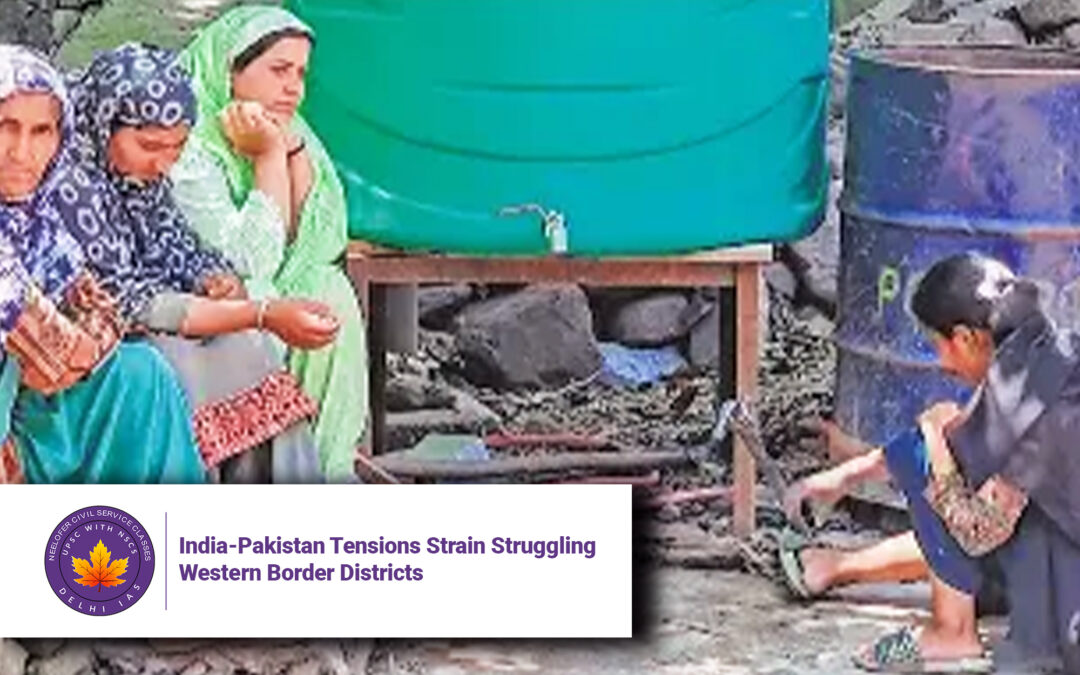
India-Pakistan Tensions Strain Struggling Western Border Districts
Why in News?
Recent data has shown that ongoing India–Pakistan tensions, including ceasefire violations and shelling along the Line of Control (LoC), are significantly affecting economic activity in India’s western border districts. These districts already face stagnating exports and high poverty levels, and the increasing hostilities are exacerbating their vulnerabilities. 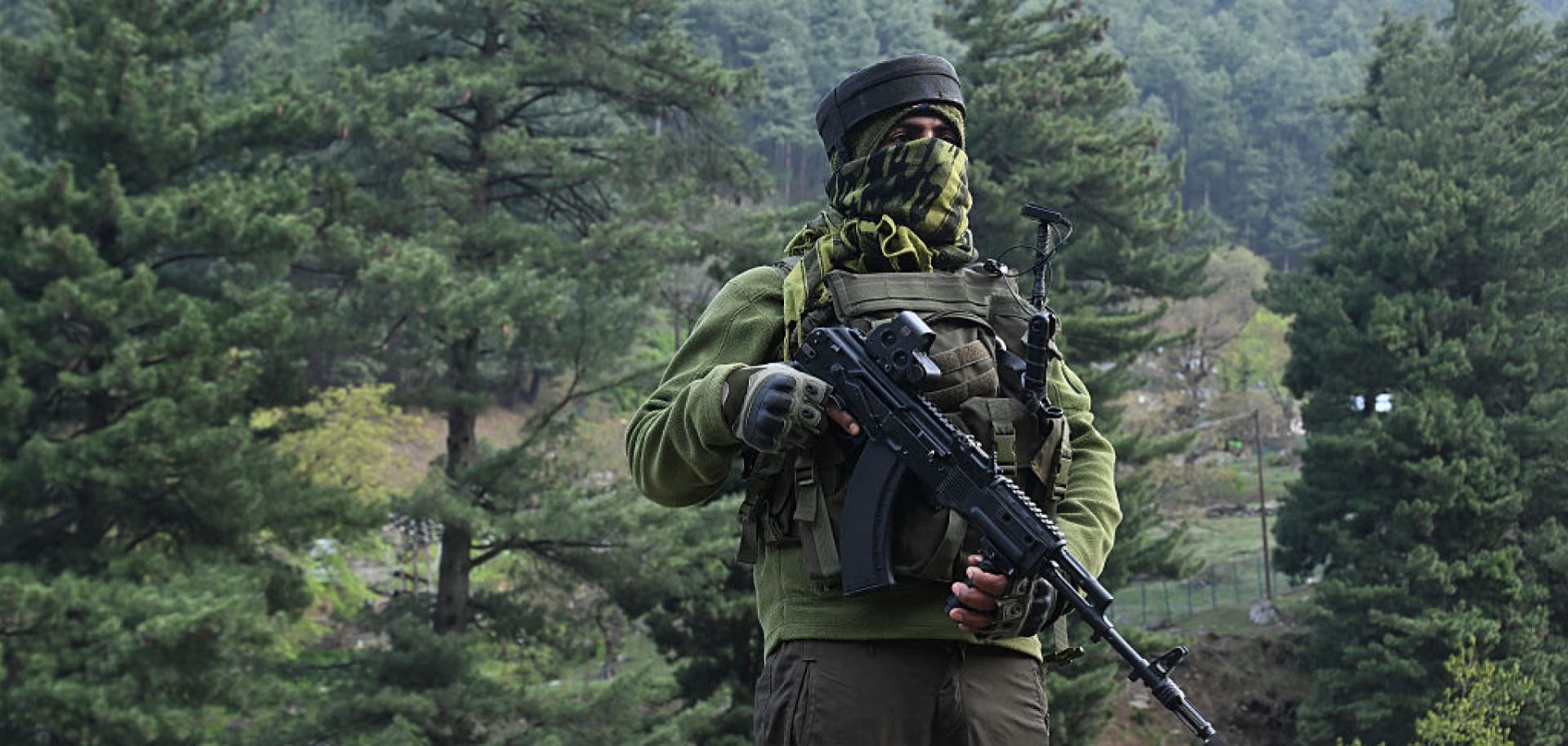
Introduction
Border districts of India, particularly those along the western frontier with Pakistan in Gujarat, Rajasthan, Punjab, and Jammu & Kashmir, have long struggled with underdevelopment and poverty. While government schemes aim to uplift these regions, new tensions and inadequate export contributions further strain their growth prospects. Recent comparative analysis reveals that eastern border districts are performing relatively better than their western counterparts.
Key Issues
1. Low Export Contribution from Western Border Districts
-
Gujarat is the only state from which exports from western border districts have shown some promise.
-
From FY22 to FY25, Gujarat’s western border districts contributed a mere 0.3% of India’s total exports (Chart 2A).
-
Other states such as Rajasthan, Punjab, and J&K show even lower figures, with limited or no export data available for border districts.
2. Stagnant or Slower Decline in Poverty
-
Between 2015–16 and 2019–21, the proportion of the population living below the poverty line declined more slowly in western border districts compared to state averages (Chart 1A).
-
In contrast, eastern border districts like those in Arunachal Pradesh, Tripura, Nagaland, and West Bengal showed better results in poverty reduction (Chart 1B).
3. Impact of Conflict
-
Twenty-two districts across Gujarat, Rajasthan, Punjab, and J&K are identified as western border districts, many of which are directly affected by cross-border tensions.
-
Shelling and insecurity due to Pakistan’s aggression have disrupted normal life and economic activity (as depicted in the accompanying image from Baramulla, J&K).
Government Responses and Programs
-
Government initiatives such as the Border Area Development Programme (BADP) have aimed to fund infrastructure and development in border regions.
-
However, the funds released to western border districts have consistently been lower than those allocated to eastern border districts (Chart 3).
-
In 2022–23 and 2023–24, the disparity continued, raising questions about the equity and impact of such developmental schemes.
Challenges and the Way Forward
Challenges
-
Ongoing conflict and insecurity inhibit industrial and infrastructural growth.
-
Slower poverty alleviation in western border districts compared to national and regional averages.
-
Limited exports and logistical issues due to restricted access to ports and trade routes.
Way Forward
-
Boost Local Economies: Encourage small industries, agriculture, and logistics hubs within border districts to create employment.
-
Strengthen Infrastructure: Allocate increased funds for physical and digital connectivity under BADP and other schemes.
-
Enhance Security and Stability: Promote confidence-building measures and stronger civilian protections to minimize disruptions.
-
Policy Realignment: Ensure more equitable resource allocation between eastern and western border regions.
Conclusion
India’s western border districts remain trapped in a cycle of conflict-driven stagnation. While government programs have attempted to bring change, the lack of adequate focus and the renewed India–Pakistan tensions have further constrained progress. A more targeted and balanced approach is essential to uplift these strategically significant but economically vulnerable regions.
5 Questions and Answers
Q1: What is the main concern regarding India’s western border districts?
A: They face high poverty, stagnating exports, and increased disruption due to India–Pakistan tensions.
Q2: How do western border districts compare with eastern ones?
A: Eastern border districts like those in Nagaland and Tripura show better outcomes in poverty reduction and fund allocation.
Q3: Which western state has relatively better performance in border exports?
A: Gujarat, though even there, exports from border districts form only 0.3% of India’s total exports.
Q4: What government program aims to develop border areas?
A: The Border Area Development Programme (BADP).
Q5: What is the suggested path forward?
A: Increase development funds, improve local economic activity, enhance security, and ensure fair treatment across all border regions.
