
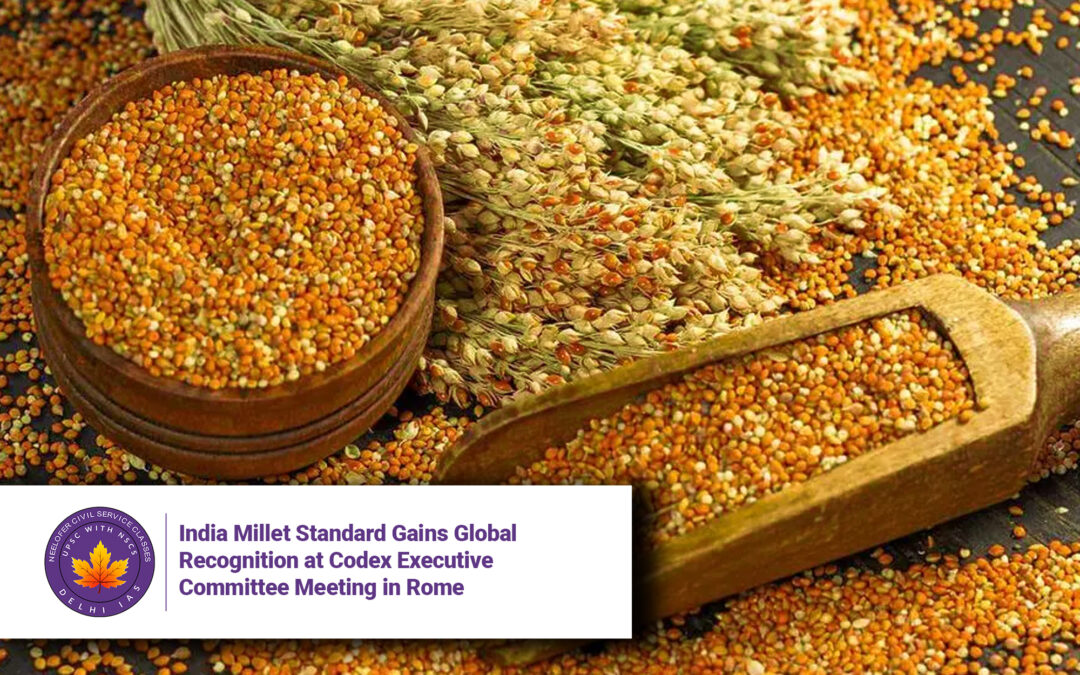
India Millet Standard Gains Global Recognition at Codex Executive Committee Meeting in Rome
Why in News?
India’s initiative to develop a global group standard for whole millet grains was widely appreciated at the 88th Session of the Executive Committee of the Codex Alimentarius Commission (CCEXEC88), held at the FAO Headquarters in Rome. The session highlighted India’s leadership in food standardization and its active global role in shaping agricultural policy and food security. 
Introduction
India’s leadership in standardizing millet grains under global food safety norms took center stage at an international platform during the recent Codex Executive Committee meet in Rome. The development, which marks a significant milestone in India’s food diplomacy, was initially approved at the 47th Session of the Codex Alimentarius Commission (CAC47) and reviewed again in the CCEXEC88 meeting.
Key Highlights of the Meeting
-
The Executive Committee reviewed progress over a five-day session, where India chaired discussions alongside Mali, Nigeria, and Senegal as co-chairs.
-
India’s proposed millet grain standard, first approved in CAC47, was critically reviewed and appreciated for its comprehensive scope and potential impact.
-
The session finalized terms for the Codex Committee on Cereals, Pulses and Legumes (CCPCL11), scheduled to be held in April 2025.
India’s Growing Global Role in Food Standards
-
India, being an elected member of the Codex Executive Committee, played a proactive role in the meeting.
-
The session was inaugurated by:
-
Mr. Godfrey Magwenzi, Deputy Director General and Director of Cabinet, FAO,
-
Dr. Jeremy Farrar, WHO Assistant Director-General, Health Promotion and Disease Prevention,
-
Dr. Allan Azegele, Chairperson of the Codex Alimentarius Commission,
-
Ms. Sarah Cahill, Secretary of the Commission.
-
-
India’s leadership in the Codex Committee on Fresh Fruits and Vegetables (CCFFV23) was praised for finalizing new standards, which are now set for further approval in CAC48 (November 2025).
Strategic Outcomes and India’s Contributions
-
India will also co-chair upcoming work proposals to frame standards for fresh turmeric and fresh broccoli.
-
India actively took part in creating the monitoring framework for the Codex Strategic Plan 2026–2031, proposing SMART Key Performance Indicators (KPIs) to guide and evaluate progress.
-
India emphasized the importance of outcome-based and measurable indicators to ensure effective global food policy implementation.
Support to Neighbouring Countries and Twinning Programmes
-
India highlighted its capacity-building initiatives in countries like:
-
Bhutan
-
Nepal
-
Bangladesh
-
Sri Lanka
-
Timor Leste
which have now been recognized by the FAO.
-
-
India encouraged the use of the Codex Trust Fund (CTF) for mentorship and technical cooperation.
-
Drawing from its successful twinning efforts with Bhutan and Nepal, India recommended including such initiatives as indicators for strategic goals.
India’s Leadership Legacy in Codex Committees
-
Since 2014, India has been chairing the Codex Committee on Spices and Culinary Herbs (CCSCH).
-
India has demonstrated consistent leadership in setting quality and safety standards for agricultural produce, contributing to global food safety norms.
Conclusion
India’s continued leadership in global food standardization through forums like Codex Alimentarius reflects its commitment to nutritional security, global collaboration, and sustainable agricultural practices. The international acknowledgment of its millet grain standards marks a major step in India’s global food diplomacy, reinforcing its stature as a leader in agro-food policy.
Five Questions and Answers
1. What is the Codex Alimentarius Commission?
The Codex Alimentarius Commission (CAC) is a body established by the FAO and WHO to develop international food standards to protect consumer health and promote fair trade practices.
2. What milestone was achieved by India at the CCEXEC88 meet in Rome?
India’s group standard for whole millet grains was recognized and appreciated at the meeting, marking a major achievement in global food safety standards.
3. Who co-chaired the committee with India during the meeting?
India chaired the committee along with Mali, Nigeria, and Senegal as co-chairs.
4. What countries have benefited from India’s Codex capacity-building initiatives?
Countries including Bhutan, Nepal, Bangladesh, Sri Lanka, and Timor Leste have benefited from India’s training and support initiatives.
5. What are India’s future commitments in Codex work?
India will co-chair new work proposals for standards on fresh turmeric and broccoli and continue to guide strategic planning through SMART KPIs.

