
India Financial Sector Reforms Need a Shake-up
Why in News?
Despite years of incremental reforms in India’s Banking, Financial Services, and Insurance (BFSI) sector, systemic inefficiencies and regulatory gaps persist. These hinder investor confidence and economic growth, demanding a comprehensive overhaul of financial sector rules and practices. 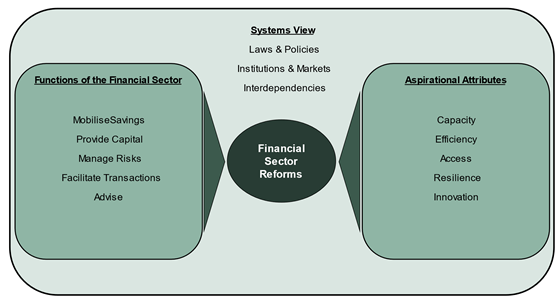
Introduction
India’s financial sector stands at a critical inflection point. While progress has been made in areas such as banking and insurance, deep-rooted challenges—like outdated nomination norms, inconsistent regulations, poor retirement planning, and the unchecked rise of shadow banking—continue to weaken the sector’s robustness and credibility.
Key Issues and Background
❖ On Nomination and Nominees
-
Across BFSI verticals (banks, mutual funds, insurance), nomination regulations are non-uniform and confusing.
-
Anyone can be nominated, but this does not give legal ownership; ownership transfer may still require succession certificates.
-
This ambiguity causes family disputes and legal delays in asset transfers.
❖ Shadow Banking Risks
-
The non-banking financial companies (NBFCs), peer-to-peer lenders, and fintech firms are growing rapidly but remain lightly regulated.
-
These entities operate in the shadows of traditional banking, posing risks similar to those seen during the 2008 global financial crisis.
-
Transparency and oversight are limited, and credit bubbles may be forming.
❖ Regulatory and Operational Gaps
-
Regulatory bodies like SEBI and RBI often act in silos.
-
SEBI’s recent push for board diversity, transparency in capital flows, and UBO (Ultimate Beneficial Owner) reforms are positive.
-
But entities like the NSE resisted public scrutiny, as seen in their response to exposés with defamation suits.
-
FATF updates in 2022 also highlighted India’s lag in financial transparency and public disclosures.
❖ Retirement Planning Crisis
-
Young professionals are offered insurance-led investment products with high intermediation costs.
-
Products like annuities are inefficient and expensive, reducing retirement security.
-
There is a lack of low-cost, efficient pension alternatives.
The Core of the Concern
India’s financial sector reforms are piecemeal and fragmented. What is needed is a holistic, harmonized regulatory structure that:
-
Encourages transparency.
-
Simplifies legal frameworks for asset succession.
-
Clamps down on shadow entities.
-
Supports low-cost retirement products.
-
Ensures cross-regulator coordination between RBI, SEBI, and Ministry of Finance.
Key Observations
-
The lack of harmonized nominee rules creates confusion for citizens.
-
India needs a deep corporate bond market and a vibrant retail investment ecosystem.
-
Public sector institutions must embrace transparency, not resist it.
-
SEBI’s recent reforms in KYC and UBO tracking are steps in the right direction.
-
SEBI and RBI must coordinate to regulate shadow banks before another financial crisis hits.
Conclusion
India’s financial reforms must shift from incremental to transformative. A clean-up of nomination laws, strong regulation of shadow banks, affordable retirement options, and inter-agency coordination are essential. Without these, India’s dream of becoming a global financial powerhouse will remain unfulfilled. A reform-oriented, investor-friendly environment is the need of the hour.
Q&A Section
-
Why does India’s financial sector need reform?
Because systemic inefficiencies and fragmented rules are harming investor trust and financial growth. -
What is the issue with nominee regulations?
Nominee designation does not guarantee asset ownership, creating confusion and legal disputes. -
What is shadow banking and why is it a concern?
Shadow banking includes NBFCs and fintech lenders operating with limited regulation, posing risks similar to the 2008 financial crisis. -
How is retirement planning failing in India?
It is dominated by insurance-linked products with high costs and low returns, lacking efficient pension options. -
What reforms has SEBI implemented recently?
SEBI has worked on KYC norms, UBO disclosures, and is pushing for board diversity and transparency in capital flows.

