
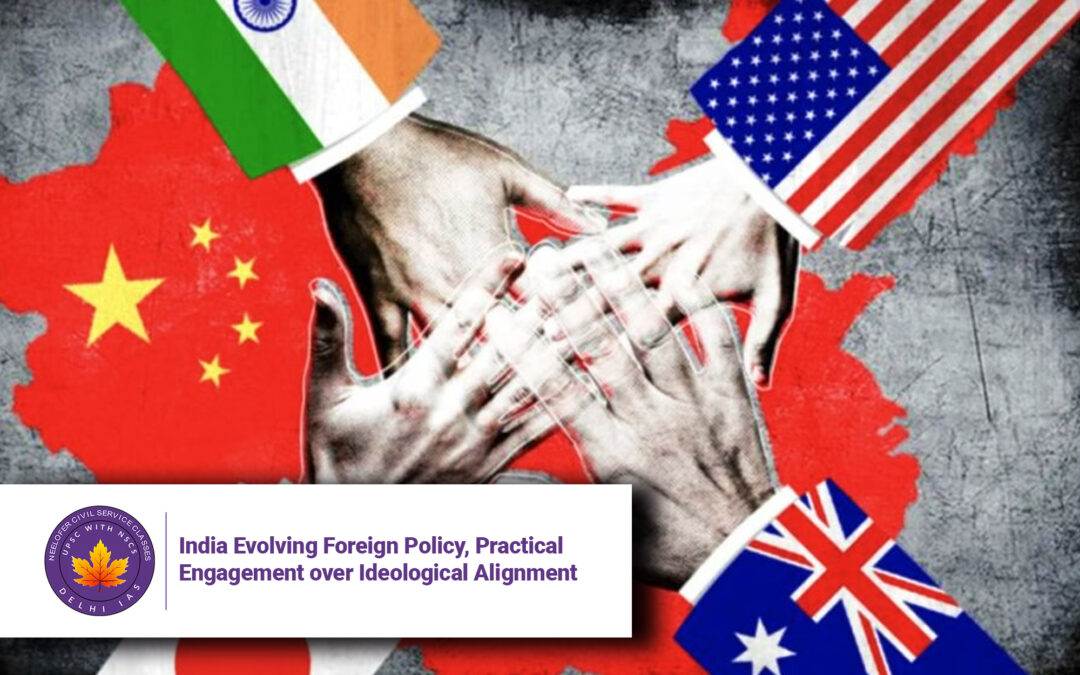
India Evolving Foreign Policy, Practical Engagement over Ideological Alignment
Why in News?
As Prime Minister Narendra Modi embarks on a multi-continent diplomatic tour, including bilateral meetings in Brazil and participation in BRICS and other forums, a shift is becoming evident in India’s foreign policy—towards practical diplomacy based on securing national interests rather than expansive ideological visions. 
Introduction
With new global realignments and power transitions underway, India’s external engagement is shifting focus from old ideological blocs like BRICS to interest-based diplomacy. This transformation comes in response to global strategic complexities including China’s rise, the weakening of BRICS, Russia’s strategic shifts, and the growing India-US partnership.
Key Issues and Observations
-
The Decline of BRICS as a Cohesive Bloc
-
While initially BRICS (Brazil, Russia, India, China, South Africa) seemed capable of offering an alternative to Western dominance, internal contradictions—especially between India and China—have eroded its utility for India.
-
China’s aggression at the borders and increasing ties with Pakistan have made India skeptical of deeper engagement in BRICS.
-
-
Changing U.S. Policy Under Trump & Beyond
-
Former U.S. President Donald Trump’s pro-Pakistan tilt and unpredictable diplomacy pushed India to reconsider blind alignment with Washington.
-
Despite setbacks, the U.S. remains crucial to India’s strategic calculus, especially in forums like Quad.
-
-
The China-Pakistan-Russia Triangle
-
Russia’s growing closeness with China and its support for Pakistan (including post-Ukraine War dynamics) is complicating India’s Eurasian outreach.
-
Delhi must navigate carefully in regional forums like SCO where Chinese and Pakistani presence is strong.
-
-
India’s Practical Shift – Focus on Bilateralism & Multipolarity
-
India is now promoting a “multipolar Asia” rather than trying to fit within large ideological frameworks.
-
Emphasis is now on bilateral partnerships, economic diplomacy, and issue-based regional cooperation.
-
-
New Strategic Formations
-
The India-Middle East-Europe Economic Corridor (announced at G20) is a new example of interest-based diplomacy.
-
Forums like I2U2 (India, Israel, UAE, USA) reflect India’s shift from non-alignment rhetoric to pragmatic coalition-building.
-
Conclusion
India’s foreign policy is evolving from grand visions to nuts-and-bolts diplomacy that serves its immediate interests. As global power equations shift rapidly, India’s priority is no longer to lead ideological coalitions but to preserve autonomy, secure economic ties, and prevent encirclement—especially by the China-Pakistan-Russia axis. This realism-based approach is more suited to the complexities of the current geopolitical era.
5 Q&A Based on the Article
Q1. Why is BRICS becoming less relevant for India?
A1. BRICS has internal contradictions, especially due to China’s aggressive behavior and its growing ties with Pakistan, which conflict with India’s interests.
Q2. What shift is observed in India’s foreign policy approach?
A2. India is moving from ideology-based alignments (like Non-Alignment or BRICS unity) to practical, interest-based diplomacy emphasizing bilateral ties and issue-based coalitions.
Q3. How has China’s regional behavior affected India’s stance?
A3. China’s border aggression, strategic alliance with Pakistan, and expansion in the Indian Ocean have pushed India to pursue balancing partnerships with the U.S., Japan, and other like-minded countries.
Q4. What impact did Trump’s foreign policy have on India?
A4. Trump’s outreach to Pakistan and disregard for traditional diplomacy disrupted India’s expectations, leading to a recalibration in its approach toward the U.S.
Q5. What is India’s strategy in forums like Quad and I2U2?
A5. India uses these forums to strengthen issue-based cooperation on critical infrastructure, technology, and security while avoiding ideological rigidity or bloc politics.

