
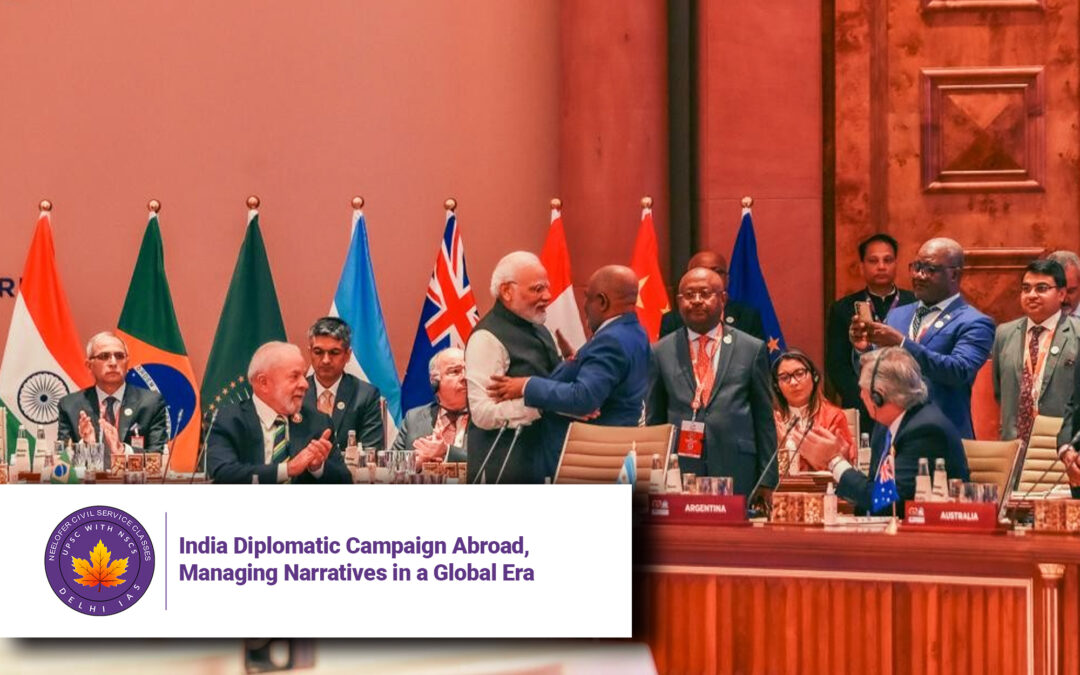
India Diplomatic Campaign Abroad, Managing Narratives in a Global Era
Why in News?
India’s recent decision to send diplomatic envoys and delegations abroad to explain its position on terrorist attacks and conflicts with Pakistan raises essential questions about strategic communication and narrative control in international relations. 
Introduction
While the move appears to be a show of strength or reassurance, it underscores a deeper necessity: managing international perception and pre-empting misrepresentation. As global narratives become central to geopolitical legitimacy, India’s approach marks a shift in diplomacy towards image-building and narrative strategy.
Key Issues and Background
1. The Need for Narrative Legitimacy:
In today’s globalized world, legitimacy is no longer self-evident. It must be performed continuously before international audiences — media, institutions, and the public. India’s outreach aims to demonstrate that its military response is measured, not reactionary, and anchored in a broader framework of sovereignty and counterterrorism.
2. Performing Credibility in a Digital Age:
The explosion of misinformation and AI-generated content complicates the credibility of official narratives. Events can now be simulated through deepfakes, game footage, and doctored videos, often spreading faster than facts. India and Pakistan both face challenges in navigating this media minefield.
3. Diplomatic Clarification as Strategy:
India’s initiative also reflects an effort to seize control of its narrative rather than allowing global opinion to be shaped by hostile or inaccurate portrayals. This isn’t just about rebutting misinformation—it’s about defining truth in an era of information manipulation.
The Core of the Concern
The growing crisis of credibility in global communications—where facts blur with fiction—poses a challenge. When both sides of a conflict present contrasting “truths,” diplomatic engagement becomes an attempt not merely to inform, but to restore trust and moral high ground in a complex world order.
Key Observations
-
Media optics dominate global politics, often replacing real diplomacy.
-
Narrative battles are now fought in the digital sphere, where perception can outweigh reality.
-
The role of humanities and ethical clarity in storytelling is critical to distinguishing propaganda from authentic representation.
Conclusion
India’s diplomatic campaign is not simply about persuasion—it reflects a broader global shift where performance, narrative, and perception define legitimacy. The success of such campaigns will depend on transparency, consistency, and India’s ability to present itself not just as a strong power, but as a responsible global actor in a post-truth world.
Q&A Section
-
Why did India launch a diplomatic clarification campaign?
To explain its position on conflicts with Pakistan and combat global misinformation. -
What challenges does India face in narrative management?
The rise of deepfakes, viral misinformation, and a global crisis of credibility. -
How is global legitimacy maintained today?
Through constant performance before international audiences, including media, foreign governments, and institutions. -
What is the significance of the “crisis of credibility”?
It challenges the public’s ability to trust any narrative, often reducing facts to opinions. -
What role does narrative play in global diplomacy now?
It shapes international perception, reinforces legitimacy, and influences geopolitical decisions.

