
India and Philippines Elevate Strategic Partnership Amid Rising Regional Tensions
Introduction
In a significant diplomatic and defence milestone, India and the Philippines have formally elevated their relationship to a strategic partnership, marking a deepening of bilateral ties against the backdrop of increasing regional instability in the Indo-Pacific, particularly in the South China Sea. This advancement reflects a growing synergy between the two democratic nations, underpinned by shared concerns over China’s assertiveness and a collective vision of ensuring a rules-based international order.
The new phase of Indo-Philippine relations signals a conscious shift from limited sectoral cooperation to a broad-based strategic engagement spanning defence, maritime security, trade facilitation, digital transformation, and developmental cooperation. At the core of this development is an effort to promote interoperability between armed forces, scale up joint military activities, and enhance maritime domain awareness.
This article explores the key outcomes of this upgraded relationship, its geopolitical significance, and its long-term implications for regional stability and security in Asia.
Diplomatic Milestone: The Strategic Partnership
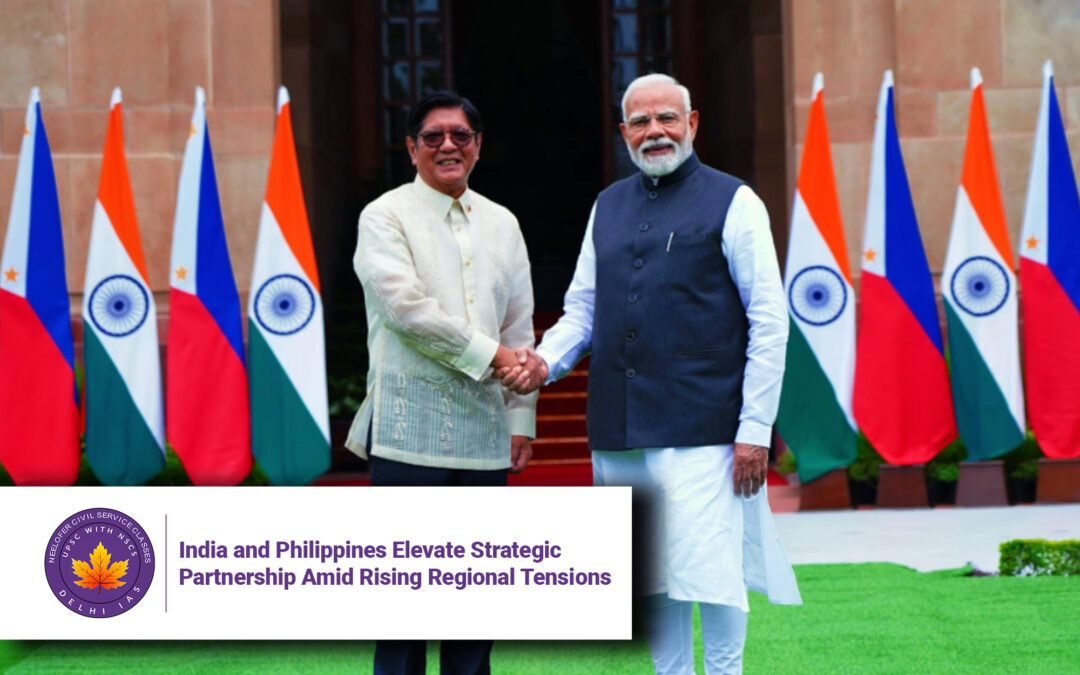
The upgraded relationship was formalised during the recent visit of Philippine President Ferdinand Marcos Jr. to New Delhi, where he held wide-ranging talks with Indian Prime Minister Narendra Modi. The leaders conducted comprehensive discussions aimed at shaping the future trajectory of bilateral ties, including defence cooperation and capacity-building initiatives.
This strategic upgrade comes in a year that also marks the 75th anniversary of India-Philippines diplomatic relations, adding historic symbolism to the event. Six new bilateral agreements are set to be finalised across diverse sectors such as:
-
Trade facilitation
-
Digital transformation
-
Infrastructure
-
Healthcare
-
Education
-
Developmental cooperation
This indicates the growing alignment of national interests and a mutual desire to transform diplomatic goodwill into tangible cooperation.
Maritime Security: A Unifying Concern
The maritime domain lies at the heart of this strategic partnership. Both India and the Philippines have expressed serious concern over China’s expanding footprint in the South China Sea, where territorial disputes and aggressive naval posturing have emerged as flashpoints of geopolitical conflict.
Given their shared maritime vulnerabilities, India and the Philippines are committed to ensuring freedom of navigation, respect for international law, and rules-based maritime governance. This has led to increasing joint naval exercises, coordinated patrols, and information-sharing mechanisms.
The Philippines is looking to enhance its naval defence posture in light of repeated Chinese incursions, and India is emerging as a valuable partner in supporting these efforts through arms transfers, technology cooperation, and military training programs.
India’s Defence Push: Strategic Outreach
India’s growing collaboration with the Philippines is also a product of its wider Indo-Pacific strategy, which seeks to position the country as a security provider in the region. The Defence Acquisition Council (DAC) of India recently cleared modernisation proposals worth ₹67,000 crore, which includes major upgrades to India’s military and defence production capabilities.
Notably, the DAC approved:
-
Procurement of 87 Medium Altitude Long Endurance (MALE) drones
-
Purchase of over 110 BrahMos supersonic cruise missiles
The BrahMos missiles, co-developed by India and Russia, are expected to be deployed on Sukhoi-30MKI fighter jets, significantly enhancing the Indian Air Force’s maritime strike capabilities. The missiles provide long-range precision capability, essential for deterring threats across vast maritime theatres.
In addition, the MALE drones, vital for long-endurance surveillance missions, are aimed at border security and maritime monitoring, particularly relevant in contested waters like the South China Sea.
These approvals are in line with India’s broader push under the ‘Aatmanirbhar Bharat’ (Self-reliant India) initiative, as nearly 60% of procurement will be domestically produced, bolstering indigenous defence manufacturing.
Philippines: Emerging Strategic Importance
For the Philippines, which lies at the frontline of territorial disputes with China, especially over the Spratly Islands and Scarborough Shoal, the partnership with India comes as a critical addition to its network of security alliances. While the Philippines maintains a traditional military alliance with the United States, diversifying its strategic relationships enhances its autonomy and resilience in the region.
New Delhi’s assistance, especially in digital technology, military hardware, and developmental aid, offers Manila tools to modernise its armed forces, increase operational coordination, and reduce dependency on a single power.
India’s expertise in e-governance, start-up ecosystems, and digital infrastructure aligns well with the Philippines’ aspirations for transformation in these sectors. These collaborations could provide the Philippines with non-traditional security tools such as cybersecurity frameworks, digital financial systems, and AI-driven maritime surveillance.
Why This Matters: The China Factor
The timing and nature of the India-Philippines strategic alignment underscore a shared apprehension about China’s actions in the Indo-Pacific.
Both nations face direct or indirect security threats from China:
-
India faces continuing tensions along the Line of Actual Control (LAC) in the Himalayas.
-
The Philippines is facing almost daily standoffs with the Chinese Coast Guard and maritime militia in its Exclusive Economic Zone (EEZ).
India’s willingness to support Southeast Asian nations like the Philippines reinforces its commitment to a free, open, and inclusive Indo-Pacific. By entering into strategic partnerships in China’s immediate periphery, India is sending a signal of its intent to counterbalance Chinese hegemony, not through military confrontation, but via coalition-building and capability enhancement.
Digital and Developmental Cooperation: A New Frontier
Beyond defence, both nations are increasingly focusing on digital cooperation. India, which has become a global model in public digital infrastructure, is sharing its expertise in:
-
Fintech
-
E-governance platforms
-
Digital health systems
-
Start-up incubation frameworks
This complements the Philippines’ goals of digitising governance and creating employment through a robust tech ecosystem. It also adds another layer of resilience by reducing vulnerabilities to cyber threats, another domain where China’s capabilities are viewed as strategic risks.
India’s development projects in the Philippines—focusing on infrastructure, education, and healthcare—are expanding steadily, building people-to-people linkages that will help solidify long-term goodwill and strategic alignment.
Conclusion
India and the Philippines’ decision to elevate their relationship to a strategic partnership reflects the convergence of geopolitical, security, and developmental priorities. It is a timely and robust response to regional challenges—most notably the growing assertiveness of China in maritime zones and along territorial borders.
The collaboration goes beyond defence procurement or symbolic diplomacy; it is a multi-layered, forward-looking alliance aimed at building interoperability, strategic autonomy, and shared prosperity. With both nations committed to upholding a free, open, and rules-based international order, this partnership is poised to play a pivotal role in shaping the future of the Indo-Pacific region.
As both countries continue to implement the new agreements and build upon the shared vision, their cooperation will not only deter aggression but also set a precedent for democratic partnerships in an era of great-power competition.
5 Key Questions and Answers
Q1: Why did India and the Philippines decide to upgrade their bilateral relationship to a strategic partnership?
Answer: The upgrade reflects a mutual desire to move beyond traditional diplomatic ties and collaborate more deeply on defence, maritime security, digital infrastructure, and developmental projects. It also addresses shared concerns about China’s aggressive behavior in the Indo-Pacific, particularly in contested maritime regions like the South China Sea.
Q2: What are the main defence components of this strategic partnership?
Answer: Defence collaboration includes India’s support through arms supplies, particularly BrahMos supersonic cruise missiles, and joint military exercises. India’s modernisation of its military, including procurement of MALE drones, adds further depth to its role as a security partner. The strategic dialogue also involves cooperation in maritime surveillance, interoperability, and technology sharing.
Q3: How does this partnership contribute to regional security in the Indo-Pacific?
Answer: By strengthening the Philippines’ defence capabilities and enhancing bilateral interoperability, the partnership contributes to maritime security, freedom of navigation, and deterrence against coercive actions in the Indo-Pacific. It signals a broader coalition of democracies seeking to balance China’s influence in the region through peaceful and strategic means.
Q4: What role does digital cooperation play in this relationship?
Answer: Digital cooperation is emerging as a cornerstone of the partnership, with India sharing expertise in e-governance, fintech, cybersecurity, and start-up ecosystems. This complements the Philippines’ digital ambitions and helps strengthen its non-military resilience in areas critical to national and regional development.
Q5: What is the long-term significance of this partnership for India’s foreign policy?
Answer: This strategic partnership is part of India’s broader effort to become a credible security provider in the Indo-Pacific. It helps India diversify its regional partnerships, reduce dependency on traditional allies, and promote a multi-aligned foreign policy. It also strengthens India’s position as a nation committed to regional stability, international law, and democratic values.

