
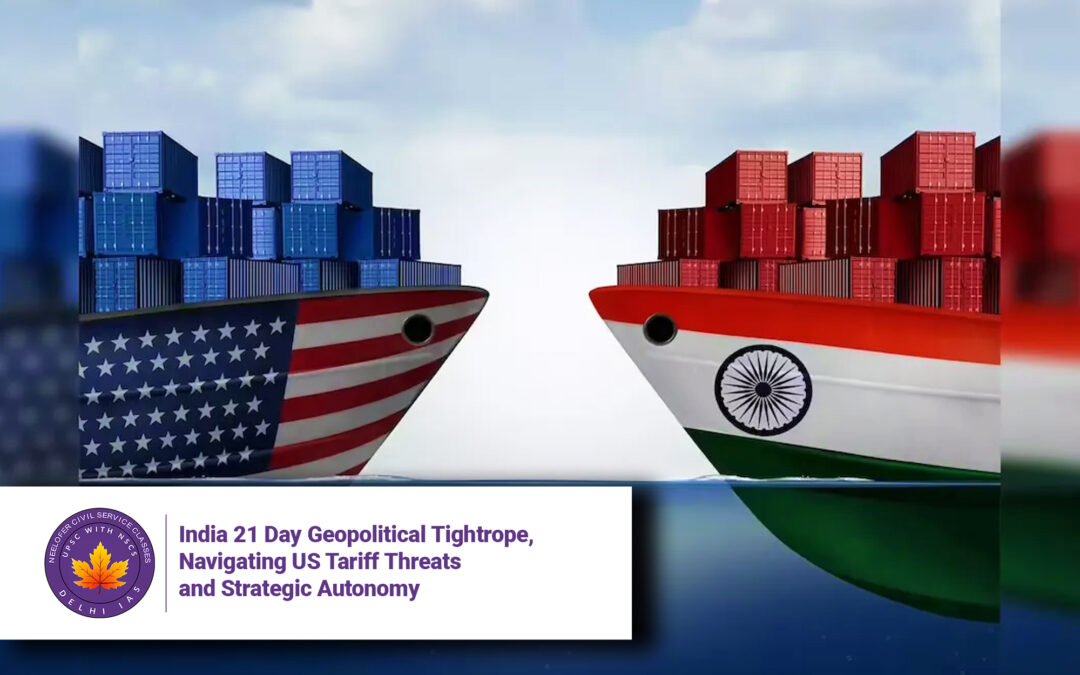
India 21 Day Geopolitical Tightrope, Navigating US Tariff Threats and Strategic Autonomy
Introduction
In a dramatic escalation of economic diplomacy, the United States has given India a 21-day ultimatum: either reduce its purchases of Russian oil or face penalty tariffs of 25% on key exports. Combined with existing reciprocal duties, this could push the total tariff burden on Indian goods to 50%, placing India in the same category as Brazil—one of the highest tariff-facing nations in US trade.
This move is not merely a trade dispute; it is a geopolitical ambush designed to pressure India into aligning with Western strategies on the Russia-Ukraine conflict. The stakes are immense—$118 billion in annual Indo-US trade, thousands of jobs, and India’s long-cherished strategic autonomy hang in the balance.
How should India respond? Should it capitulate to US demands, risking its energy security and diplomatic independence? Or should it stand firm, potentially inviting economic retaliation? This article dissects the crisis, explores historical precedents, and outlines a pragmatic path forward for New Delhi.
Why in News?
-
US threatens 25% penalty tariffs on Indian exports unless it cuts Russian oil imports.
-
Deadline: 21 days—after which tariffs take effect, raising total duties to 50% in some sectors.
-
India imported $35 billion worth of Russian crude in 2024 (up from $2.5 billion pre-2022).
-
US wants India to push Russia toward a Ukraine ceasefire—linking trade with geopolitics.
-
India calls the move “unfair”, citing other nations (China, Turkey) still trading with Russia.
Key Issues and Analysis
1. The US Ultimatum: Trade as a Geopolitical Weapon
The US is using economic coercion to force India’s foreign policy alignment. Key aspects:
-
Energy Security vs. Trade Access: India relies on discounted Russian oil (30-40% cheaper than Brent crude) to control inflation and fuel growth.
-
Selective Targeting: While China, Turkey, and even NATO members continue Russian energy trade, India faces disproportionate pressure.
-
Broader Implications: If India yields, it sets a precedent where trade policy dictates sovereign decisions.
Historical Parallel:
-
1990s US-Japan Trade War: US imposed auto tariffs to force market opening—Japan adapted without abandoning strategic interests.
-
EU-US Aircraft Subsidy Dispute: Retaliatory tariffs on wine, cheese, and motorcycles lasted years but didn’t rupture ties.
Lesson: Trade spats need not break alliances if managed with strategic patience.
2. India’s Strategic Dilemma: Balancing Principles and Pragmatism
India’s response must balance three core interests:
-
Energy Security
-
Russian oil saves India $5-7 billion annually in import costs.
-
Alternative suppliers (Saudi, US) are more expensive and politically volatile.
-
-
Economic Resilience
-
Top US-bound exports at risk:
-
Engineering goods ($25 billion)
-
Pharmaceuticals ($8 billion)
-
Textiles ($7 billion)
-
-
50% tariffs could wipe out 15-20% of exports, risking 500,000+ jobs.
-
-
Strategic Autonomy
-
India has long resisted bloc politics, maintaining ties with US, Russia, and EU.
-
Capitulation risks loss of credibility in Global South.
-
3. Diplomatic Pathways: Can India Avoid the Tariff Trap?
A. Quiet Negotiation & Tactical Concessions
-
Buy more US oil—but only if priced competitively.
-
Revive Ukraine ceasefire diplomacy (NSA Doval’s Moscow visit hints at backchannel talks).
B. Diversify Trade & Retaliate Smartly
-
Accelerate EU, UK, UAE FTAs to reduce US dependence.
-
Impose selective counter-tariffs (e.g., US almonds, apples, Harley bikes).
C. Reform India’s Own Trade Regime
-
Lower non-strategic tariffs to attract supply chains leaving China.
-
Boost manufacturing under PLI schemes to absorb export shocks.
Case Study: How China Navigates US Pressure
Despite Western sanctions, China continues Russian trade while keeping US ties functional:
-
Buys 2 million barrels/day of Russian oil (vs. India’s 1.7 million).
-
Balances rhetoric: Criticizes NATO but avoids outright confrontation.
-
Leverages economic heft—US firms lobby against decoupling.
Lesson for India: Economic interdependence can be a shield.
The Road Ahead: A 3-Phase Survival Plan
Phase 1 (0-21 Days): Crisis Management
-
Diplomatic outreach to US Congress, businesses to dilute hardliners.
-
Public messaging: Frame tariffs as “harmful to US consumers.”
Phase 2 (1-6 Months): Economic Adaptation
-
Rush export diversification to EU, Middle East, Africa.
-
Strategic oil stockpiling before potential US sanctions.
Phase 3 (Long-Term): Systemic Resilience
-
Fast-track Atmanirbhar Bharat in critical sectors (semiconductors, APIs).
-
Formalize rupee trade mechanisms with Russia, Iran, Africa.
Conclusion: India Must Outmaneuver, Not Outmuscle
The 21-day countdown is less about tariffs than about India’s geopolitical maturity. By blending unflinching strategic autonomy with nimble economic tactics, India can:
-
Preserve energy ties with Russia without rupturing US relations.
-
Shield exporters via market diversification.
-
Emerge stronger with a more self-reliant economy.
As former UN envoy Syed Akbaruddin argues, this is a moment for “quiet confidence”—not panic. The world watches whether India will bend or craft its own escape from Trump’s trap.
5 Key Questions & Answers
Q1: Why is the US targeting India over Russian oil?
A1: To weaken Russia’s war economy and test India’s loyalty to Western bloc.
Q2: Which Indian exports face maximum risk?
A2: Engineering goods, pharma, textiles—$40 billion combined.
Q3: Can India replace Russian oil easily?
A3: No—alternatives (US, Saudi) are costlier and logistically challenging.
Q4: What’s China’s role in this crisis?
A4: Beijing ignores US pressure on Russia trade, giving India diplomatic cover.
Q5: Will Modi government yield to US demands?
A5: Unlikely—expect symbolic concessions (more US oil buys) but no strategic surrender.

