
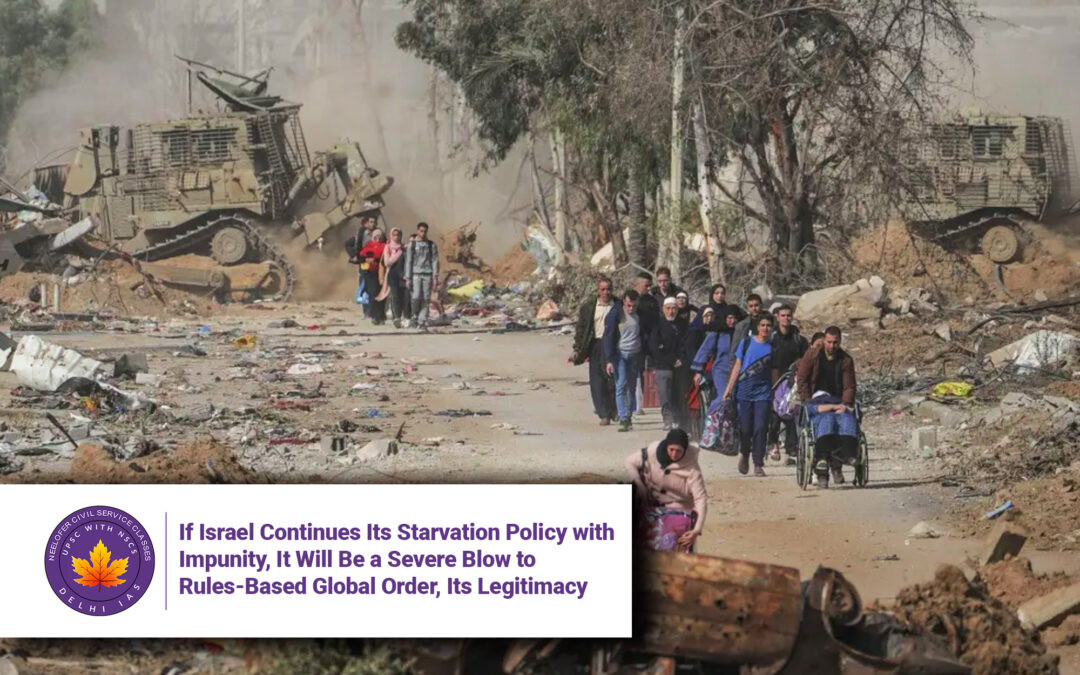
If Israel Continues Its Starvation Policy with Impunity, It Will Be a Severe Blow to Rules-Based Global Order, Its Legitimacy
Why in News?
The alarming humanitarian crisis in Gaza has drawn sharp global attention due to an unprecedented surge in starvation, malnutrition, and aid obstruction, especially impacting women and children. With over 55,000 Palestinian deaths since the onset of the war in October 2023, and more than 111 people — mostly children — dying recently due to malnutrition, the crisis is being described as man-made and potentially genocidal. International condemnation is rising against Israel’s military operations and its reported starvation policy, which many argue directly undermines the rules-based global order. 
Introduction
Since October 2023, the Gaza Strip has been at the center of a severe humanitarian catastrophe. According to Gaza’s Health Ministry, the ongoing Israeli military campaign has resulted in the death of more than 55,000 Palestinians, including a disproportionate number of children. In just one recent week alone, more than 40 people — many of them aid workers and children — reportedly died from starvation-related causes.
The Gaza crisis is no longer just a humanitarian issue; it has become a test case for the legitimacy and efficacy of international laws, humanitarian conventions, and the rules-based global order. With the international community failing to ensure safe and unimpeded humanitarian access, questions are now being raised over the global system’s ability to prevent atrocities and protect civilians during armed conflicts.
Key Issues
1. Starvation as a Weapon of War
Israel’s military campaign in Gaza has not only included relentless airstrikes but also a systematic blockage of humanitarian aid. According to the UN and several aid agencies, food, water, and medical supplies are being restricted from entering Gaza, a region already plagued by chronic shortages due to longstanding blockades.
Reports indicate that Israeli authorities have blocked or heavily obstructed aid deliveries, citing concerns that aid may be diverted by Hamas. However, humanitarian agencies such as Doctors Without Borders, Amnesty International, and others have signed joint letters asserting that this obstruction violates international humanitarian law.
More than 109 aid organizations have declared that Israel is deliberately impeding aid to the two million residents of Gaza, pushing the region toward mass starvation. With most of the population now reliant on humanitarian assistance for survival, this form of blockade is being described as a man-made famine.
2. Targeting of Aid Workers
Another deeply concerning element of the crisis is the systematic targeting of aid workers. UN agencies have reported that doctors, food aid distributors, and humanitarian staff are collapsing from hunger or being killed while on duty. This directly violates international humanitarian law, which protects aid workers even during armed conflicts.
Earlier this year, four key aid entry points into Gaza were shut down and replaced with only four militarized aid hubs, run jointly by the United States and the Israeli-backed Gaza Humanitarian Foundation. This move has significantly reduced the volume of aid reaching those in dire need.
3. Civilian Toll and Forced Starvation
Over the past month alone, more than 1,000 Palestinians have died while attempting to access food from these militarized hubs. People are reportedly being shot while queuing for flour or scavenging for supplies. Families are forced to make impossible choices — between dying of starvation and risking their lives in desperate attempts to find food and water.
This strategy, aimed at weakening Hamas militarily, is causing widespread suffering among the civilian population, especially the most vulnerable — children, elderly, and women. The use of starvation as a method of warfare is prohibited under the Geneva Conventions and is considered a war crime under the Rome Statute of the International Criminal Court.
4. Global Silence and Delayed Condemnation
Despite the severity of the crisis, international responses have been largely muted or delayed. Powerful allies of Israel such as the United States, the United Kingdom, Australia, and Canada were initially hesitant to publicly criticize the situation. However, as the crisis deepens and the evidence of mass starvation becomes irrefutable, international actors are beginning to speak out.
Recently, over 17 countries, including France, Italy, Spain, and several Arab nations, have called for an immediate ceasefire and full humanitarian access. The UN has warned that if Israel continues its starvation policy with impunity, it would seriously damage the global order and international law’s credibility.
Alternative Approaches and Humanitarian Responsibility
International law obligates all parties in a conflict to ensure unhindered access to humanitarian aid. This principle is non-negotiable and is enshrined in various treaties and conventions, including:
-
The Fourth Geneva Convention
-
UN Security Council Resolutions 2417 (2018) and 2286 (2016)
-
Rome Statute of the International Criminal Court
The current approach of militarized aid distribution and targeted obstruction contradicts these obligations. Instead, neutral and professionally operated humanitarian corridors must be restored. Aid agencies must be allowed to operate independently and safely, without political interference or security pretexts.
Diplomatic pressure must be mounted on Israel to lift restrictions, reopen previously functional aid routes, and allow the free flow of food, medicine, and relief workers into Gaza. Airdrops, maritime aid shipments, and international escorts for humanitarian convoys could be viable alternatives.
Challenges and the Way Forward
1. Political Barriers
One of the biggest challenges to resolving the crisis is the deep political divide between Israel and the international community. The Israeli government argues that aid is being misused by Hamas and diverted for military purposes. While this concern may have some legitimacy, it cannot justify the mass starvation of an entire population.
Moreover, international diplomacy is constrained by alliances, particularly the United States’ unwavering support for Israel. Until a unified global stance emerges, applying pressure on Israel will remain difficult.
2. Humanitarian Access and Security
The militarization of aid hubs, combined with active conflict zones, makes it extremely difficult for humanitarian agencies to safely deliver aid. The withdrawal of many NGOs due to unsafe conditions further complicates efforts on the ground.
A possible solution is the deployment of international peacekeeping forces to create secure humanitarian corridors. The UN could play a central role in negotiating safe zones and monitoring aid distribution.
3. Long-Term Implications for Global Order
Perhaps the most profound consequence of this crisis is its impact on the legitimacy of international institutions. If the global community allows a nation to use starvation as a weapon without consequence, it sets a dangerous precedent. Other regimes in future conflicts may replicate similar tactics, eroding the very foundation of humanitarian law.
The crisis in Gaza is testing the world’s commitment to the rules-based global order. If there is no accountability or redress, the future of human rights enforcement, international cooperation, and peacekeeping could be irreversibly damaged.
Conclusion
The humanitarian disaster unfolding in Gaza is not merely the result of a conflict — it is a direct outcome of deliberate policy choices. With more than 55,000 people killed, and many thousands more on the brink of death due to starvation, the world can no longer afford to look the other way. Israel’s justification of aid obstruction under the guise of targeting Hamas cannot excuse the indiscriminate suffering inflicted upon millions of civilians.
The global order, already fragile, is being severely tested. If starvation, a universally condemned war tactic, is allowed to continue unchecked, the moral authority of the international community will stand diminished. Immediate action is required — not just to save lives, but to save the legitimacy of the world’s most important humanitarian principles.
The international community must act decisively, not merely with words but with urgent, coordinated, and meaningful steps. Whether that means diplomatic isolation, sanctions, or international legal proceedings, the time for passive observation is over. A failure to act now will haunt global conscience for generations.
Five Questions and Answers
1. What triggered the humanitarian crisis in Gaza?
The crisis began following Israel’s military operations in October 2023. Since then, over 55,000 people have been killed, and access to food and humanitarian aid has been deliberately obstructed, leading to mass starvation.
2. Why is the situation being called a “man-made famine”?
Because the starvation in Gaza is not due to natural disaster but a result of intentional blockades and aid obstruction, despite the availability of food and medicine outside the region.
3. What are the criticisms against Israel’s aid policy?
Israel has been accused of weaponizing starvation by obstructing aid, targeting aid workers, and restricting access to humanitarian corridors, leading to civilian deaths and violating international laws.
4. How has the international community responded?
Initially slow to react, several countries including France, Italy, and Canada have begun condemning the situation. Calls for ceasefires and open humanitarian access have increased, though concrete action remains limited.
5. What could be the long-term consequences if this policy continues unchecked?
Continued impunity could undermine the entire rules-based global order, set dangerous precedents for future conflicts, and erode faith in international humanitarian institutions.
