
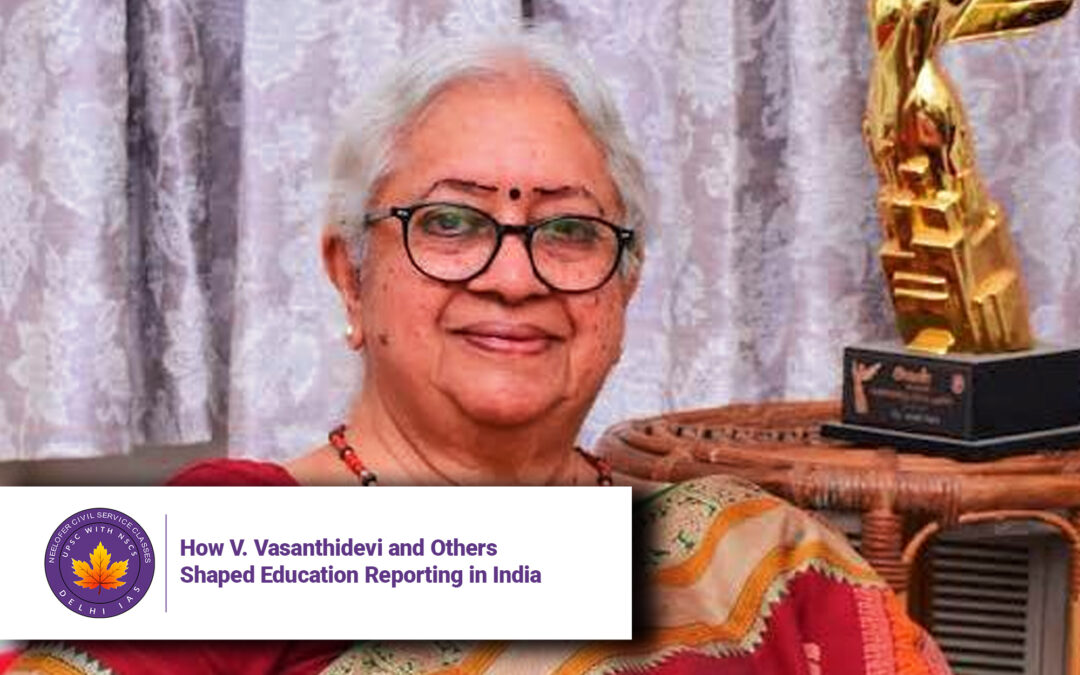
How V. Vasanthidevi and Others Shaped Education Reporting in India
Why in News
The passing away of Professor V. Vasanthidevi, an eminent educationist, former Vice-Chancellor, and social activist, has once again brought attention to her lasting contributions to school education and the role she played in shaping critical discussions on educational policy in India. Journalists, policymakers, and educationists recall her persistent efforts to democratize education and highlight the inequalities embedded within the system. Her legacy offers lessons for present and future generations at a time when education in India is at a crucial crossroads.
Introduction
The first decade of the 21st century was a turning point for India’s school education system. With the Union government launching the Sarva Shiksha Abhiyan (SSA) programme for universal elementary education and Parliament enacting the Right to Education (RTE) Act, sweeping reforms were initiated. At the same time, Tamil Nadu pioneered its own innovations, including Montessori-inspired learning models in primary education and the Samacheer Kalvi scheme to bring uniformity in school standards.
These changes sparked debates across the country on how to make education more accessible and equitable. Reporters covering this beat had to navigate complex issues — from the push for inclusivity to resistance from private schools, and from the benefits of progressive reforms to the dangers of hasty policy shifts. Amid this flux, practitioners and activists like Professor V. Vasanthidevi, Dr. S.S. Rajagopalan, and others played a pivotal role in influencing both public discourse and media understanding of education.
Key Issues and Background
- Policy Shifts and Challenges
- Sarva Shiksha Abhiyan (SSA): Aimed at universalizing elementary education across India. It expanded access but faced challenges of implementation, quality, and infrastructure.
- Right to Education (RTE) Act: Enshrined education as a fundamental right, but raised questions about affordability, public-private school dynamics, and the preparedness of state systems.
- Samacheer Kalvi (Tamil Nadu): Aimed at ensuring uniformity in educational standards by integrating multiple streams of curricula. This reform, though progressive, encountered backlash from elite private institutions.
- Resistance from Private Schools
Private schools expressed concerns over uniform curricula and regulatory control, fearing a decline in their autonomy and status. This highlighted the class divide in education and raised questions about inclusivity. - Ground-Level Reporting
Journalists covering education had to learn from practitioners, educators, and activists to truly grasp the nuances. While government officials provided official perspectives, voices from teachers, parents, and students enriched the debate. - Contributions of Activists
- Prof. V. Vasanthidevi: Advocated democratization of education, exposed structural inequities, and challenged meritocracy as a flawed concept ignoring caste, gender, and socio-economic disparities.
- Dr. S.S. Rajagopalan: A seasoned headmaster with decades of experience, he emphasized practical challenges in implementing policies.
- Other Voices: Education specialists like Aruna Rathnam (UNICEF) and feminist scholars like V. Geetha contributed to shaping critical perspectives.
Specific Impacts or Effects
- Shaping Journalistic Understanding
Reporters like Meera Srinivasan, who engaged closely with these activists, found their views transformative. Their ability to break down complex issues into simple, persuasive arguments equipped journalists with deeper insights to present education stories meaningfully. - Critique of Meritocracy
Prof. Vasanthidevi argued that children’s learning outcomes cannot be attributed merely to innate “ability.” She located educational outcomes within the broader matrix of resources, pedagogy, environment, caste, gender, and geography. This radical critique exposed the fallacy of meritocracy, emphasizing structural inequities. - Political Dimensions of Education
Prof. Vasanthidevi believed that education and politics were inseparable. She noted that politicization was essential to address systemic barriers. Her statement, “Politicisation is such an important part of education,” reflected her conviction that education is not neutral but deeply tied to social justice. - Inspiring Future Generations
Vasanthidevi’s legacy continues to influence policymakers, scholars, and activists who advocate education as a tool for empowerment and social transformation.
Challenges and the Way Forward
- Persistent Inequalities
Despite decades of reforms, disparities based on caste, class, gender, and geography remain entrenched in the Indian education system. Ensuring equitable outcomes requires targeted interventions. - Quality vs. Quantity Debate
While enrollment rates have risen due to SSA and RTE, learning outcomes remain low in many areas. Addressing quality of teaching, pedagogy, and resources is essential. - Balancing Public and Private Education
The tension between state-run schools and private institutions persists. Policymakers must navigate this divide to ensure access without compromising quality. - Role of Media and Activists
Journalists need to continue engaging with committed practitioners and activists to understand ground realities. Education reporting must go beyond statistics to capture human experiences. - Future Reforms
- Strengthening teacher training and support systems.
- Bridging digital divides in education.
- Integrating critical pedagogy that addresses social inequalities.
- Ensuring that policies are grounded in research and community needs, not merely political agendas.
Conclusion
Professor V. Vasanthidevi’s lifelong activism and intellectual contributions underscored that education is not merely about literacy or employability but about justice, equality, and empowerment. Her interventions inspired journalists and policymakers to rethink education as a political and social process. As India moves forward with new educational frameworks like the National Education Policy (NEP) 2020, her legacy reminds us of the need for critical thought, inclusivity, and continuous dialogue between the state, civil society, and the media.
Education is not just a sectoral issue — it is the foundation of democracy and social justice. Remembering voices like Prof. Vasanthidevi’s ensures that the fight for equitable and quality education continues with renewed vigor.
5 Questions and Answers
Q1. Who was Professor V. Vasanthidevi and why is she significant in India’s education discourse?
A1. Professor V. Vasanthidevi was a former Vice-Chancellor, educationist, and activist who worked extensively on democratizing education. She exposed systemic inequalities in India’s schooling system and challenged dominant narratives like meritocracy, making her a key voice in shaping inclusive education policies.
Q2. What were some key education reforms in the first decade of the 21st century in India?
A2. Major reforms included the Sarva Shiksha Abhiyan (SSA) for universal elementary education, the Right to Education (RTE) Act, and Tamil Nadu’s Samacheer Kalvi system aimed at standardizing curricula across schools.
Q3. How did Prof. Vasanthidevi critique the idea of meritocracy in education?
A3. She argued that meritocracy ignores structural inequalities like caste, class, gender, and geography. She emphasized that learning outcomes depend on resources, pedagogy, and environment, not merely on inherent student “ability.”
Q4. Why did private schools resist some education reforms like Samacheer Kalvi?
A4. Private schools resisted reforms due to fears of losing autonomy, dilution of their elite status, and uniform standards that could undermine their competitive advantage.
Q5. What lessons does Prof. Vasanthidevi’s legacy hold for present-day education reforms?
A5. Her legacy underscores the need for equity, inclusivity, and critical engagement in education. Policymakers must recognize education as a socio-political issue, address structural inequities, and ensure reforms are rooted in justice and accessibility.

