
How did Indian universities fare on the QS ranking list?
Why in News?
For the first time, Indian universities have secured more than 50 positions in the QS global university rankings (2026 edition). With 54 institutions ranked, this milestone reflects India’s growing global academic presence and a notable improvement in adapting to international norms in higher education. 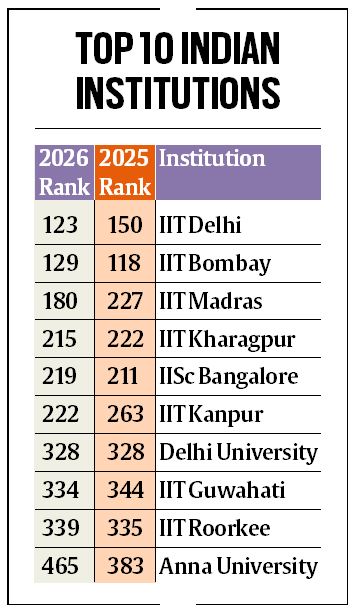
Introduction
The QS World University Rankings, published by Quacquarelli Symonds (U.K.), evaluate universities based on a range of academic and employer-focused criteria. In 2026, IIT Delhi achieved the highest rank among Indian institutions (Rank 123), followed closely by IIT Bombay, IIT Madras, IIT Kharagpur, and IISc Bengaluru. Other private institutions like Ashoka University and Shiv Nadar Institute of Eminence also made notable entries.
Key Parameters of QS Rankings
The QS ranking methodology includes:
-
Academic reputation (30%)
-
Research impact (20%) through citations
-
International faculty and student diversity (10%)
-
Employer reputation (15%)
-
Student-to-faculty ratio (10%)
-
Student placements and campus sustainability (5% each)
The 2026 list evaluated these parameters to judge performance across institutions globally.
How Has Indian Higher Education Improved?
India’s performance has seen major improvement, rising from 11 ranked universities in 2015 to 54 in 2026. This growth has been propelled by rising academic output, better infrastructure, international collaborations, and the implementation of the National Education Policy (NEP) 2020, which emphasizes research, global engagement, and industry-academia partnerships.
At Ashoka University, for instance, the student-faculty ratio stands at 11.5, supported by students from 20 countries. However, most public institutions continue to have low international participation and limited research from undergraduate programs, contributing to weaker scores in diversity and academic output.
Challenges Faced by Indian Universities
-
Low number of international students and faculty
-
Research concentrated in research institutes rather than universities
-
Limited academic-industry linkages
-
Public universities traditionally ignoring employer connectivity
-
Lack of global visibility in many disciplines
How Can Indian Universities Improve?
-
Increase global collaborations and research partnerships
-
Improve international visibility and academic branding
-
Recruit international students and faculty
-
Develop strong ties with industries for placements
-
Encourage interdisciplinary and socially relevant research
As universities become more competitive and globally integrated, those aligning with international standards in education, research, and student experience are likely to climb higher in future global rankings.
Q&A Section
1. Q: Which Indian university secured the highest rank in the QS 2026 list?
A: IIT Delhi, ranked 123 globally.
2. Q: How many Indian universities are now ranked in the QS list?
A: 54 institutions, up from 11 in 2015.
3. Q: What are the key parameters used by QS for ranking universities?
A: Academic reputation, citations, international faculty and student diversity, employer reputation, student-faculty ratio, and sustainability.
4. Q: What challenge do most public universities in India face with respect to internationalisation?
A: Most cannot hire international faculty or attract global students, leading to lower scores in diversity metrics.
5. Q: What steps can help Indian universities perform better in global rankings?
A: Promoting research, increasing international student/faculty presence, engaging with industry, and building global partnerships.

