
How Did India Develop Genome-Edited Rice?
Why in News?
India has become the first country in the world to develop rice varieties using genome editing technology, marking a significant milestone in agricultural innovation. This development is poised to revolutionize rice production, ensuring higher yields, stress resistance, and better nutrition, especially amid the growing threats of climate change.
Introduction
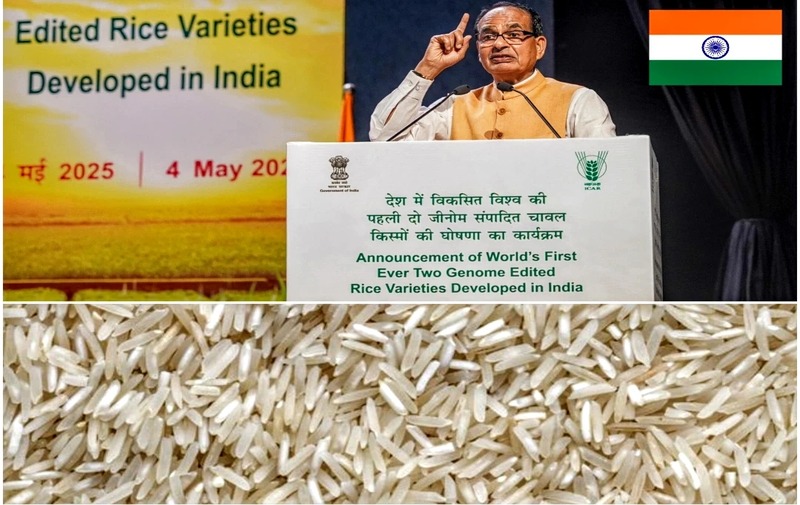
Union Agriculture Minister Shivraj Singh Chouhan recently announced the launch of two genome-edited rice varieties. This technological advancement was led by scientists from the Indian Council of Agricultural Research (ICAR) and other research institutions. These rice varieties promise better resilience to environmental stress, improved yield, and enhanced nutritional value—without falling under the category of Genetically Modified (GM) crops.
Key Features and Background
-
The New Rice Varieties
-
DRR Dhan 102: Known as Kamalha, developed from Samba Mahsuri. It shows high yield, reduced maturity time, and better water and nutrient use efficiency.
-
Pusa Basmati 1 SD: A genome-edited version of Pusa Basmati 1, developed from Manitureu 1010 (MTU1010). Offers increased yield and stress tolerance.
-
-
Unique Characteristics
-
Higher yield and early maturity.
-
Improved stress tolerance (especially to drought and salinity).
-
DRR Dhan 102 yields 5.47 tonnes/hectare, while MTU1010, its parent line, yielded only 3.9 tonnes/hectare.
-
These varieties are not genetically modified, but precisely edited using advanced technology.
-
-
The Technology Used
-
Scientists used Site-Directed Nuclease 1 and 2 (SDN-1 and SDN-2), which do not involve the use of foreign genes.
-
These methods create targeted mutations, allowing precision without altering the plant’s core genome.
-
The mutations mimic natural evolution, making them exempt from GMO regulations in India.
-
-
Scientific Validation
-
The varieties were developed and tested as part of the All India Coordinated Research Project on Rice (2023–2024).
-
More than 300 scientific papers back the performance and validity of these crops.
-
-
Controversies and Farmer Concerns
-
Venugopal Ravadwaja, a farmers’ representative in ICAR, criticized the hasty approval, citing lack of transparency and stakeholder engagement.
-
Concerns were also raised about intellectual property rights (IPR), and the fear that farmers might lose seed sovereignty in the future.
-
The Coalition for a GM-Free India voiced concern about the policy being fast-tracked without a clear regulatory framework.
-
Five Key Takeaways
-
India is the first country globally to develop rice varieties using non-GMO genome editing.
-
The new varieties show higher yield, early maturity, and resilience to salinity, drought, and climate stress.
-
Technology used—SDN1 and SDN2—does not use foreign genes, avoiding GMO classification.
-
Farmer groups and activists have raised concerns over lack of transparency and potential IPR entanglements.
-
The government plans to roll out these varieties to farmers within 3 years, aiming for mass-scale production.
Challenges and the Way Forward
Challenges:
-
Lack of clear legal guidelines on genome-edited crops.
-
Farmer distrust over seed control and ownership.
-
Need for greater public awareness about genome editing vs. GM crops.
-
Potential international IPR conflicts.
Way Forward:
-
Ensure transparent communication from government and scientists.
-
Establish regulatory frameworks specific to genome-edited crops.
-
Involve farmers in decision-making through inclusive policy dialogues.
-
Promote indigenous research and seed sovereignty.
Conclusion
India’s genome-edited rice marks a technological leap in agriculture, combining scientific innovation with national food security goals. However, its success hinges on public trust, farmer empowerment, and regulatory clarity. With proper safeguards, this innovation could set a global precedent in sustainable and inclusive agriculture.
Q&A Section
1. What makes genome-edited rice different from genetically modified (GM) rice?
Genome-edited rice uses precision techniques (SDN1 & SDN2) that do not involve foreign DNA, unlike GM crops, making it safer and exempt from strict GM regulations.
2. What are the names of the two genome-edited rice varieties launched in India?
-
DRR Dhan 102 (Kamalha)
-
Pusa Basmati 1 SD, developed from Manitureu 1010 (MTU1010).
3. What benefits do these new rice varieties offer?
They offer higher yields, early maturation, drought and salinity tolerance, and are nutritionally richer.
4. Why are some farmers and activists objecting to this development?
They fear a lack of transparency, corporate control of seeds, and insufficient legal protection for farmers’ rights.
5. Will these varieties be available to all farmers soon?
Yes, the government plans to make these seeds available for large-scale farming within 2–3 years after field trials and scale-up.

