
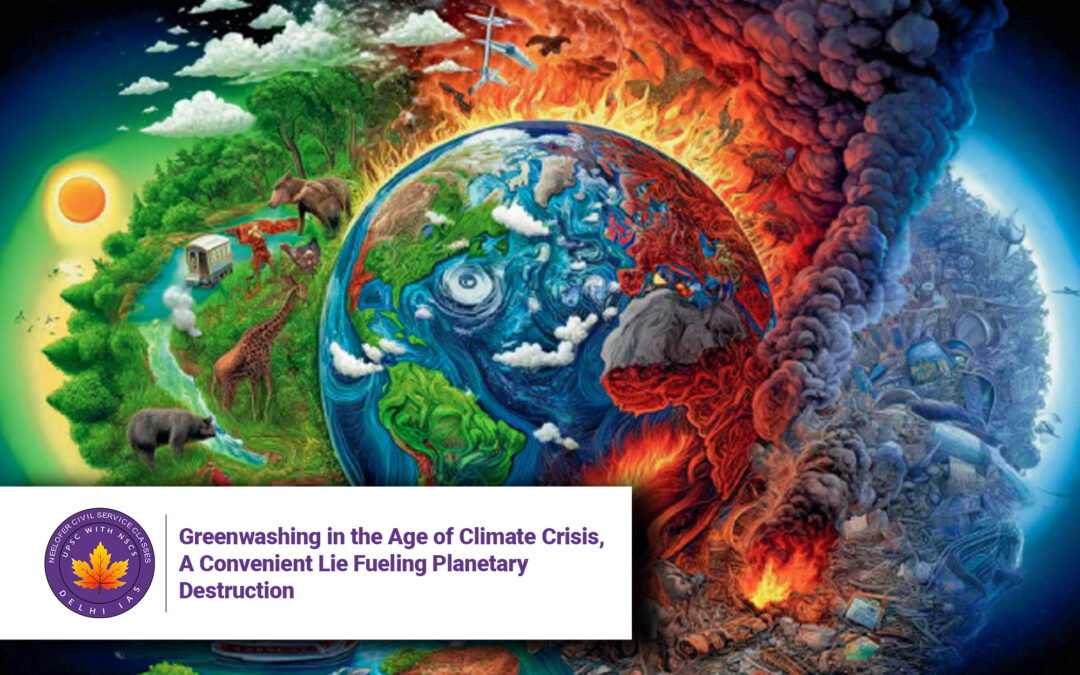
Greenwashing in the Age of Climate Crisis, A Convenient Lie Fueling Planetary Destruction
Introduction
In an era where climate change is no longer a distant threat but a lived reality, the world is grappling with rising temperatures, erratic weather patterns, and escalating natural disasters. Amid this growing chaos, a strange paradox has emerged: while more people than ever before claim to care about the environment, actual ecological health continues to deteriorate at an alarming rate.
What explains this contradiction? The answer, as eloquently highlighted by Acharya Prashant in his thought-provoking article “Greenwashing: Pretending to Care While Burning the Planet,” lies in a dangerous deception — greenwashing.
Greenwashing refers to the practice of making superficial or misleading claims about environmental responsibility while continuing to engage in or support practices that are ecologically harmful. It is a form of moral laundering where individuals, corporations, and even governments pretend to take environmental action, not to protect the Earth, but to protect their image.
As the planet burns and biodiversity collapses, greenwashing offers a psychological escape hatch. It allows people to feel good without doing good — a toxic illusion that comforts egos while sacrificing ecosystems.
The Reality of Climate Emergency
Before we examine greenwashing in detail, it’s important to understand the backdrop against which this deception plays out.
Global temperatures have already risen by over 1.1°C since pre-industrial times. Extreme heatwaves are becoming more frequent, polar ice is melting at unprecedented rates, and wildfires rage from California to Australia. Sea levels are rising, threatening coastal cities. Floods and droughts — once seen as cyclical — now increasingly overlap. In 2024 alone, India, Europe, and Africa have reported record heat-related deaths and crop failures.
The science is unequivocal: if we continue on this trajectory, the Earth will become increasingly uninhabitable for many life forms, including humans.
Greenwashing: The Great Environmental Charade
Acharya Prashant rightly points out that today, we are witnessing the widespread normalization of greenwashing. It has become the socially acceptable mask worn by individuals, corporations, and policymakers who want to appear environmentally conscious without changing the status quo.
1. The Corporate Facade
Walk into a supermarket and you’ll see “eco-friendly” labels on everything from plastic bottles to fast fashion items. Major polluters like oil companies run advertisements showing wind turbines and happy children running through green fields. Banks that finance deforestation projects also launch tree-planting drives and climate awareness ads.
Behind the green branding lies a brutal reality — these are not solutions, but marketing strategies designed to maintain profitability while projecting a false commitment to sustainability.
For example:
-
Carbon offsetting has become a billion-dollar industry, but many of these offsets are based on flawed science or unverifiable claims.
-
Companies launch “net-zero” goals without concrete plans, and continue polluting, assuming future technology will clean up their mess.
-
Products with “green” packaging may still be manufactured in ecologically devastating ways — the packaging is recycled, but the product is not.
This manipulation isn’t just immoral. It’s deadly. It leads to public complacency, where people believe action is being taken and delay real systemic change.
2. Personal Virtue Signaling
Greenwashing is not limited to corporations. It has trickled down into individual lifestyle choices, where people perform symbolic acts like:
-
Turning off lights for an hour on Earth Day
-
Using bamboo toothbrushes while flying internationally multiple times a year
-
Posting climate awareness stories on social media while living high-consumption lives
Acharya Prashant calls this a “quiet sense of doing the right thing.” We wear sustainability like a badge but rarely examine our deeper behaviors. The act becomes a personal morality show, not a commitment to ecological responsibility.
The Eco Illusion of Tree Planting
One of the most widely promoted acts of environmental virtue is tree planting. Governments, schools, companies, and NGOs champion it as a go-to solution for combating climate change.
But, as Acharya Prashant argues, this too often becomes a dangerous oversimplification.
Planting a single tree can absorb approximately 400 kilograms of carbon dioxide over its lifetime. However, the average urban middle-class Indian emits over 5,000 kg CO₂ annually. This means one tree cannot offset even a fraction of a person’s emissions.
Moreover, the conditions under which trees are planted are often poor:
-
Planted trees are not maintained or irrigated.
-
Native biodiversity is ignored in favor of monocultures.
-
Forests are cleared in one area, only to plant saplings in another — a net loss.
Thus, tree planting becomes a way to distract from structural environmental destruction. It may soothe our conscience but doesn’t solve the underlying crisis.
The Structural Drivers of Climate Collapse
To understand why greenwashing is so effective, we need to confront the deeper truth — climate change is not just a result of individual actions or lack of trees. It is driven by a global economic system that prioritizes endless growth, mass consumption, and population pressure.
1. Overproduction and Hyper-consumption
Modern capitalism depends on constant production. More goods, more services, more profits. In this system:
-
A car company doesn’t want fewer cars sold, even if the roads are choked.
-
A fast fashion brand doesn’t care if people throw away clothes every few weeks.
-
A tech company wants users to replace phones every year.
All this consumption requires energy, raw materials, water, and land — directly contributing to ecological collapse.
2. Population Growth
Acharya Prashant makes an important observation: even large families with low income can have a huge ecological impact over time. Ten people consuming modestly still put pressure on land, water, waste systems, and energy.
Population growth is a taboo topic in many policy circles, but it must be addressed through education, reproductive rights, and empowerment of women — not coercion.
3. Glorification of Wealth and Status
Modern society worships excess. A person with ten cars, five houses, or a private jet is seen as successful. But their environmental footprint is astronomical. We measure success by GDP and income, not by harmony with the Earth.
What Must Be Done: A Path Forward
To counter greenwashing and tackle real climate change, we need a radical shift in values, systems, and policies.
1. Redefine Success
We must stop glorifying excessive wealth and instead celebrate those who live meaningfully, minimally, and mindfully. Sustainable living should be aspirational, not sacrificial.
2. Regulate Green Claims
Governments must enforce strict environmental advertising laws. Companies should be required to prove sustainability claims with independent audits and data.
Misleading labels like “eco-friendly” or “carbon neutral” must be banned unless they meet rigorous standards.
3. Restructure the Economy
Our current model of GDP-driven growth is incompatible with ecological survival. We must transition to a circular economy that:
-
Reduces resource extraction
-
Promotes product repair, reuse, and recycling
-
Imposes environmental costs on polluters
4. Individual Responsibility With Structural Awareness
While systemic changes are crucial, individuals must also act with awareness. This means:
-
Reducing air travel
-
Avoiding fast fashion and single-use items
-
Supporting local, organic food systems
-
Living in smaller homes, using public transport
-
Having fewer children as a conscious ecological decision
5. Restore Ecosystems, Not Just Plant Trees
Protecting existing forests, wetlands, coral reefs, and grasslands is far more effective than planting new trees. Natural ecosystems store more carbon, support biodiversity, and require no artificial intervention.
Why It’s Urgent: Time Is Running Out
Acharya Prashant ends with a powerful warning — the planet is not waiting for our moral awakening. The laws of physics, chemistry, and ecology operate regardless of our sentiments. If we delay, ecosystems will collapse irreversibly, and our species will suffer alongside others.
The time for symbolic gestures is over.
The real question is: Will we have the courage to step off the conveyor belt of greed, comfort, and false progress — and begin living as humble stewards of the planet, rather than arrogant conquerors?
Conclusion: Beyond Appearances
In the end, greenwashing is a symptom of a larger disease — our unwillingness to confront inconvenient truths. It’s easy to recycle, plant a sapling, or buy a “green” product. It’s much harder to examine how our lifestyles — even our aspirations — are intertwined with environmental destruction.
As the article suggests, we must go beyond doing what looks good and begin doing what actually helps. Not because it makes us feel virtuous, but because it may be the only way to survive.
The Earth doesn’t need our charity — it needs our honesty.
And we owe it, not just to the trees we plant, but to the forests we destroy, the rivers we poison, and the generations we are failing.

