
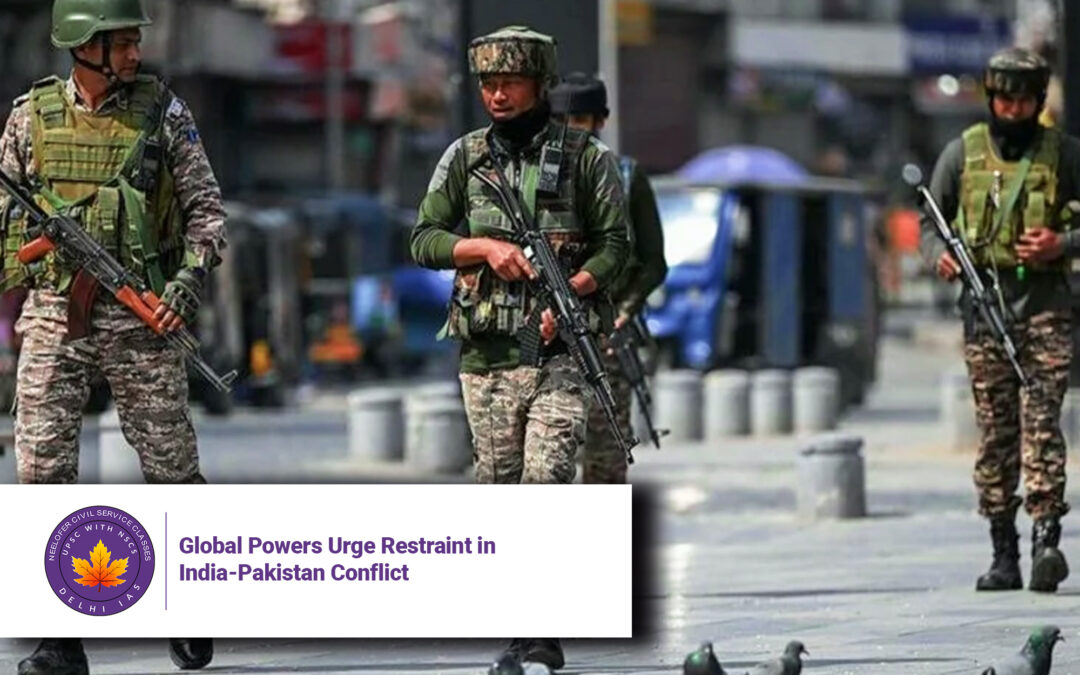
Global Powers Urge Restraint in India-Pakistan Conflict
Why in News?
Following the terrorist attack on Indian forces in Pahalgam and India’s subsequent military response through missile strikes in Operation Sindoora, there has been growing international attention on India-Pakistan relations, with major powers like the US, Russia, and China reacting in line with their own strategic interests. 
Introduction
The global reaction to rising tensions between India and Pakistan reflects not just concern for peace but also geopolitical calculations. While the United Nations Security Council (UNSC) members condemned terrorism, their individual responses were shaped by their long-term alliances and strategic objectives.
Key Issues and Background
India’s Missile Retaliation
-
In response to the Pahalgam terror attack, India launched missile strikes under Operation Sindoora, asserting its right to self-defence.
UNSC and Major Powers’ Reactions
-
The US, Britain, and France condemned the attack and blamed Pakistan, while China vetoed any resolution criticizing Pakistan.
-
Russia maintained a neutral stance, highlighting the 1972 Simla Agreement, which favors bilateral resolution.
The Core of the Concern
US Double Standards?
-
Though the US supports India’s right to self-defence, it continues to sell F-16 fighter jets to Pakistan, raising concerns in India.
-
Under Trump, US policy was unpredictable, stressing strong personal ties with both nations’ leaders but offering no consistent policy shift.
China’s Strategic Support
-
China’s refusal to condemn Pakistan is tied to its Belt and Road Initiative (BRI), which includes major infrastructure investments in Pakistan-occupied Kashmir (PoK).
-
Pakistan has also increased military imports from China, including submarines and fighter jets.
Key Observations
-
India’s real concern lies in long-term regional competition with China and Pakistan, especially in terms of infrastructure, military power, and influence over the Indian Ocean region.
-
Russia, despite being traditionally close to India, avoids antagonizing Pakistan due to shared security interests in Central Asia and its own anti-West posture.
Conclusion
The rising India-Pakistan tension is not just a bilateral issue but a global strategic concern. However, major powers are unlikely to pick sides beyond rhetoric, given their economic and geopolitical stakes. India must carefully balance assertiveness with strategic diplomacy to avoid being cornered in a multi-front scenario.
5 Questions and Answers
Q1. What triggered the recent rise in India-Pakistan tensions?
Answer: A terrorist attack on Indian soldiers in Pahalgam, allegedly sponsored from Pakistan, led India to respond with missile strikes under Operation Sindoora.
Q2. How did major global powers respond to the situation?
Answer: The US, UK, and France condemned the terror attack; China blocked any resolution against Pakistan at the UNSC, and Russia remained neutral.
Q3. Why is the US criticized for its stance?
Answer: The US continues to sell F-16 jets to Pakistan while publicly supporting India’s self-defence, showing a contradictory policy stance.
Q4. What role does China play in supporting Pakistan?
Answer: China supports Pakistan to safeguard its Belt and Road Initiative, especially in PoK, and supplies it with advanced military hardware.
Q5. What should be India’s approach in this situation?
Answer: India should maintain strategic clarity, focus on regional stability, and avoid over-reliance on external powers who act based on self-interest.

