
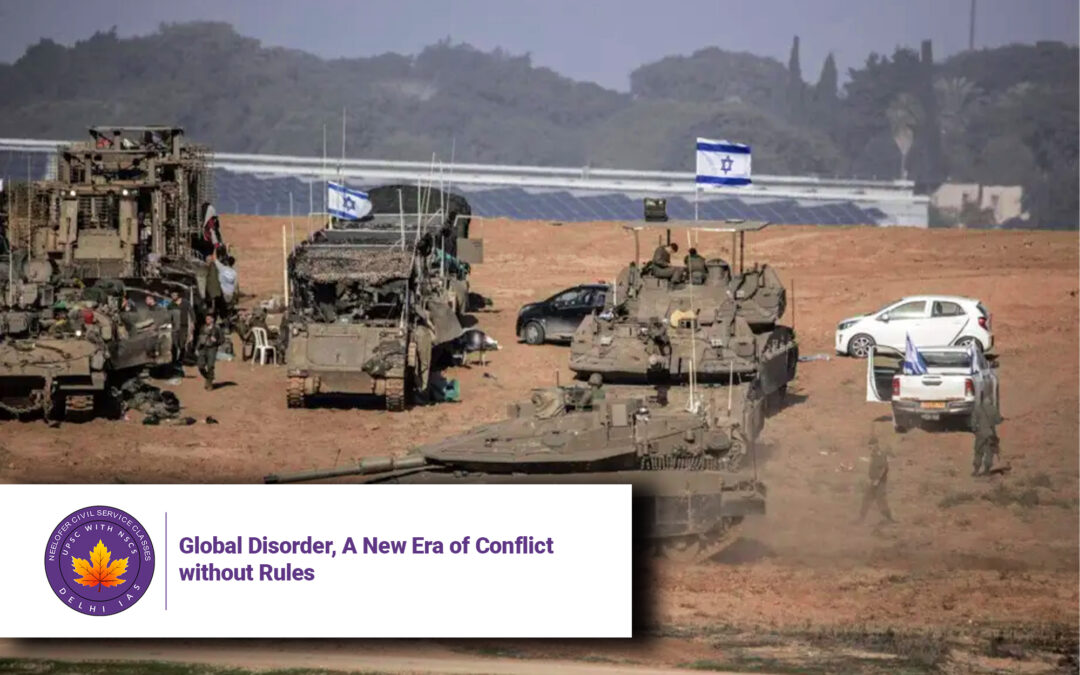
Global Disorder, A New Era of Conflict without Rules
Why in News?
A rising wave of unchecked conflicts — from Gaza to Ukraine to Iran — is redefining the international order. Increasing violations of war norms, disregard for diplomatic resolution, and erosion of global conventions mark the emergence of a dangerous new “normal,” as global powers and local actors alike bypass laws and accountability. 
Introduction
The 21st-century global order is witnessing a disturbing shift — not just in geopolitics but in the collapse of fundamental war ethics. With the Israeli attacks in Gaza, Russia’s invasion of Ukraine, and ongoing tensions with Iran, the pattern shows a blatant disregard for international law and humanitarian norms. These actions raise serious concerns about the stability of international diplomacy and the future of conflict resolution.
Key Issues Discussed
-
Gaza and the Erosion of International Norms
Israel’s attack on the al-Shifa hospital and the subsequent death tolls have shocked the world, not only for their brutality but for openly violating Geneva Convention protections on civilians and medical facilities. -
Ukraine and Proxy Warfare
Russia’s continued use of nuclear rhetoric and indiscriminate attacks underline a new age of war, with fewer constraints and broader disregard for international consensus. -
Unlawful Wars & Preemptive Justifications
Recent attacks are often justified as ‘pre-emptive’ self-defense, but increasingly lack legitimacy. Many nations bypass UN charters, launching offensives without clear authorization or accountability. -
Rise of Military Autonomy and Erosion of Diplomacy
Both state and non-state actors now conduct war without negotiating tables. Diplomacy is seen as secondary to force, while world powers struggle to maintain influence. -
Decline of Institutions and Treaty Violations
There is a growing irrelevance of treaties like the Geneva Conventions and the erosion of norms set after World War II to regulate armed conflict.
Conclusion
The post-World War II order — designed to prevent conflict through international cooperation — is under severe threat. The rise of lawless warfare, normalization of civilian casualties, and weakening of international treaties call for an urgent reevaluation of global security frameworks. Peace may no longer be the global ambition — power without rules seems to have become the new geopolitical currency.
5 Q&A Based on the Article
Q1. What does the article highlight as a major global trend in modern warfare?
A1. The rise of unchecked conflicts where international law is ignored, and war is increasingly waged without regard for rules or diplomacy.
Q2. How is Israel’s attack on Gaza described in the article?
A2. It is cited as a major example of lawless warfare, notably with the bombing of hospitals and residential areas, violating Geneva Conventions.
Q3. What concern is raised regarding Russia and the Ukraine conflict?
A3. Russia’s actions show a disregard for nuclear ethics and a normalization of indiscriminate attacks without international sanction.
Q4. What does the article say about the weakening of global institutions?
A4. It argues that institutions like the UN and agreements like the Geneva Conventions are becoming irrelevant as countries act unilaterally.
Q5. What is the article’s final message on peace and war?
A5. The world may be entering an era where war is the norm and peace the exception, with an increasing acceptance of violence as policy.

